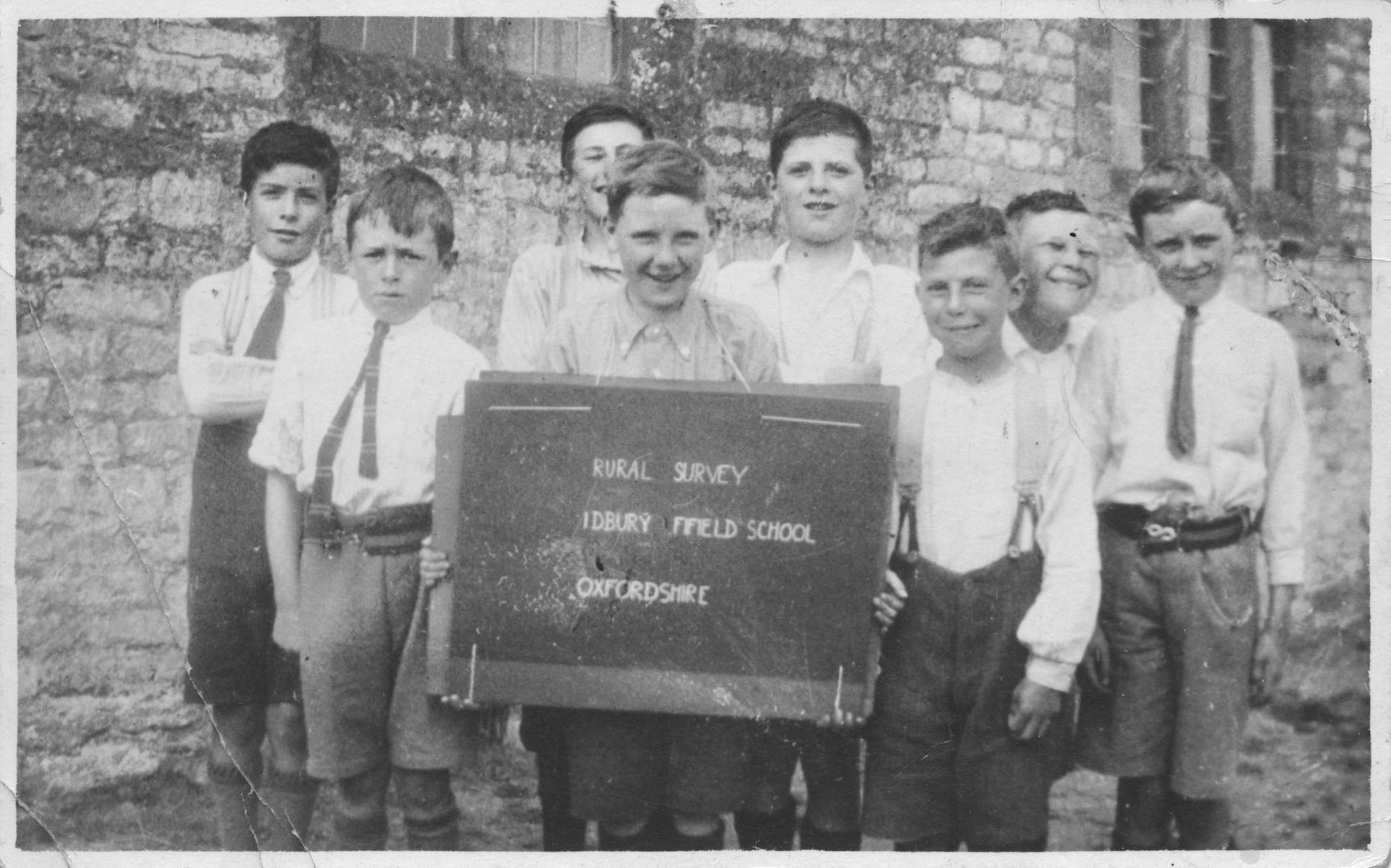
Boys from the Idbury and Fifield School Rural Survey
30 October 2020
“Have you ever longed to go away with other lucky children, to the sea or to a town a long way off for the holidays and have been left behind in the same old place, with holidays and nothing nice to do? We have. So we made up a lovely game years ago in our village which you can go on playing perhaps all your life on and off. It is known by ever so many names, but we will call it “Exploring.”
So wrote Jessie Jones, Head Teacher of Idbury and Fifield village school in west Oxfordshire, who, during the 1920s and 30s, engaged her pupils in an innovative Rural Survey. “Miss Jones” encouraged them to discover and record the history and traditions of their locality, and to study the countryside around them. A remarkable collection of her papers and the schoolwork of the children, held at Oxfordshire History Centre, provides a vivid insight into her work.
Jessie Kate Jones was born in Charlbury, the daughter of baker and confectioner George Joshua Jones (1847-1927) and his wife, Mary Fisher Jones (neé Clifford, 1848-1925). Jessie’s maternal grandfather, Jesse Clifford (1816-1892), was for more than 40 years, the headmaster of the British School at Charlbury, and a founder member of Chipping Norton Teachers’ Association. He was described as “a successful master in every way, gaining the love and esteem of his pupils,” and seemingly inspired his granddaughter to pursue her inclination to teach.
‘Miss Jones’ gained her teaching qualification, aged 17, under the pupil teacher system. She was effectively an apprentice at Charlbury Board School (formerly British School), attending a pupil teacher training centre part-time; this being the route to certification taken by most elementary school teachers who qualified prior to the 1902 Education Act.
Boys from the Idbury and Fifield School Rural Survey
In July 1919, following a period “on supply” at Idbury School, Jessie was appointed its Head Teacher. The school served, a remote rural district on Oxfordshire’s western border and had no living accommodation for its staff, so she took the train from Charlbury to Kingham and then cycled to Idbury, each school-day. Her pupils, aged between 5 and 14 years, were drawn from the villages of Idbury and Fifield. Jessie later described being “bewildered by smallness and yet by all that must be done single-handed”.
It was the challenge of providing activities that would interest the older boys that saw her introduce the idea of surveying and recording the local area, inspired by her grandfather’s country records and teaching devices. The survey began with the creation of a local field map and a nature study of “soils, crops, beasts, birds, weather, etc.”, but was extended over several years to include the mapping and the collection of artefacts and data relating to all aspects of the geography and history of the locality together with details of village life.
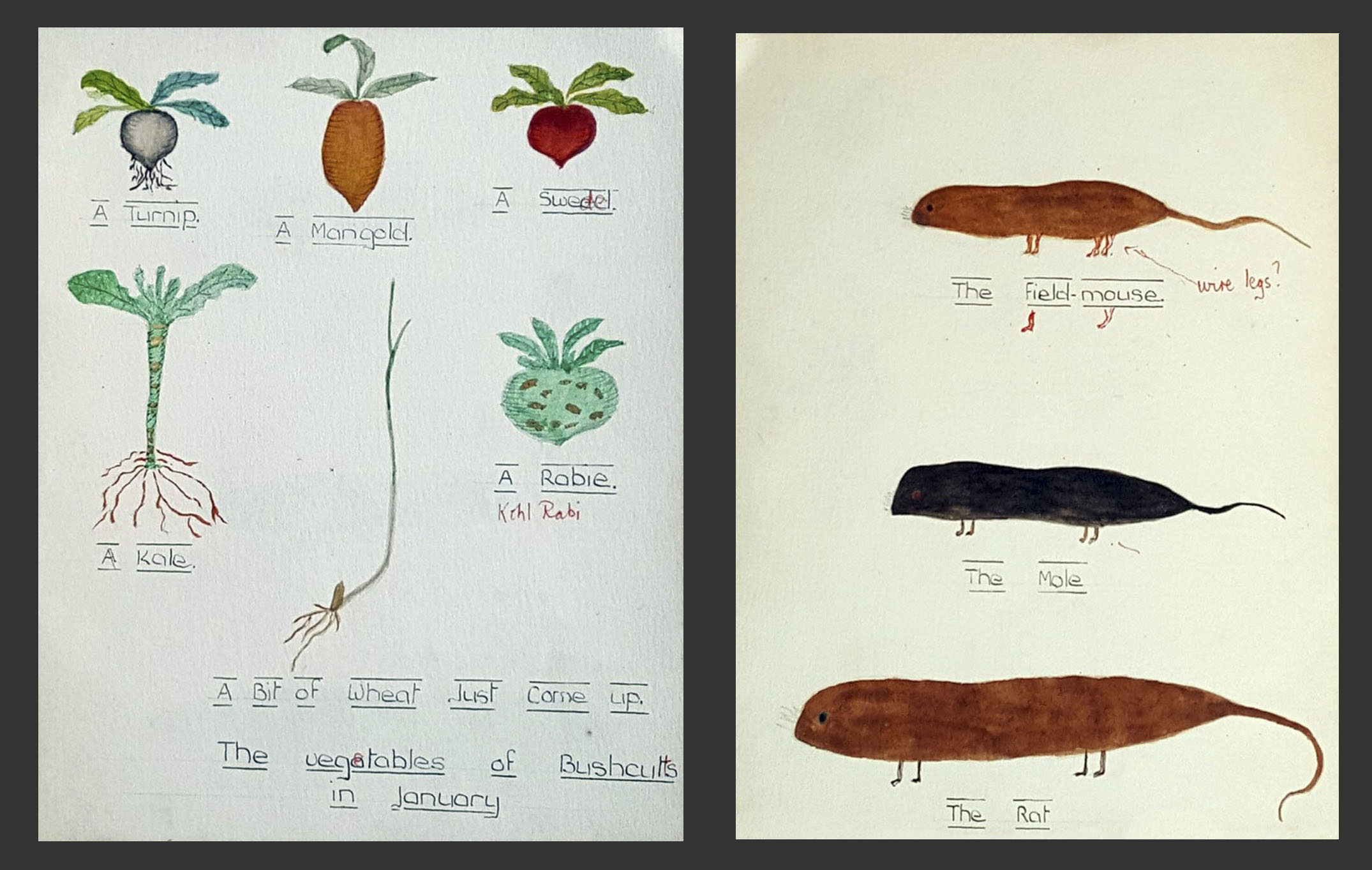
Drawings of pupil, Fred Truman
Jessie’s survey work was in tune with current educational trends and she became a leading member of a village survey project developed at Barnett House, Oxford; a centre established in 1914 ‘to advance the systematic study of current social and economic questions’, to encourage people to take up community work and promote adult education. The project convenor Violet Butler (1884-1982), well-known for her social survey of Oxford, gave a paper on Village Surveys at a meeting of the British Association for the Advancement of Science at Oxford in 1926. Idbury School’s work was amongst that from a handful of Oxfordshire schools featured in an associated exhibition.
Butler subsequently wrote Village survey-making: an Oxfordshire experiment (Board of Education Educational Pamphlets no. 61) published in 1928, which describes the creation of thematic maps and recording of Idbury and Fifield’s past and present by Jessie Jones and her pupils, with the help of villagers and assistance from “Oxford experts” on geology and manorial history. Such surveys were thought to be, if “carried through in the real explorer’s spirit” not only of educational benefit but of wider value as they stimulated local interest in the neighbourhood and encouraged civic pride. They could also provide “a small but permanent contribution to knowledge of the twentieth-century countryside”.
The success of the project led to the formation, in 1929, of an Oxfordshire Teachers’ Rural Survey Association based at Barnett House, with Butler as their president. The members arranged lectures from experts on relevant subjects and organised field outings to extend their knowledge and skills. Jessie took the role of Honorary Secretary and promoted village surveying and the work of the association through conference papers and articles. The association continued to meet into the war years; in 1939 promoting their schemes of rural studies to the teachers from schools recently evacuated to rural Oxfordshire.
The collection of her papers held at Oxfordshire History Centre includes manuscripts and published papers and articles by Jessie Jones which reveal her survey methods, the topics explored, and delightful details of the children’s activities.
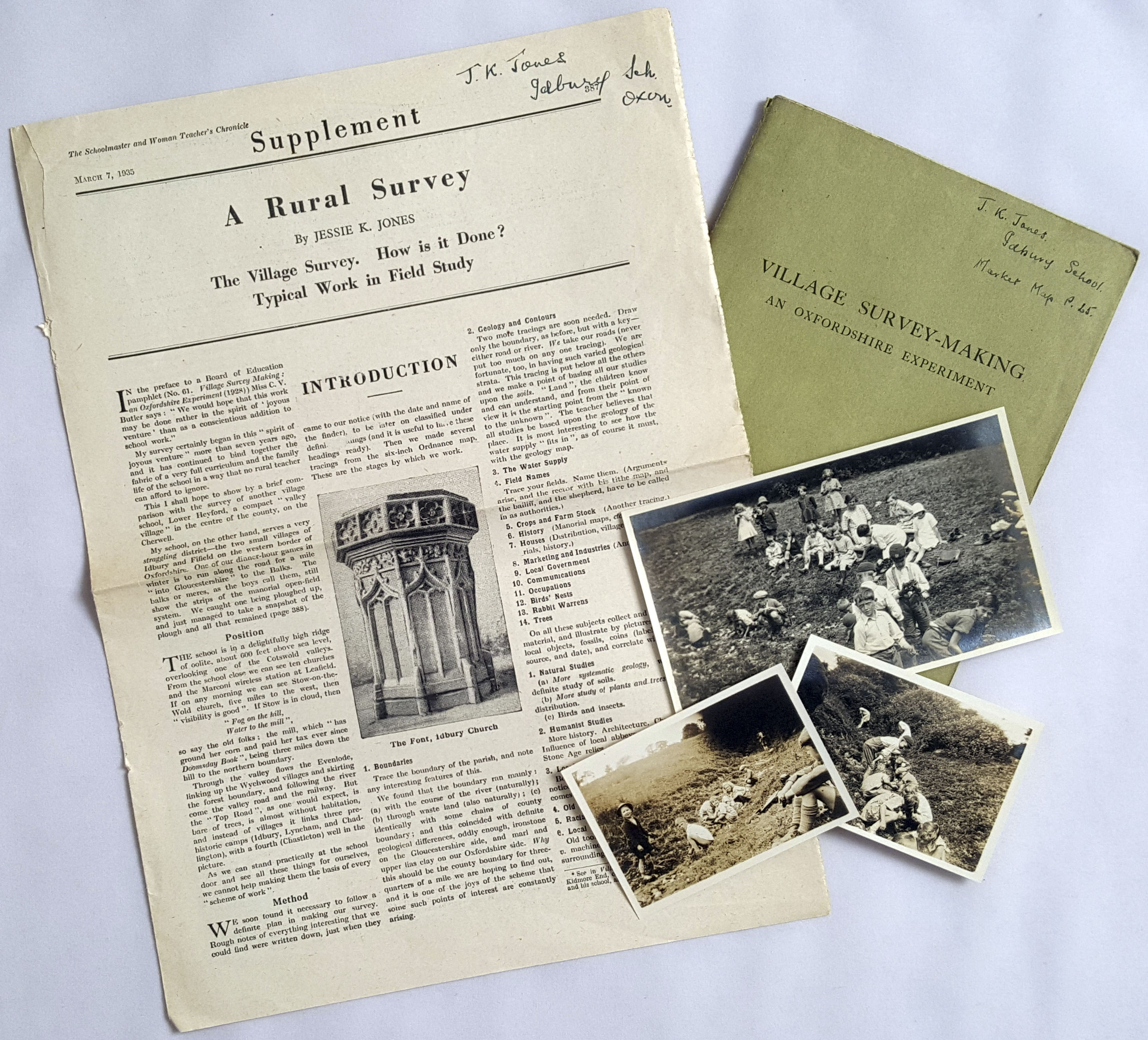
Articles and photographs by Jessie K. Jones
Jessie and the children gathered information on a whole range of topics which they logged in notebooks and mapped. Much of the exploring was done as the children walked to and from school, at lunchtime, after school and in the holidays; the discoveries later being recorded in class. An important part of the survey was the use of tracings of the local 6-inch Ordnance Survey map to create base maps on which to add thematic data. Individual maps created included: a parish boundaries map, a geology and contours map; a field map combining information from tithe, enclosure and farm maps, with local knowledge; and others showing archaeological sites, housing types, occupations and land use.
The maps being tracings, could be overlayed so data on different themes could be correlated. Idbury did not receive a mains water supply until the late 1950s so the ‘water supply map’ showing the rivers and springs they had recorded during their explorations, showed where their water came from. When laid over the geology map, the map revealed that the springs emerged at the junctions of porous and non-porous rock, and that changes in geology explained the changes in the ‘sound’ of the running water they had noticed. Back at school, they used a bicycle pump to pump water through a length of tubing buried under a bucket-load of clay and covered in layers of porous rock, to simulate the emergence of a spring.
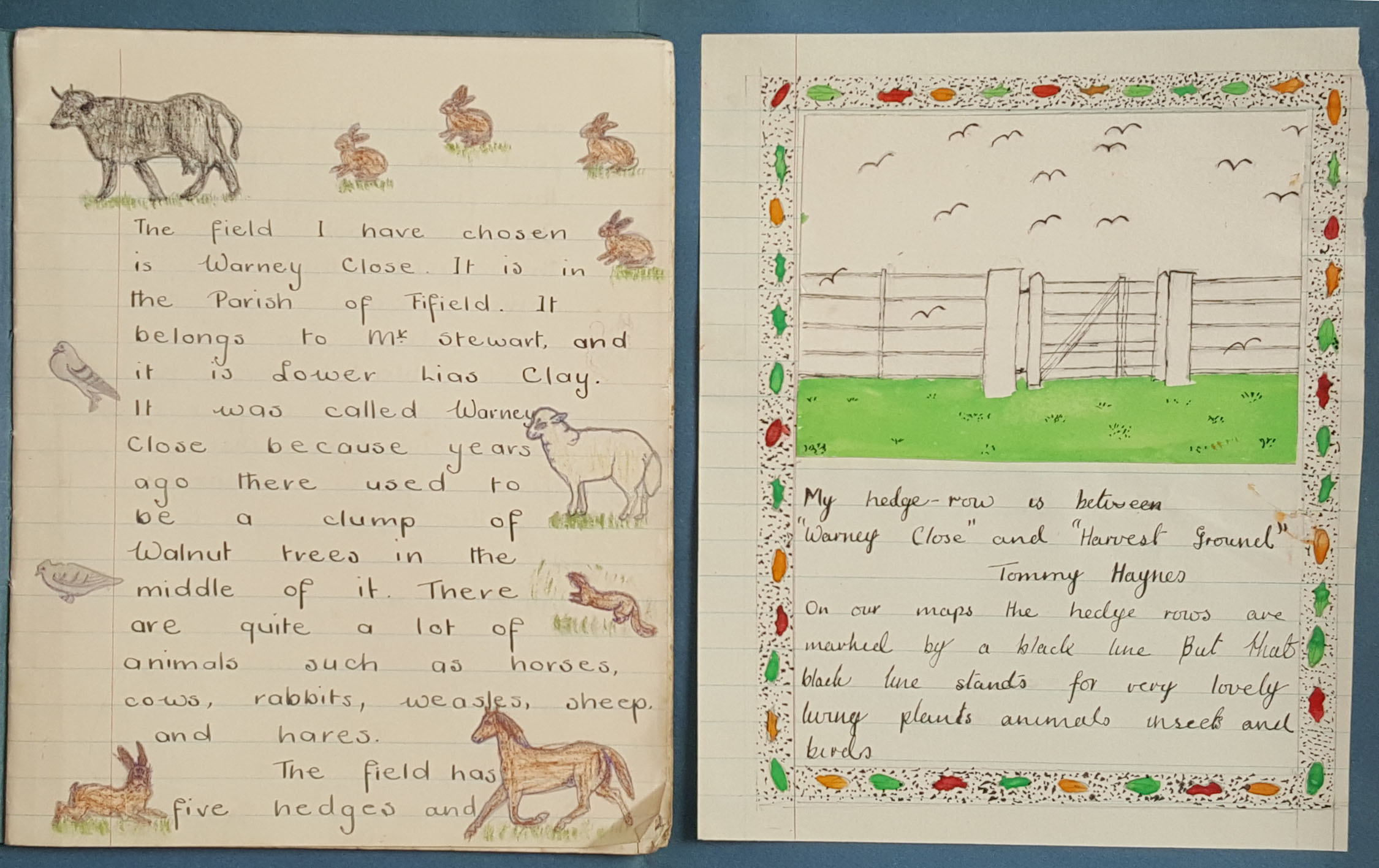
Example hedgerows chosen for study by the children
Some of the work involved individual investigations. The children each chose a field or hedgerow to study and recorded everything they could find out or observe. Special group studies were carried out each year – one year, trees, another birdlife. They even timed the length of the song of a skylark. In winter, the explorations continued: “One of our dinner-hour games in winter is to run along the road for a mile “into Gloucestershire” to the Balks. The balks or meres, as the boys call them, still show strips of the manorial field-system.” She also reported that the rural survey had initiated a new custom; “Each child upon leaving makes for itself a neat framed and varnished map of the fields, with their names as a school keepsake.”
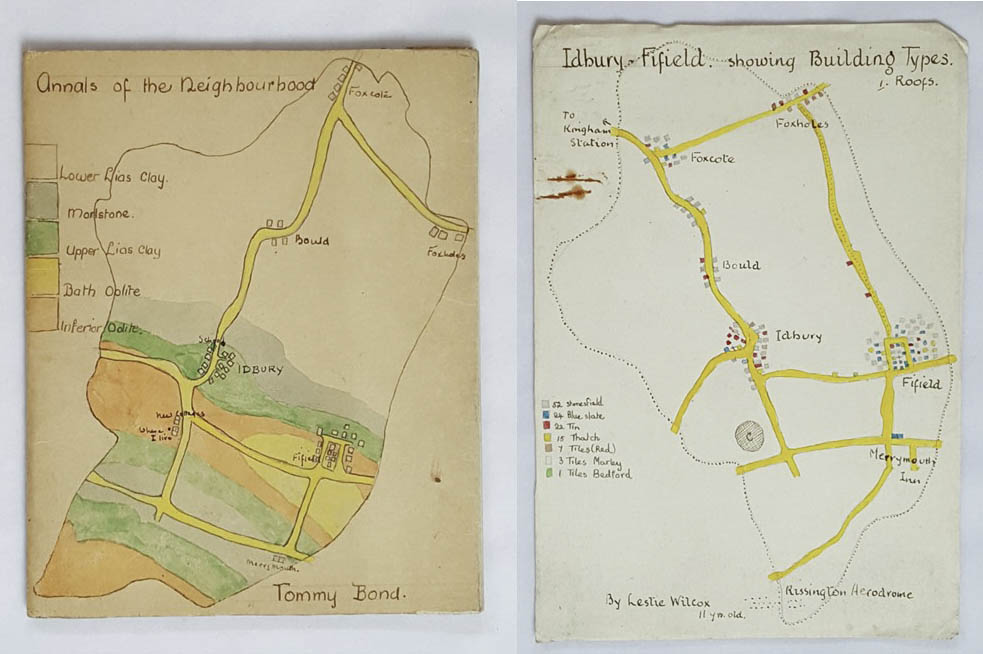
Maps recording the local geology and distribution of building stone

Searching for lucky stones, such as ammonites
In her papers, Jones describes how the children got their families involved, the local farmers, ploughmen and roadmenders helping with geology and local crafts people and family members providing their reminiscences of times gone by. They also used documentary sources such as: census returns to look at population and changing occupations.
In 1933 Jones wrote: “Only last July, one glorious dinner hour, we watched a sheep shearing; weighed with amazement the fleece of one animal and saw the load sent to the stapler at Charlbury. We at once went back to school and looked up all we could about pack-horses taking their loads along the highroad to Burford in the 14th century.”

Exploring the production of wool, and the use of "down" from bullrushes as a pillow-filling
The rural survey also recorded local traditions and folklore, a subject Jessie had a personal, interest in. In the 1920s she had supplied information from her grandfather’s diary, to folk song and dance collector Cecil Sharp, concerning morris dancing in Charlbury. She also wrote about the unbroken May day traditions of Idbury. The ‘explorers’ collected local weather lore, old sayings, rhymes, and games. In one old house she describes finding a “guggle hole” a worn stone where children used to play “guggles” (tossing snails shells)”.
Her talks were well received, one writer describing her enthusiasm as “contagious and helpful” another that she “brought the veritable spirit of the English countryside into the meeting.” In 1937 a former Idbury resident recalled “we used quite often to be made aware of the importance of our little school when we saw motor-cars drawn up outside and learned that grand people had come down from Oxford or London to see the work going on there.”
Despite the evident success of her approach to teaching in a rural school, Jessie Jones was modest in her assessment of the survey results achieved, apparently conscious of the limitations of her own teacher training. She made a point of acknowledging that village survey-making, was not entirely new citing the influence of her grandfather’s work, but her approach was clearly inspirational and she was keen to promote the many benefits of ‘exploring,’ both to the children and to village life generally.
Jessie Jones continued in post throughout the war, staying beyond her due retirement age. In December 1945 she was taken ill at work and died shortly after. She lies in Charlbury Cemetery; her epitaph, so appropriate for a teacher, “Hometime”. Her friends and colleagues having been unable to acknowledge her achievements at her forthcoming retirement, later arranged a memorial.
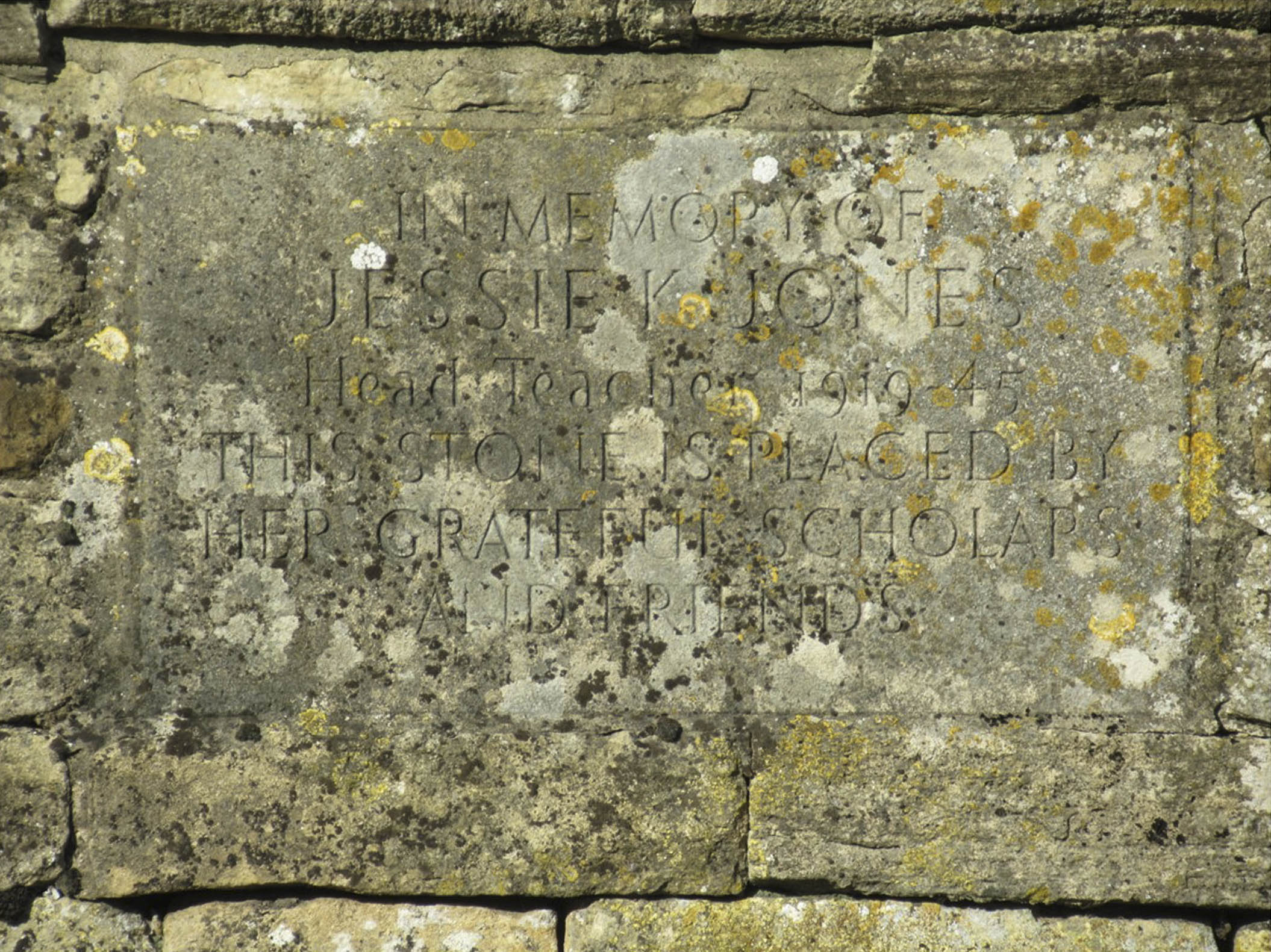
The memorial to Jessie Jones, set in the churchyard wall at Idbury, next to the school where she taught
Jessie’s papers and the work of the schoolchildren, which make quite a bulky collection, survive thanks to Violet Butler. In 1954, she deposited them with County Librarian Miss Stanley Smith who considered the collection “so precious that it lives in my room at the library”. Butler clearly had an affection for the project. In a letter retained with the collection she thanks Miss Stanley Smith: “With good wishes for the well being of a beloved white elephant and thanks to you for tending it.” We too, are so pleased she did.

Group photo of Idbury School children out and about on village survey duty
Children whose work appears in the collection include:
Violet Arthurs, Tommy Bond, Archie Bull, Fred Bull, Henry Bull, Eric Cooper, Hammond Cooper, Hilda Cummins, Kathleen Ferriman, Bertie Fields, Mary Fields, Joe Gorton, Arthur Harris, Billy Harris, Horace Harris, Marion Harris, Cyril Haynes, Francis Haynes, Lucy Haynes, Tommy Haynes, Eric Hewson, Jimmy Hicks, Mervyn Hicks, Harry Howse, Jimmy Jackman, John Neville, Roddy Neville, Jack Paxford, Rachel Reynolds, Doris Simons, Dennis Soden, Colin Townsend, Fred Truman, Joyce Webb, Leslie Wilcox.
Posted by: Ellie Reid, Local Studies Librarian, Oxfordshire History Centre