
Example of an archive catalogue hierarchy
19 March 2021
This exploration of the variety and development of the History Centre’s archive catalogues looks at how we’ve been working to improve online access to information about our collections. During recent lockdowns, without ready access to our building, remote access to our catalogues has been vital in helping our users plan and carry out their research.
A brief word about what I mean by a ‘catalogue’ in this context. In essence, an archive catalogue is a description of a set of documents that all originate from the same source (for example, an official body, an organisation or society, or an individual person or family), arranged in a layered list that reflects the way the records were created. The records in a catalogue are likely not to have been deliberately put together as an archive in their working life and may have reached us by different routes.
In its structured arrangement a catalogue differs from a list and makes the archive and its contents more easily findable and accessible for anyone who wants to use it. For each catalogued document or group of documents there is a reference number, title, description or summary, and date, so that the content of the records can be searched at each level within the hierarchy of the collection.
An archive collection that remains uncatalogued may have sufficient documentation recorded about it to identity its existence, but the details of the material in it may remain largely unknown and inaccessible until a full catalogue is produced.
Example of an archive catalogue hierarchy
With all the demands on an archivist’s time, the opportunities to devote to cataloguing the volume of collections that our office receives and has accumulated and looked after over the years seem to diminish. In the early days of the History Centre’s predecessor (Oxfordshire Record Office), there were fewer deposits or donations each year and much of the staff time seems to have been set aside for cataloguing. This resulted in very detailed catalogues (virtual word-for-word transcripts of documents in some cases), with each record handwritten – or later typed – on a bespoke index card or set of cards. These cards are still all housed in drawers in our searchroom, with accompanying sets of indexes by place, name, and subject.
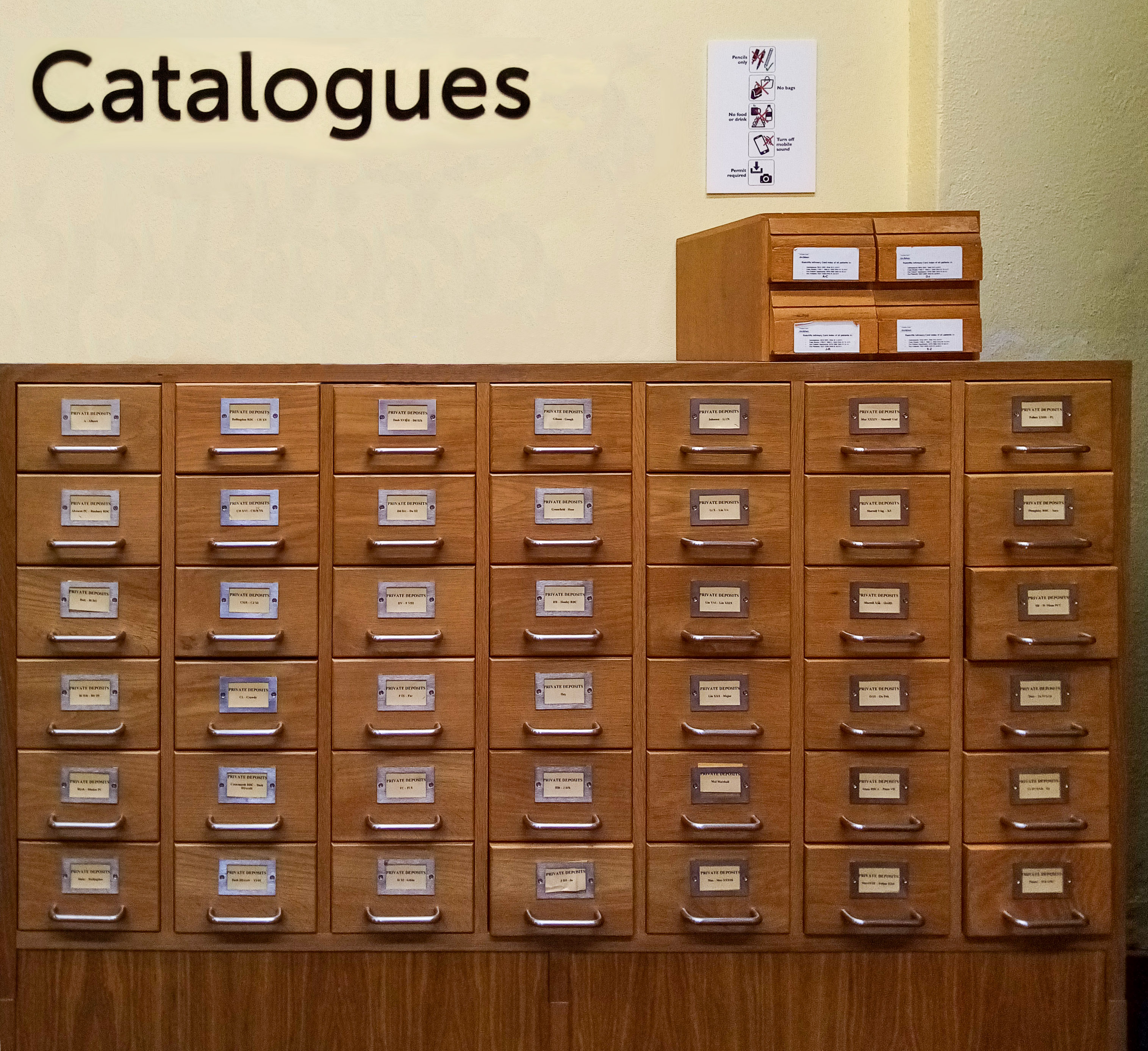
Card catalogue drawers in History Centre searchroom
Up to now, the contents of most of these card catalogues have only been able to be consulted directly by physical visitors to the office, and by staff in response to specific enquiries.
The majority of the collections catalogued in this way were deposited by estate owners, landed families, solicitors, or private individuals, but there are also parish records, organisational collections, and school records (among others). They include some of our largest and most important collections.
A large proportion of the records covered by these catalogues are title deeds and other property documents, many in series covering several centuries, and therefore are potentially rich sources for personal name, family relationship, and land and building history research.

Map of Bestmoor Meadow in North Aston, 1724 (reference: Dash II/2/I)
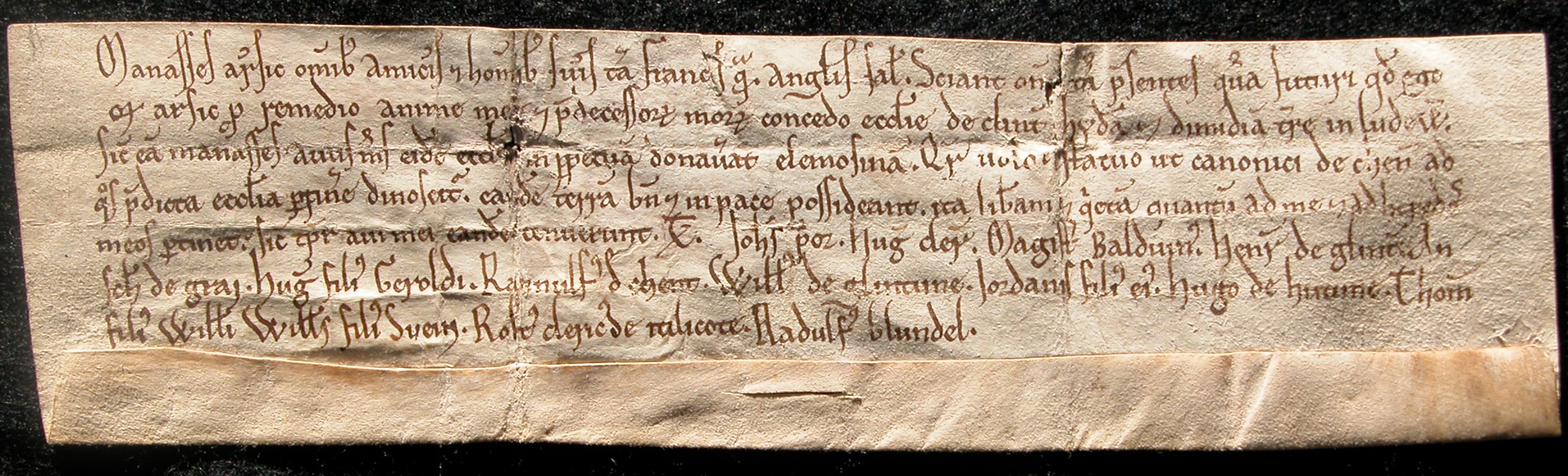
‘Arsic’ deed, c. 1150 (reference: Dash XXIII/ii/1a)
The Manage Your Collections (MYC) service developed recently by the National Archives (TNA) has provided us with the opportunity to put some of this collections’ information online on TNA’s Discovery website. Ideally, we would re-catalogue all these ‘card collections’ to current archival standards, but this would be at the expense of new cataloguing projects. However, access restrictions and the switch to home working caused by the pandemic have led to our shifting some of the focus of our collections’ work to widen access to these catalogues.
The initial stage of our card catalogue project was to identify the collections which were the priority catalogues for transferring onto spreadsheets. The main criterion by which a collection was judged was likely frequency of consultation, based on how well particular catalogues had been used in the past. We also acknowledged, though, that some collections may have been less often requested because their existence was not well known, even to staff.
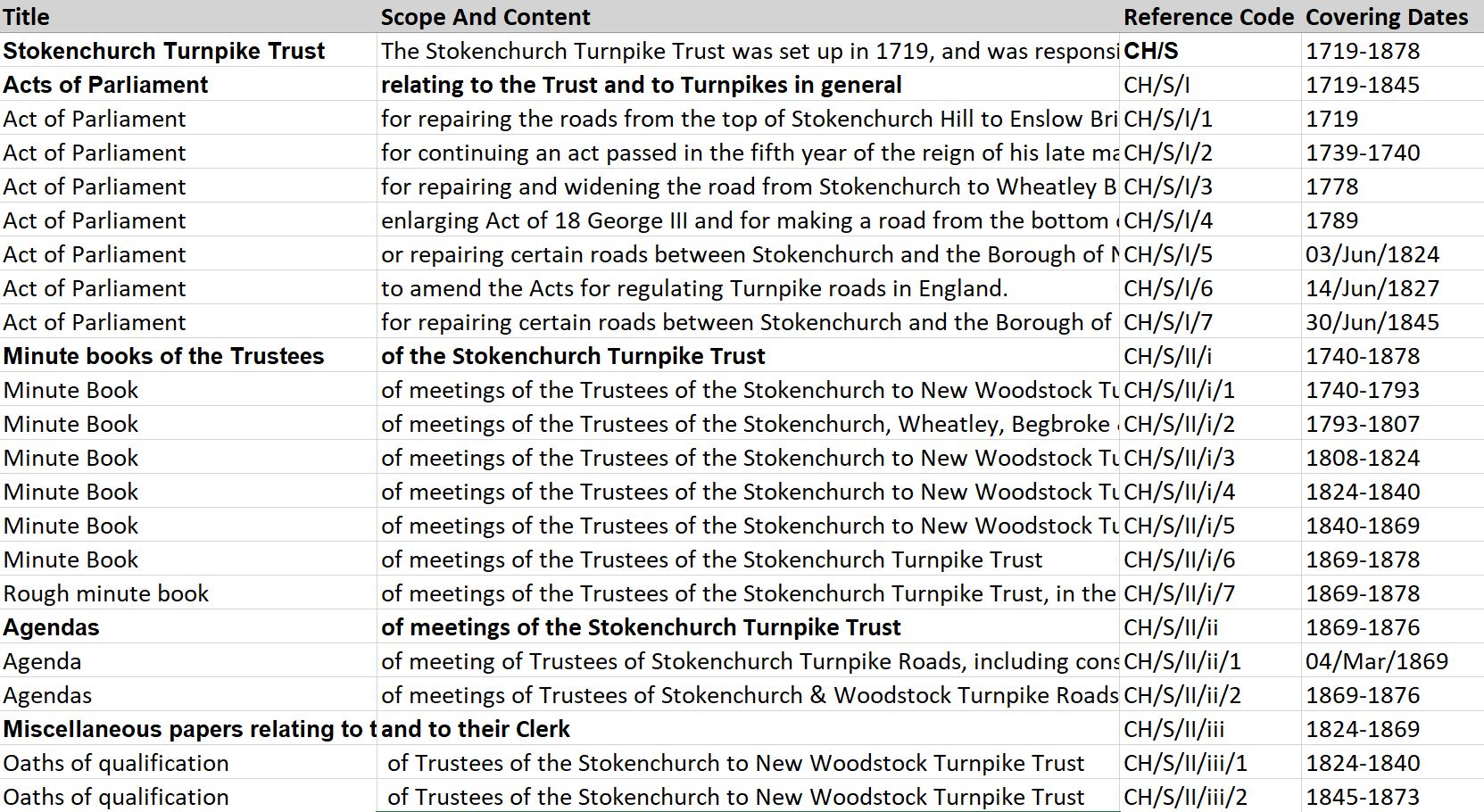
Extract from spreadsheet template for transcribing Stokenchurch Turnpike Trust catalogue cards
At the start of the first lockdown, we devised a workflow process so that staff and volunteers could data input and edit these catalogue records to fit the MYC spreadsheet template, from which we could upload the catalogues online. The editing stages have removed some of the repetitive and descriptive content of the original catalogues, while maintaining the key information and terms that make the documents more readily searchable and usable. The reference numbers and structure of each catalogue of our collections that you can now see on Discovery have been retained, although we have corrected errors or inconsistencies when appropriate.
The first selections for the project, to trial the processes, were from our smaller collections, principally the artificial ‘CH’ archive (CH simply indicating that the common link between all the records under this umbrella reference were found in County Hall, generally in the 1950s and 1960s!). These include turnpike trust, enclosure, manorial, and county election papers.
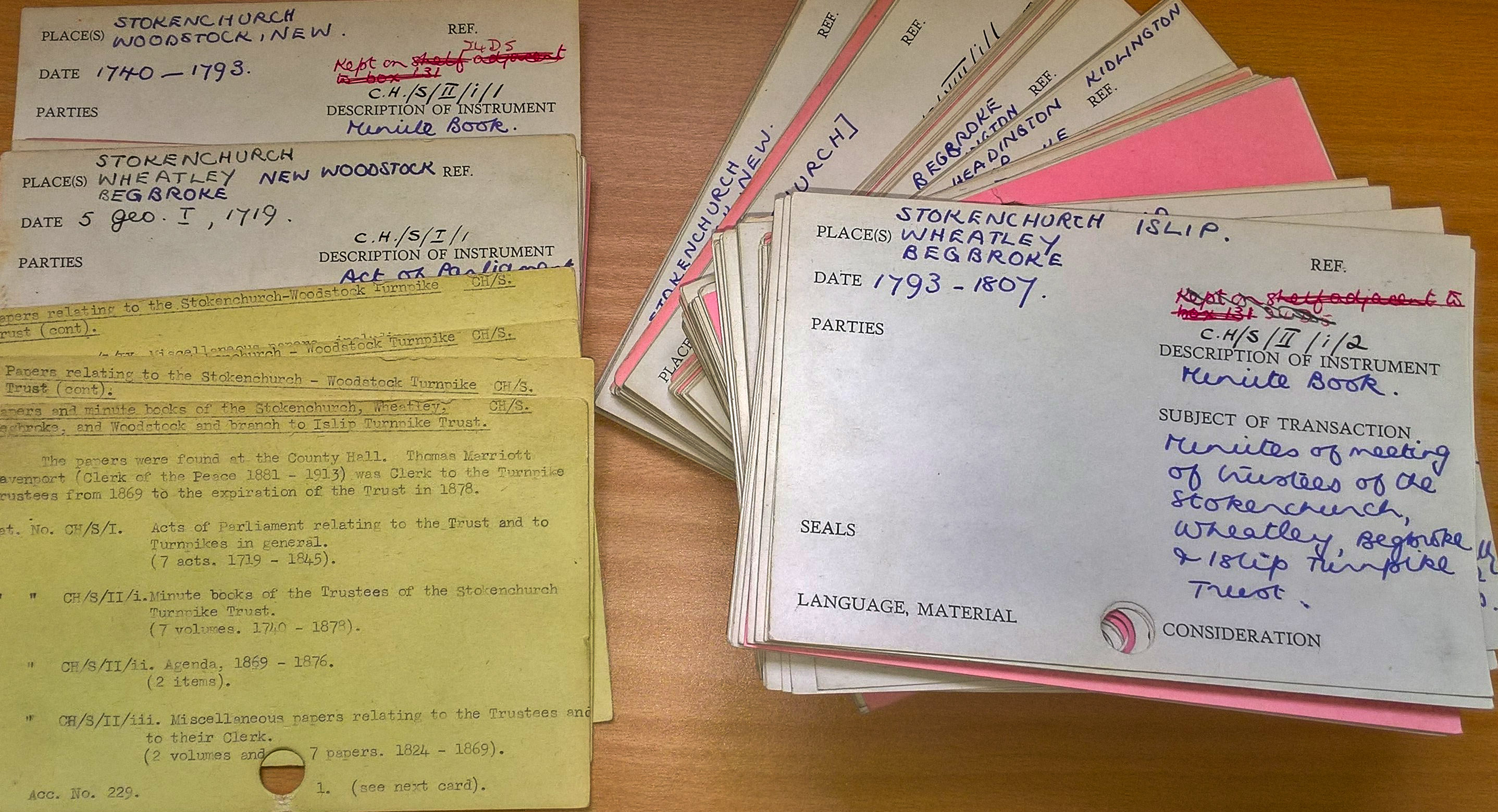
Catalogue cards for collection CH/S: Stokenchurch Turnpike Trust, consisting of summary cards (yellow) and individual record cards (white)
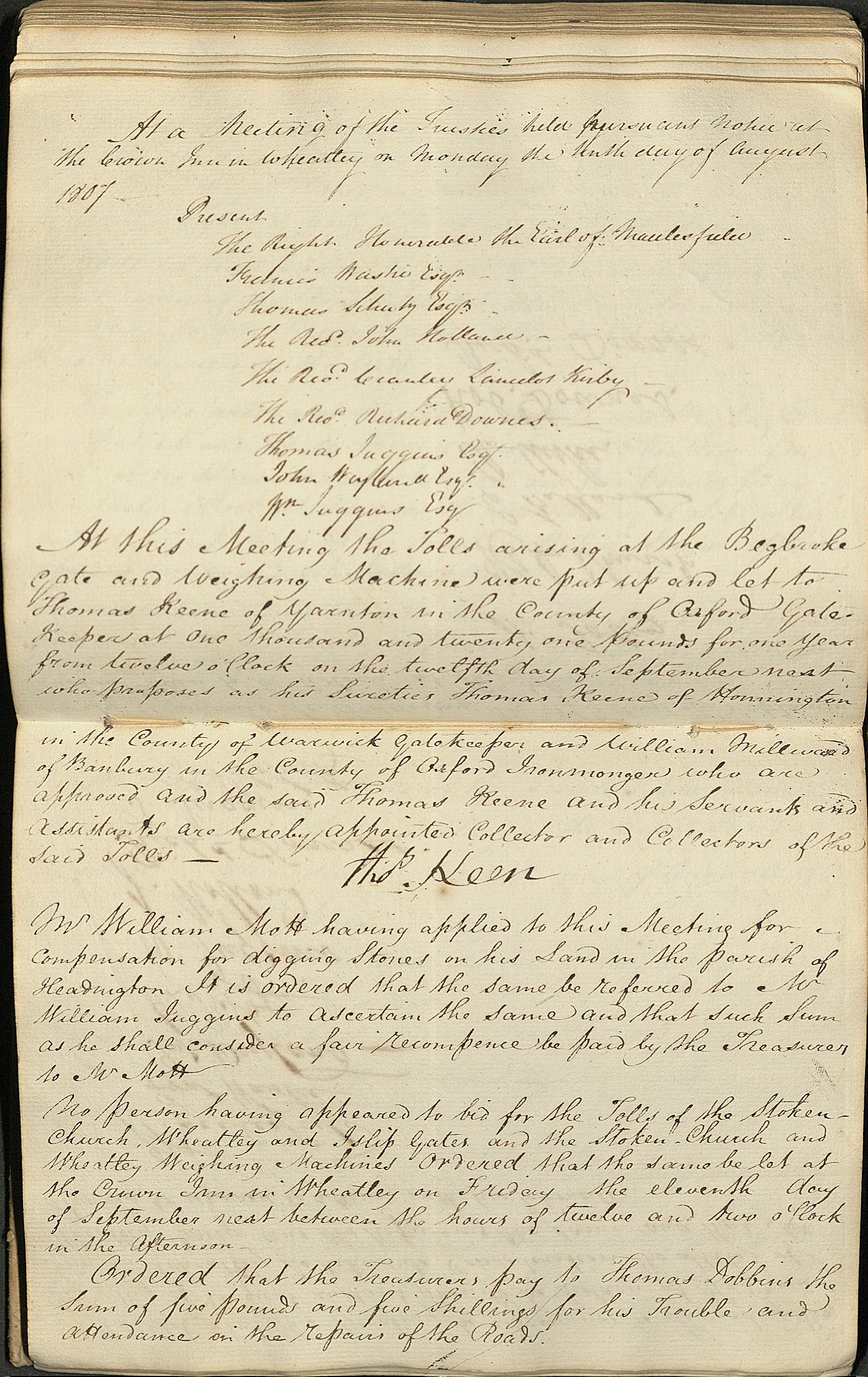
Details of the August 1807 meeting, from Stokenchurch Turnpike Trust Minute Book, 1793-1807 (reference: CH/S/II/i/2)
The next candidates were two of our most significant estate, manorial and family collections: the Dashwood of Kirtlington Park and the Jerseys of Middleton Stoney. These catalogues consist of 2,500 and 2,000 records respectively, and the records generate interest beyond those localities. The Dashwood (‘Dash’) papers includes 17th and 18th century estate maps. They also contain many series of title deeds, for estates held by the family and their predecessors in Oxfordshire and other counties. Some pre-date the period when the Dashwoods held the properties. Among these records is a mid-12th century grant of land to the church of Glympton, which is the oldest-known document within the History Centre’s collections (see image Dash XXIII/ii/1a).
The Jersey family’s association with Middleton Park began when William Villiers, the 3rd Earl of Jersey, bought the estate in 1737. The family was closely involved in the life of the village, and was responsible for improvements, particularly in the nineteenth century, with the building of new cottages for their tenants, and the provision of a school, shop and reading room, among other charitable works. Their archive includes financial records for the Jerseys’ estates in several parishes in Oxfordshire. Middleton Park remained the seat of the Jersey family until it was sold in 1946.
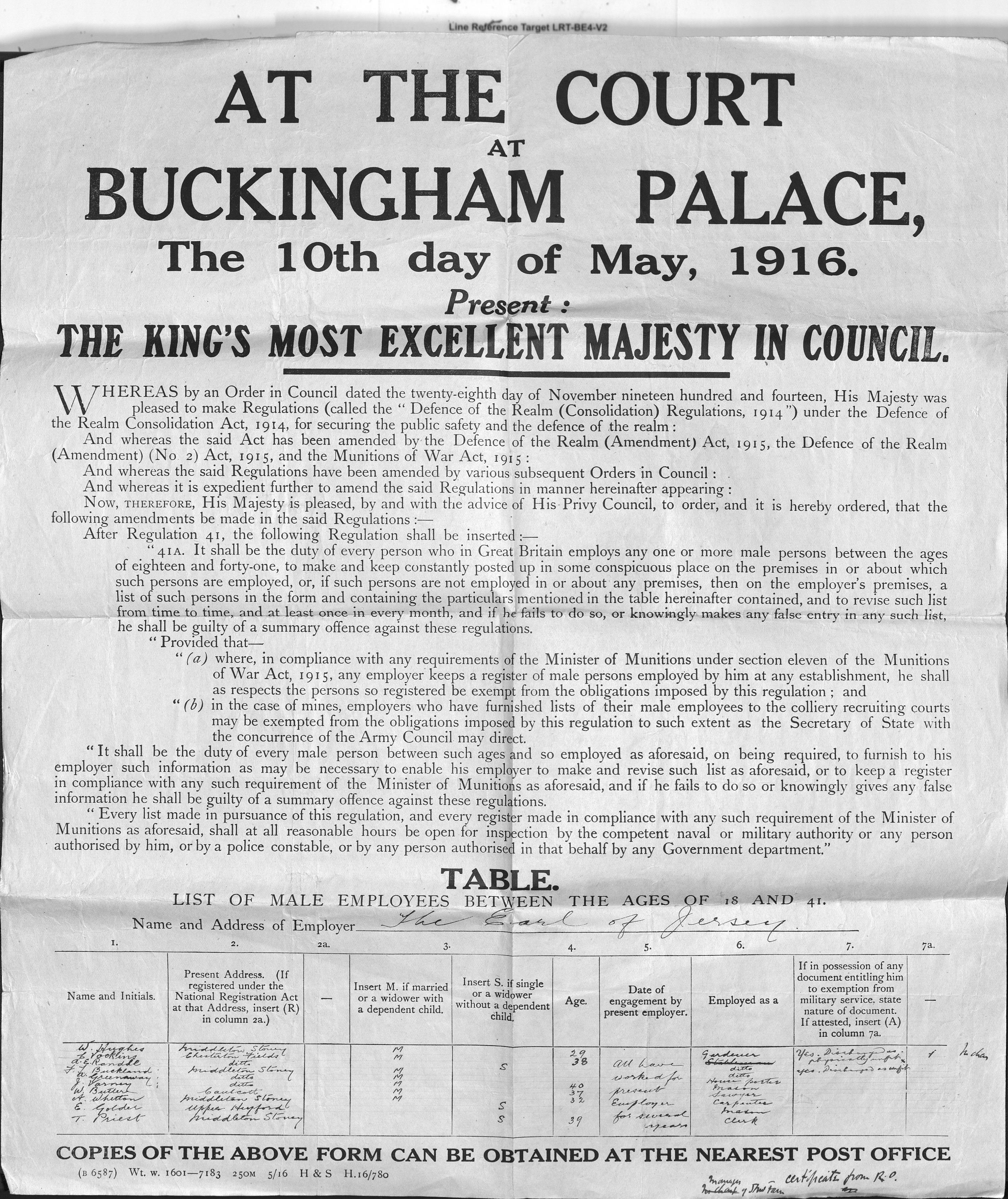
List of male employees on Jersey Estate, 1916, compiled under the Defence of the Realm Act. It includes two gardeners listed as ‘discharged, as unfit for military service’ (reference: J I/af/22)
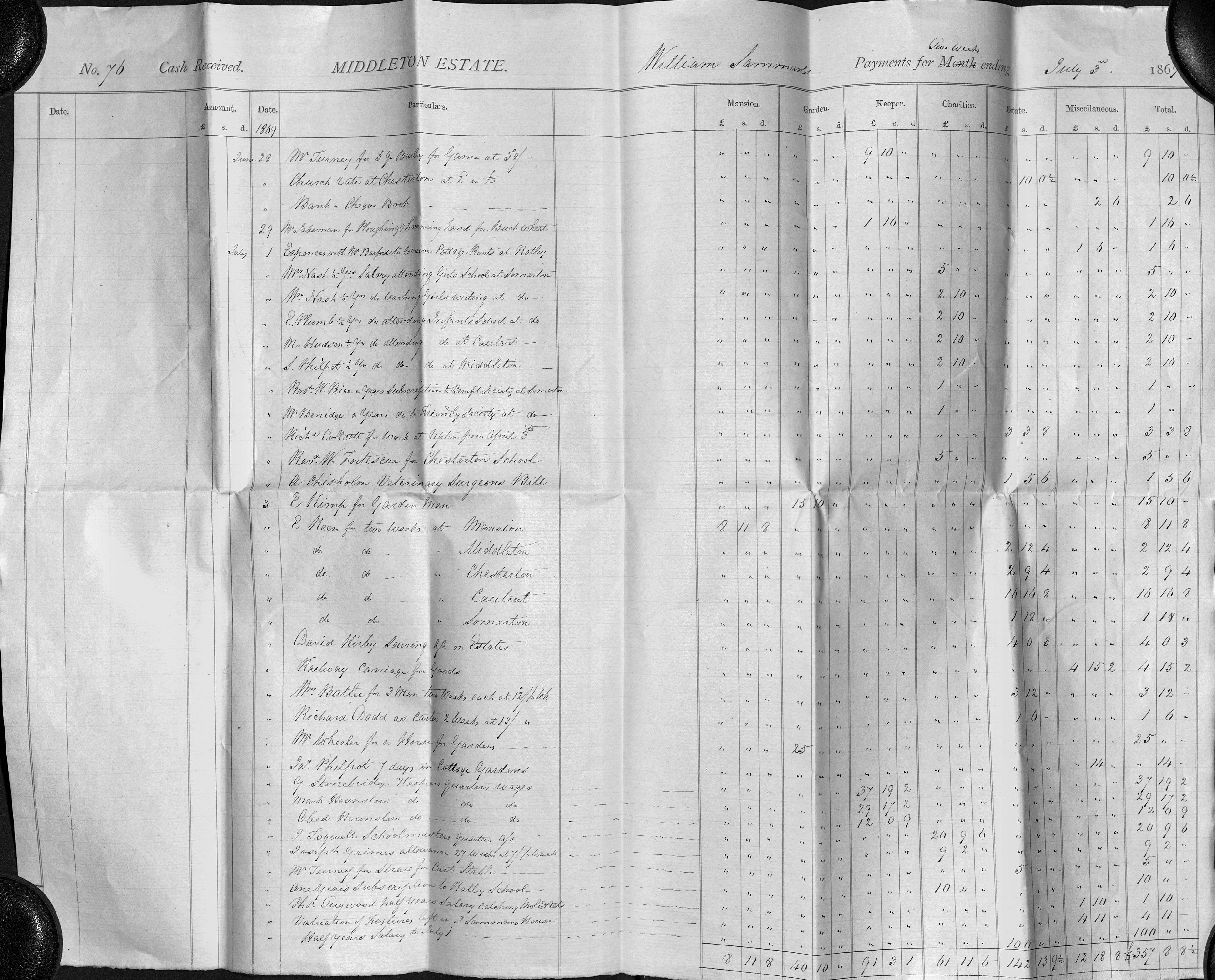
Steward’s accounts, 1869, including for estate work and schoolteacher’s expenses (reference: J I/ag/1)
Another of the catalogues now online is an archive collected by Charles John Peers of Chislehampton House about his family, its property holdings and business. As well as title deeds for premises in Oxfordshire, Buckinghamshire and London owned by the family, there are maps and plans, probate, financial and genealogical papers. In addition, there are records of the interests, businesses, careers, and official appointments that members of the Peers family held or were involved in. Notable among these are the documents reflecting the work of Charles Reed Peers (1868-1952), a renowned architect and archaeologist, who was Chief Inspector of Ancient Monuments.
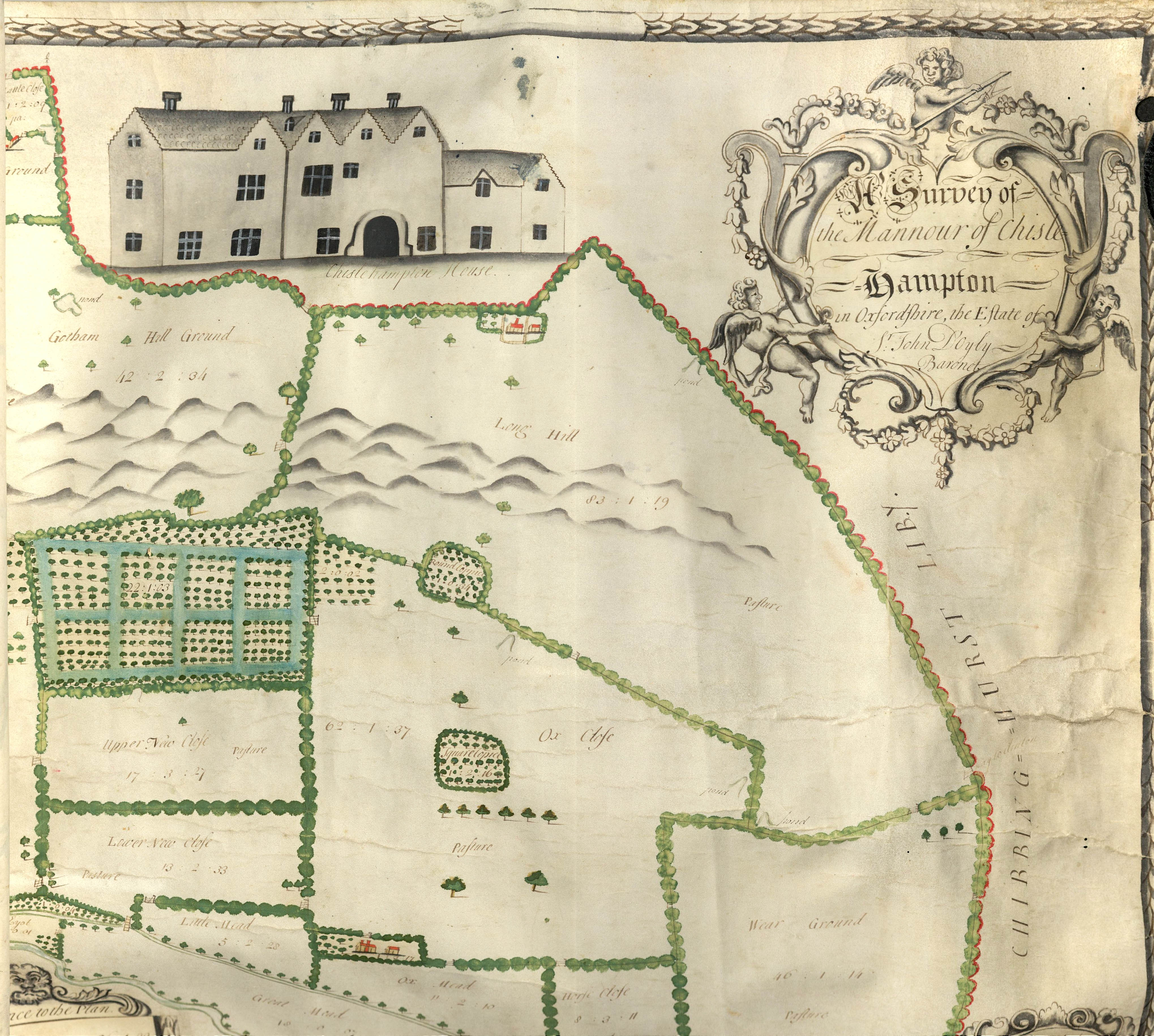
Survey of Manor of Chislehampton, 1743 (reference: Peers XIV/4)
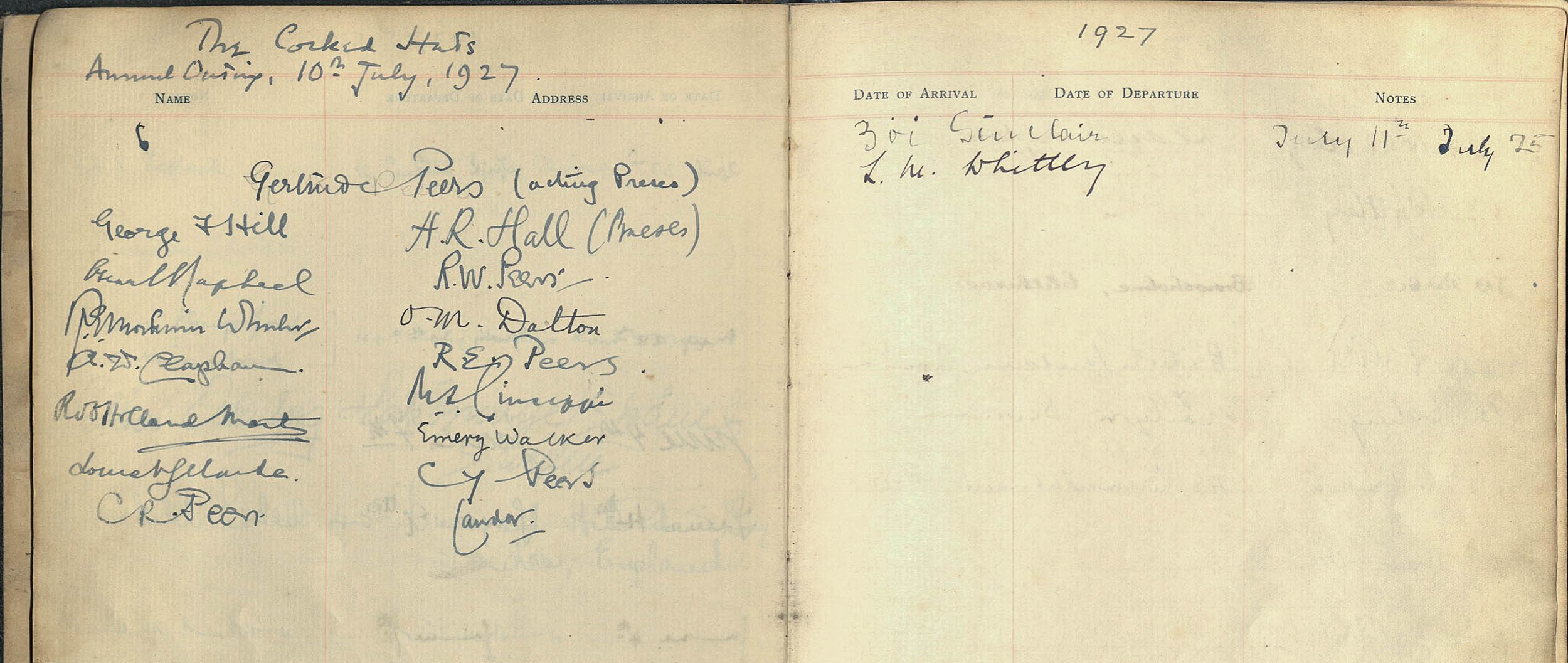
Visitors’ book for Chislehampton House, 1927. This page lists members of the Cocked Hats visiting during their annual outing (reference: Peers XVIII/vi/8b)
One of the latest additions to our catalogues on Discovery is a collection of papers about the Marshall family who lived at Little Tew, Enstone, Sandford St Martin and Iffley among other places in Oxfordshire between the 17th and 20th centuries. These extensive sets of records include title deeds and other documents relating to property they owned, photograph albums, wills and probate papers, and notes of the history of places in which they lived. Several of the family members who feature were called Nicholas or Edward, so the detailed family research papers within the collection help to clarify the generations and relationships!
Rev. Edward Marshall Hacker married Mary Anne Burton in 1814; Burton and Marshall estate and family papers can be found in the Burton collection, another of our card catalogues and coincidentally also recently uploaded onto Discovery. This collection particularly relates to Rev. Jenner Marshall of Westcote Barton, Edward, and Mary Ann’s son.
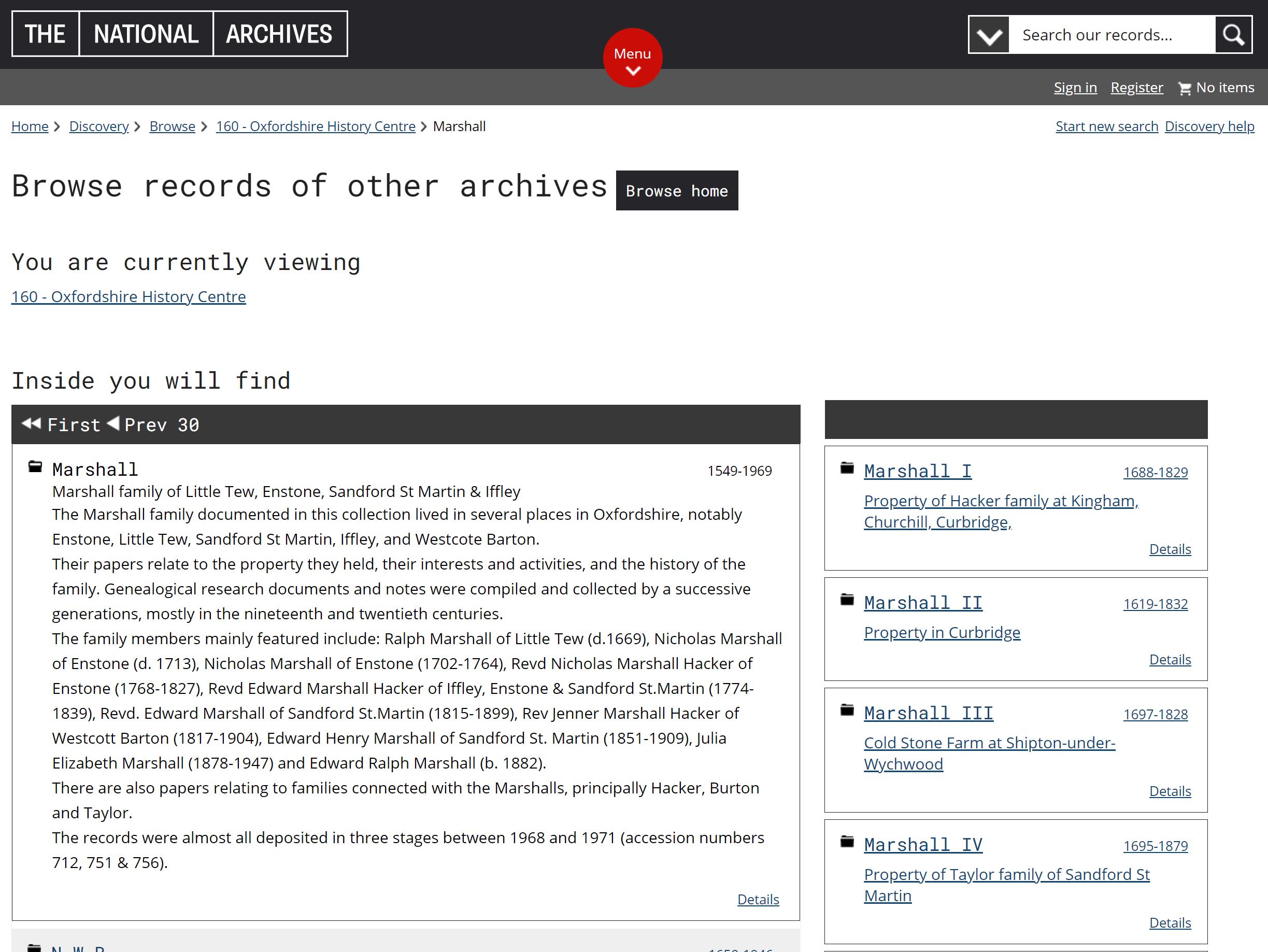
Screenshot of the Marshall catalogue introductory page on Discovery
At time of writing, we have uploaded almost 9,500 card catalogue record entries on Discovery, using MYC. These join 28 other catalogues of History Centre collections that were already on Discovery as a legacy of specifically funded projects or initiatives in the early 2000s. Since the start of April 2020 History Centre staff have converted about 15,000 card entries into spreadsheet records. These are gradually coming to fruition as online catalogues.
We are able to edit, add, remove, or restore individual entries within our own catalogues through MYC, so any updates needed or errors to be amended can be easily processed.
Our catalogues on Discovery are distinct from and complement (rather than duplicate) those on the County Council’s catalogue platform, Heritage Search. Any new catalogues we create or existing catalogues of archive catalogues that we revise or add to are compiled on CALM, our collections management system. From CALM we export to Heritage Search each month any newly completed catalogues for online access.

Part of an archive catalogue on Heritage Search
The range of types and the numbers of collections on Heritage Search is much greater than on Discovery, so when searching our holdings, this is generally the best place to start. CALM serves a wider function as our archive collections’ management database, so key information about new deposits or donations is created and maintained on it as well.
Heritage Search contains over 2,300 archive catalogues, produced over the past 30 years: these include records of local government, schools, parishes, courts, businesses, organisations, families, and individuals, among others.
Some of the card catalogues, particularly of the smaller collections (mainly those of less than 150 records), can be converted to modern-style format and re-referenced relatively easily, so in these cases, the catalogues will be added to Heritage Search. Others appear to belong with existing catalogued collections, so will be re-catalogued and amalgamated with these as one archive on CALM.
One example of a re-catalogued former card catalogue are title deeds of the Trustees of the Batt School for properties in Witney. Details of these and the other records we hold for the school are available on Heritage Search.
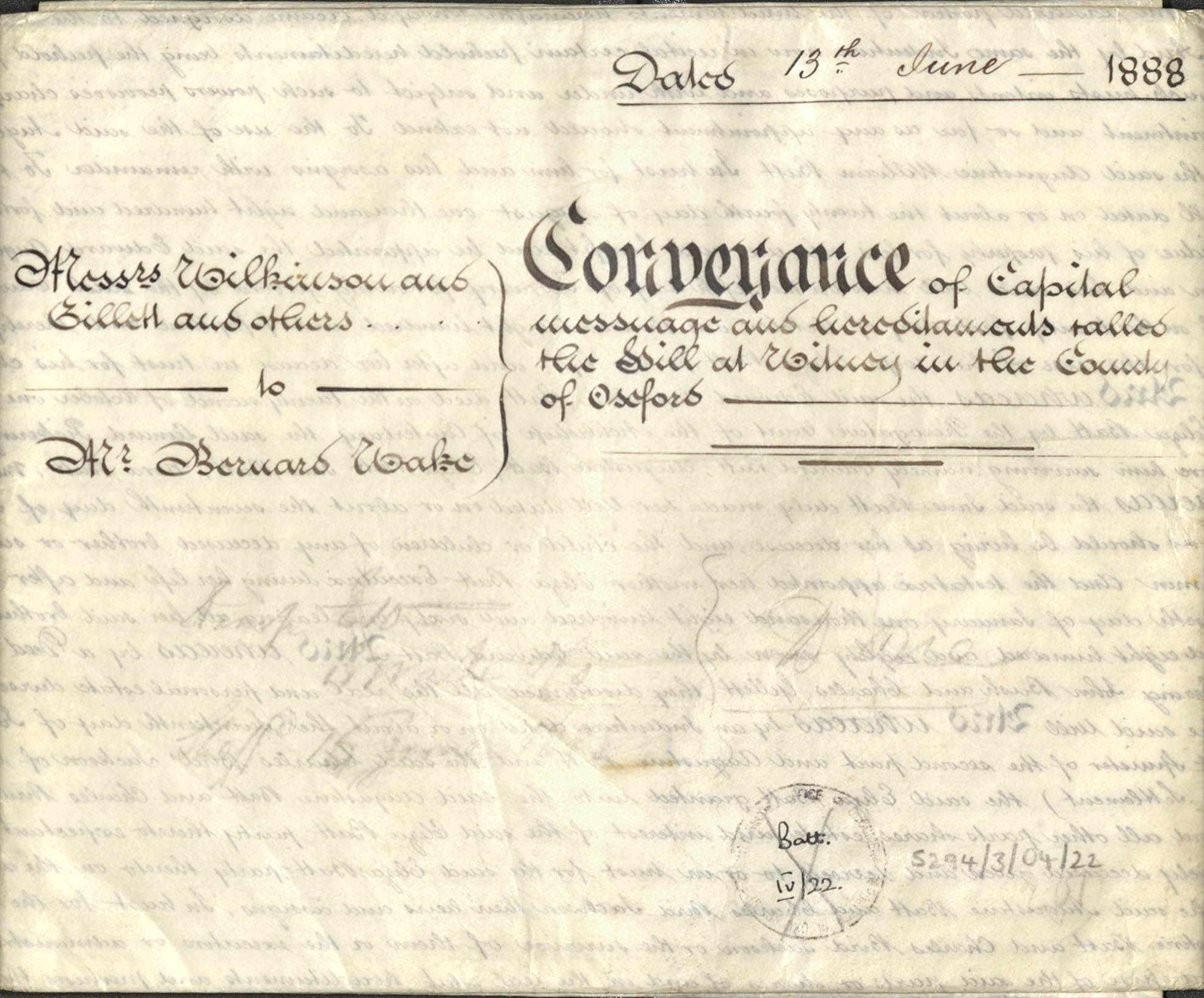
Summary title of deed of conveyance of a house called The Hill, in High Street, Witney, 1888 (reference: S294/3/D4/22)
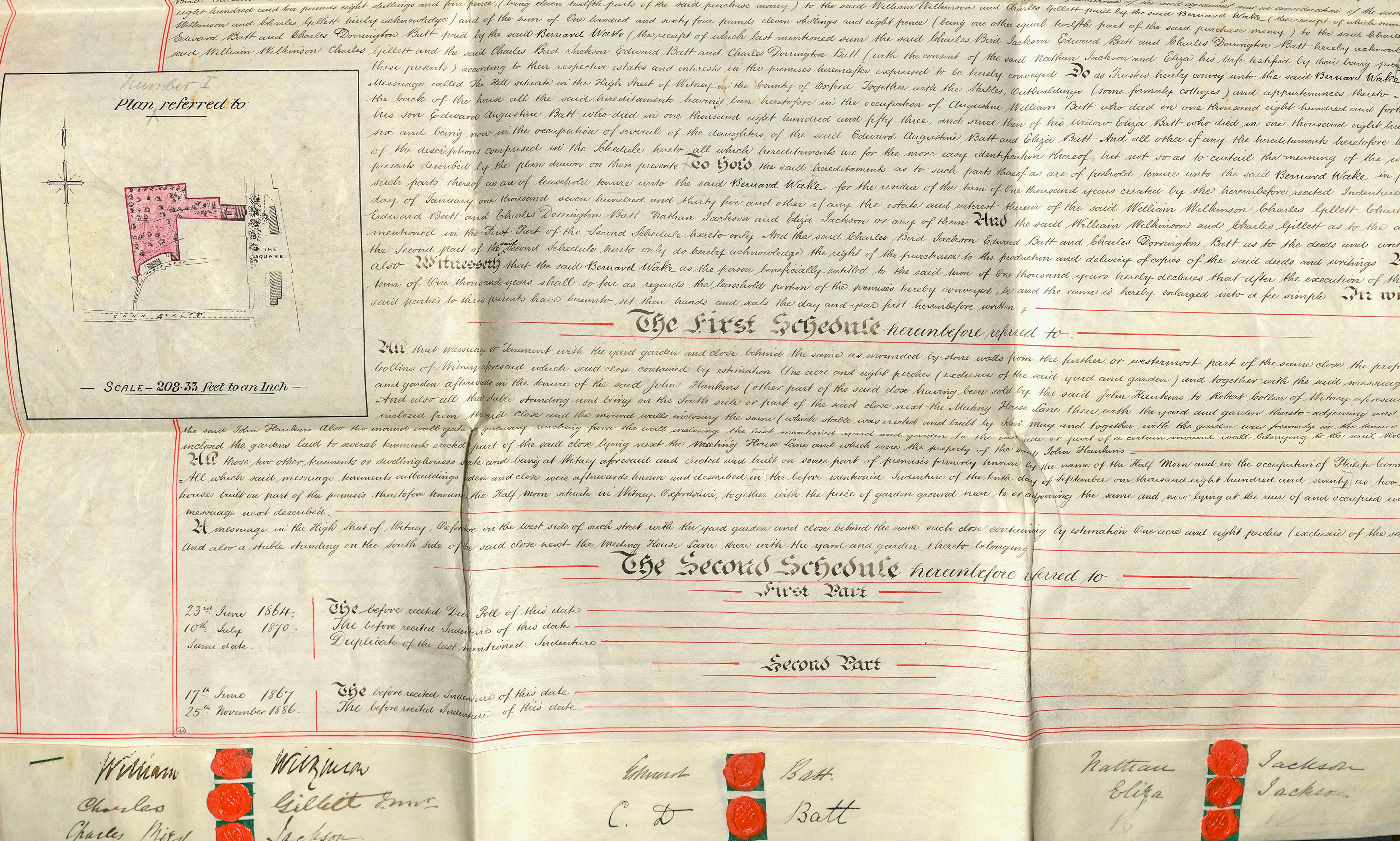
Deed of conveyance of a house called The Hill, in High Street, Witney, 1888.
The document includes a site plan of the property and schedules of related properties and deeds. The Hill was occupied by several generations of the Batt family (some of whose wills are recited in the deed). The premises were sold for £1,975. (reference: S294/3/D4/22)
Another project we have been able to progress during our building closure is to add our CALM-generated catalogues to the Archives Hub. This website is a free online service that provides access to descriptions of collections of archives held by over 350 institutions throughout the UK, such as universities, companies, and other organisations, as well as by local authority repositories like ours.
The content and structure of our catalogues on the Hub is the same as on Heritage Search, though the layout for each collection looks somewhat different. We have so far exported and uploaded over 800 of our collections; our aim is that during 2021 all our CALM catalogues will be available on the Hub. This channel should reach potential users of our resources who may not otherwise find us.

Screenshot of the introductory page on the Archives Hub for collection catalogue NQ2.
As well as the card catalogues, we have other legacy catalogues in hard-copy format only. During this period of closure of our service to physical visitors, we have gradually been adding these to our digital content website www.oxfordshirehistory.org.uk as pdf pages, again as part of our drive to increase digital access.
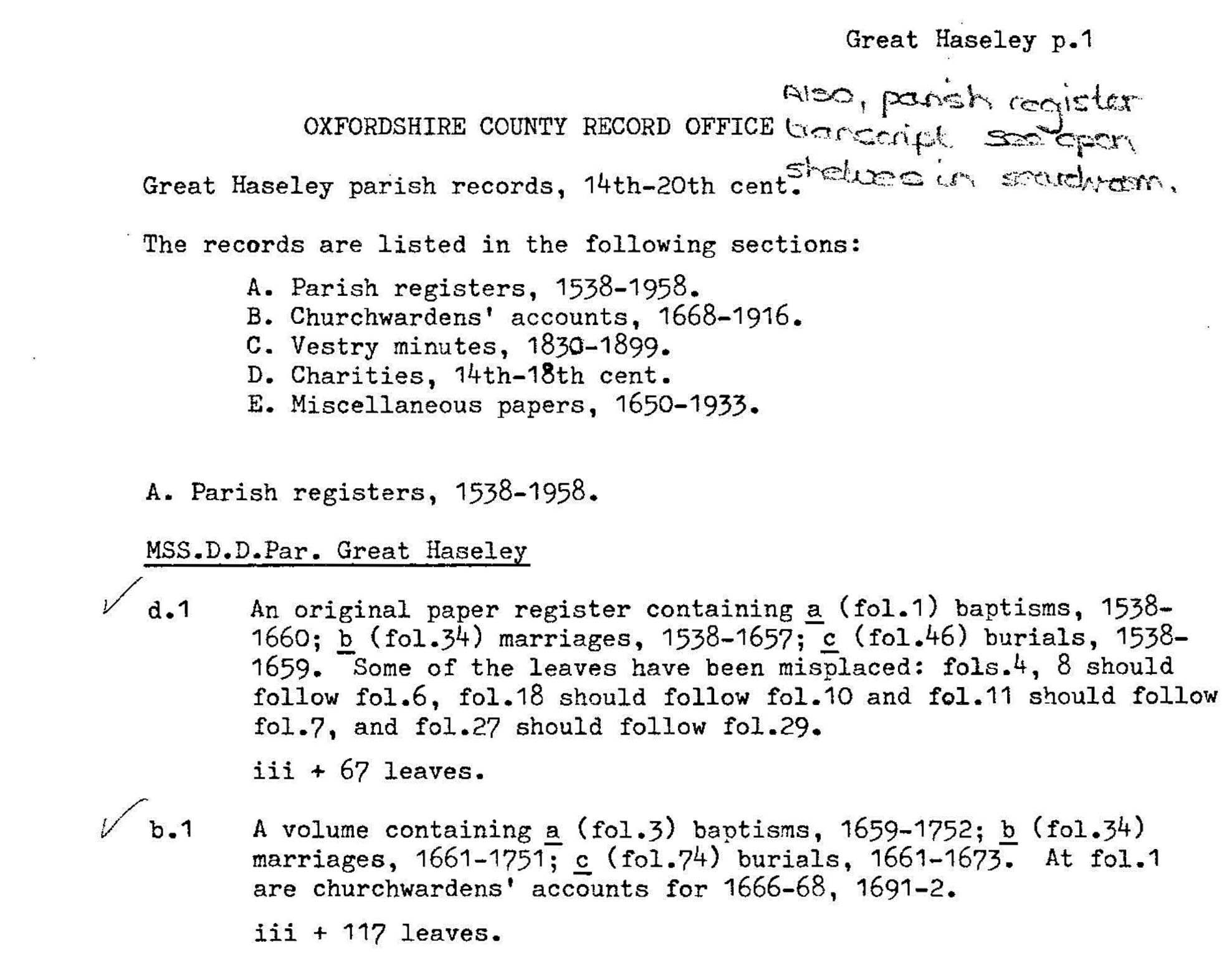
Extract from typescript Great Haseley parish catalogue (ref: MSS.D.D.Par.Great Haseley)
These pdf catalogues consist of 20 parish collections and selections from the Oxford City Archives (e.g. cemetery records, electoral registers, Poor Law Guardians’ minutes, and Quarter Sessions’ court) not yet on Heritage Search.
The evolution of eighty-five years of documenting our archive holdings, and changing trends and expectations, means that we still have some way to go before our catalogues are likely to be fully digital, but the past year has at least been a step forward in this regard, when other aspects of the work of the service have had to be put on hold.
For further information about our archive catalogues, with links to their online locations, see the Catalogues at the Oxfordshire History Centre page of our website.
Posted by: Mark Priddey, History Centre Manager (Archives), Oxfordshire History Centre