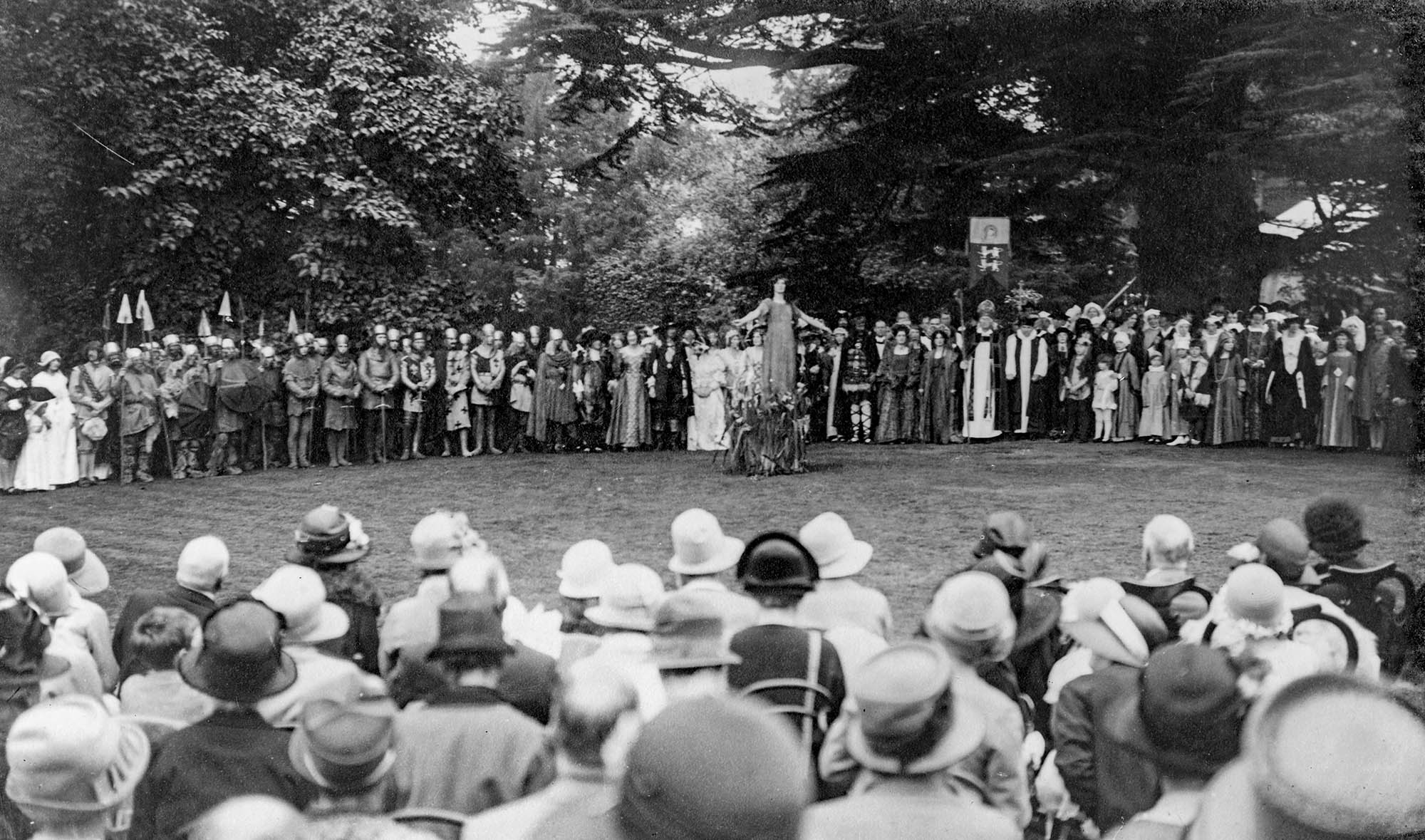
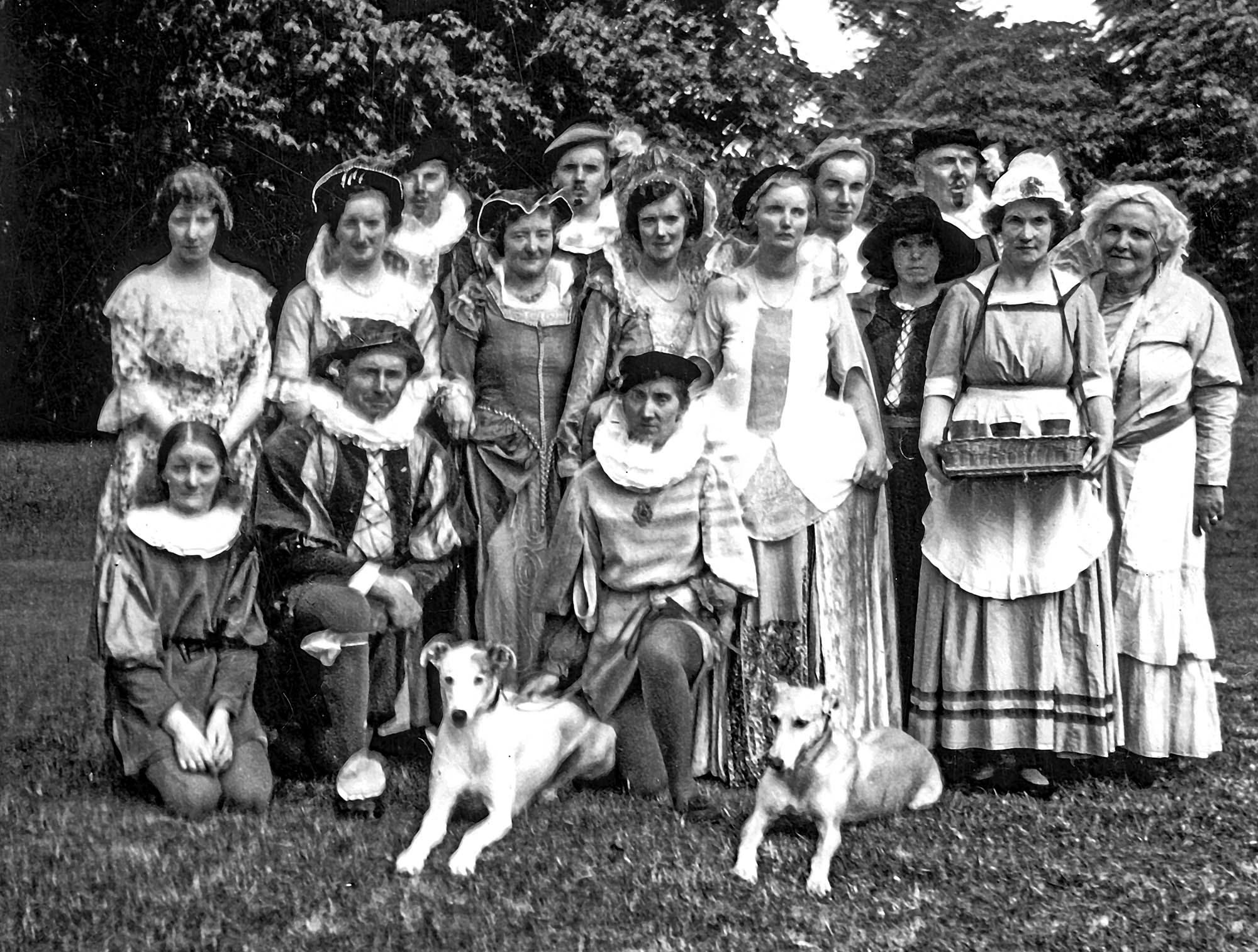
The Henley Pageant: final tableau with all the performers assembled (ref: POX0595039)
16 July 2021
During the 1920s and 1930s historical pageants, in which people dressed up as historic characters and re-enacted episodes from their local history, were a popular summer entertainment. These colourful spectacles drew large audiences and had the potential to raise significant funds for local causes.
Two photograph albums recording historical pageants performed at garden fetes at Henley-on-Thames (1927) and Blenheim Palace (1938,) together with their respective pageant programmes, are preserved in Oxfordshire History Centre collections. They have recently been digitised and can now be accessed on Picture Oxon (click here for Henley, and here for Woodstock).
Read on to find out who was ‘the Spirit of Henley’ and what parts the then Duke of Marlborough and his family played in the Blenheim and Woodstock Pageant. If you have Oxfordshire family history, you might find your ancestors were pageanteers!
The Henley Pageant: final tableau with all the performers assembled (ref: POX0595039)
At the beginning of 1927, a crack was discovered in the bell tower of St Mary’s, the parish church of Henley. The cost of repairing the wall and re-hanging the bells was estimated at £600. To raise this considerable sum, an historical pageant and garden fete was planned. Mr and Mrs Bright of Paradise House, Gravel Hill, Henley, offered their garden as the venue and the Rector of Henley, the Rev. Canon Dams (1867-1951), became president of the Pageant committee.
Historical pageants tended to have a ‘pageant master’, effectively a producer, who worked with various sub-committees to create the script, commission the music, acquire or create the props and costumes, recruit performers and backstage help, and bring the proposed pageant to fruition. A prominent local citizen, Edgar Payton (1866-1945), estate accountant of the Yewden Estate, Hambleden (Bucks), took on the role. Payton already had a successful track record at pageant-making having written and produced a pageant performed at Hambleden Manor for Hambleden Women’s Institute early in the 1920s.
This was followed by ‘The Pageant of the Seasons’ performed at Normanstead, Henley, on 15th and 16th July 1925, the proceeds from which enabled Henley Congregational Church to clear a substantial and long-standing debt. Payton had gained his pageant-making expertise through involvement with the renowned Edwardian pageant master, musician, and dramatist, Louis N. Parker (1852-1944), probably at Warwick in 1906 where Payton had personal and family connections.
Louis Parker had ignited a craze for historical pageants before the First World War with his pageant staged at Sherborne (Dorset) in 1905. This was followed by similar events at Warwick, Bury St Edmunds, Dover, Colchester, and York that involved hundreds of performers and drew audiences numbering in tens of thousands. His ‘modern pageantry’ was seen as a departure from other kinds of pageant. Rather than a free street procession with parade floats, his pageants comprised a series of dramatic episodes drawn from documented local history and tradition, that were performed outdoors in an historic location. Paying audiences, seated mostly in a grandstand, were guided through a chronological local history in a spectacle that saw hundreds of costumed performers, some on horseback, recreate scenes from the past in song, dance, and dramatic form culminating in a grand tableau of all the ‘pageanteers’.

Henley Pageant book of words (1927) - cover design by Constance Bradley.
View full text of Henley Pageant book of words
Payton’s ‘Henley Pageant (A.D. 775 to 1633)’ reflected Parker’s style. In his introduction to the Book of Words (a programme for the fete and pageant which also contained the script), he explained that his main source had been John Southerden Burn’s 1861 History of Henley-on-Thames, in the county of Oxford. ‘The main facts have the authority of history’ he said, ‘but they have been freely amplified in detail for the purpose of dramatic effect’ – an approach adopted by successful pageant masters throughout the twentieth century!
To guide the audience through the pageant episodes, an historical or mystical figure was frequently deployed as narrator. Payton’s choice was an embodiment of ‘The spirit of Henley’ played by Miss Bryce. She was required to be on stage throughout the pageant to provide the episode links. Her performance was commended by a newspaper reviewer for her excellent diction and audibility.

The Spirit of Henley - Miss Bryce.
(ref: POX0595003)
The evidence suggests that this was a local resident, Margaret Vincentia Bryce (1891-1973) who in support of women’s suffrage had ridden on horseback dressed as Joan of Arc at the head of the Women’s Coronation Procession through London, in June 1911, and had later become a professional actress under the stage name Margery Bryce.
The majority of the 200 performers were volunteers from Henley or the surrounding parishes who assisted by taking on specific episodes. The six episodes were as follows:
Episode 1 saw King Offa abandon his pursuit of Cynewulf of Wessex who had crossed the river Thames, and Offa’s partial conversion to Christianity. This episode was arranged by the parish of Greys.
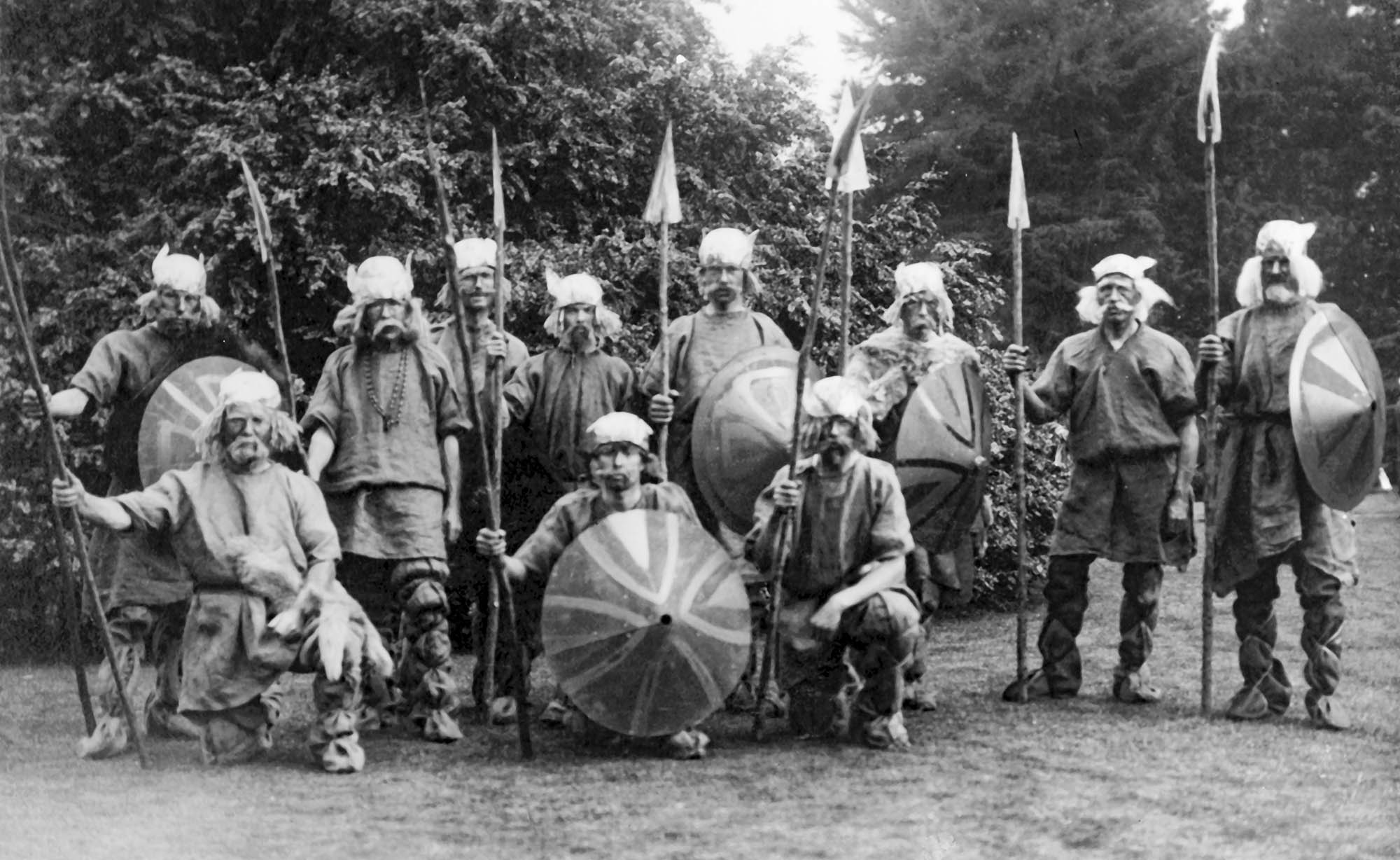
Episode 1: Anglo-Saxon soldiers: W. Barrett (Junior), Mr Underwood, Mr C. Underwood, Mr Adams, Mr R. Adams, Mr G. Hunt, Mr G. Hunt (junior), Mr J. Hunt, Mr R. Northeast, Mr. G.A. Smith, Mr J. Gibbs.
(ref: POX0595007)
Episode 2 saw the dramatic capture of King Edwards II’s favourite Piers Gaveston (who had been granted the Manor of Henley), by the powerful barons who sought to end his influence over the king. This was presented by the parish of Hambleden.
Episode 3 saw the Henley-born Bishop of Lincoln presenting funds for education to the governors of Henley school and funding for almshouses to the churchwardens of the parish. This episode was presented by the parish of Remenham.
In Episode 4, the Charter of AD 1571 was presented by the parish of Harpsden. Queen Elizabeth I was the most portrayed figure in twentieth-century historical pageants – her inclusion not always being strictly historically accurate! At Henley, her character didn’t appear in person. Instead, the Royal Herald announced the granting of her charter which was presented by the Queen’s Commissioner to the town’s officials played by the present mayor and members of the town council.

Episode 4: The herald, Miss Tudor Williams, and trumpeters, Joyce Wallum and Violet Lovegrove.
(ref: POX0595015)
Episode 5, presented by Greys, depicted Lady Periam, founder of a charity school in the town, being visited and entertained by the scholars. The music for the pageant was the responsibility of William Bayley, organist at St Mary’s. During his research for suitable music, he discovered that the British Museum held a book of canzonets (songs) by Thomas Morley which had been dedicated to Lady Periam. His discovery was incorporated into this episode and was promoted as evidence of the historical authenticity of the pageant.
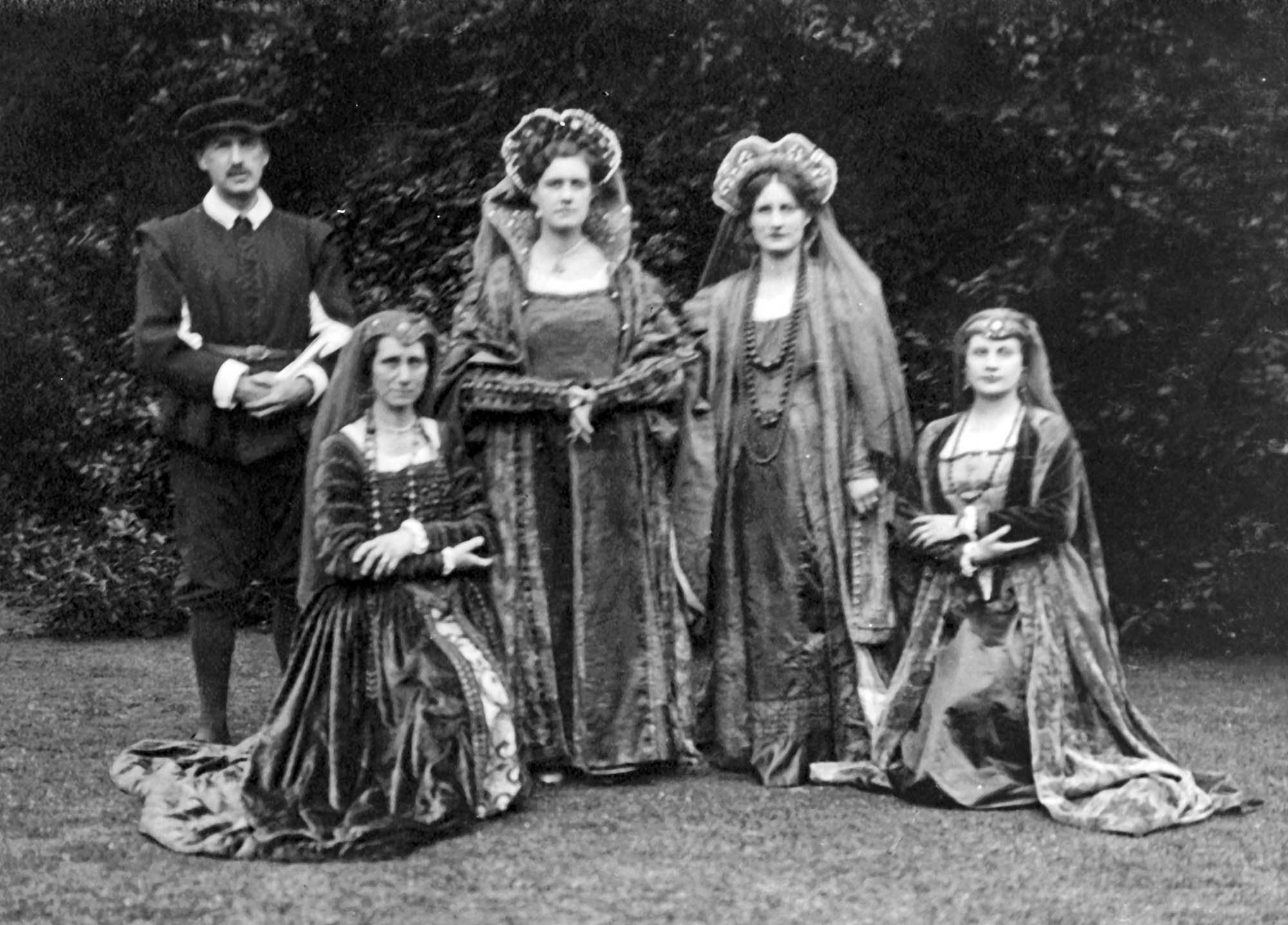
Episode 5: Lady Periam, the school Usher, Juliana Doyley and 1st lady played by members of the Ovey family of the Hernes estate, and 2nd lady, Miss Catherine Kerse.
(ref: POX0595021)
In the final episode, Archbishop Laud (played by the Rev. Canon Dams) visits Henley to distribute gifts to poor brides. The church had been gifted a set of bridal jewellery for hire to ‘poor brides’, but three sisters were to be married on the same day and a recipient of the ‘bride gear’ had to be chosen. The arrival of King Charles I and Queen Henrietta Maria provides the solution as the King and Queen are prevailed on to choose the lucky bride – the third bride Henrietta being chosen on account of her name. The episode concludes with a country dance ‘Haste to the Wedding’.
After the final episode, ‘The Spirit of Henley’ took to her pedestal in the centre of the arena and all the performers, led by King Offa and King Charles I performed a march-past, saluting her before assembling in a mass tableau. The entire company then sang ‘The Old Hundredth’ followed by the national anthem.
All the work in preparing for the pageant culminated in two performances at 3pm and 6.30pm. Pageants needed to draw an audience from a wide area to ensure a profit, and usually sought the patronage of royalty, aristocracy or other well-connected or influential people. Henley had secured the presence of H.R.H. the Princess Victoria (who lived at Iver, Bucks) at the afternoon performance, for which the tickets were 2/6 and 1/-.
Historical pageants like Henley’s were unique to their location, and the local history they told was likely to be unfamiliar to their audience. ‘Books of Words’ were sold in advance to enable vistors to gen up on the pageant before the day. Princess Victoria apparently delighted the organisers by asking for her copy to be sent in advance, a request which was exploited to encourage others to buy one too!
Although the afternoon was sunny, conditions for the evening performance, when tickets were 1/- and 6d, were not so favourable, and the final votes of thanks to Pageant Master Edgar Payton and others were overlooked in the scramble to escape the rain. Nevertheless the pageant and the fete were a huge success, raising £674 on the day for the St. Mary’s Tower and Bells Fund.
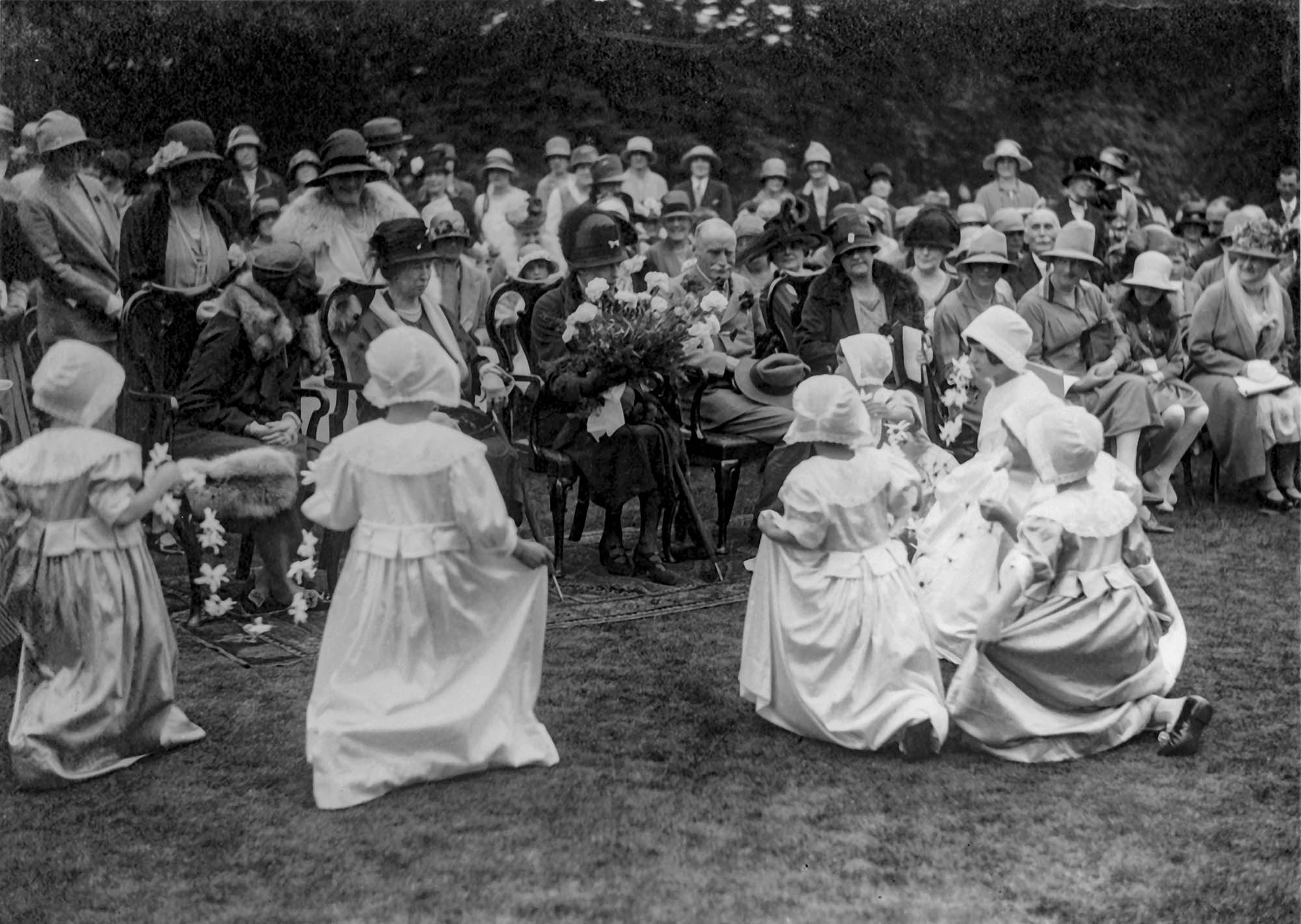
Presentation of a bouquet of carnations to Princess Victoria by Ann Pearce, with daisy chain dancers Patricia Bayley, Joan and Molly Walden, P. Bonser, M. Robins and M. Swabey.
(ref: POX0595002)
The second album recently digitised is a collection of 40 snapshots of this 1930’s pageant which was promoted by the Duke of Marlborough and the Rev. Harold Pickles, Rector of Woodstock, to raise funds for a Church of England secondary school to be built in the town.
Woodstock’s ‘A pageant in ten episodes’ was arranged and produced by the Hampshire-based theatre professional, Lola Morris Platt (1889-1969) who was described by the Oxford Times (3 June 1938) as ‘having considerable experience in connection with historical pageants, as well as on the London and provincial stage’. She was one of several theatre professionals such as Mary Kelly, and Gwen Lally whose work in the inter-war period included pageant-making.
Episode 6: Wootton and Glympton group
(ref: POX0584230)
Women were especially active in the pageant movement, both as performers and organizers. When the Oxford Times reported on the preparation for the Woodstock pageant, it did so in its regular feature, ‘Family circle - things that interest women’. Pageants required a vast amount of voluntary participation: volunteers were needed both to perform, and to make props and costumes; horses were needed for the mounted performers and venues needed for rehearsals.
Lola Platt toured the neighbouring villages who were helping with half of the ten episodes, to direct rehearsals. Inevitably, some of the plans didn’t come to fruition. Platt had to contend with a shortage of male performers, which was a common difficulty faced by pageant organisers, and further difficulties led to an announcement that episode 9 (which was due to depict James II) was “unavoidable cancelled”.
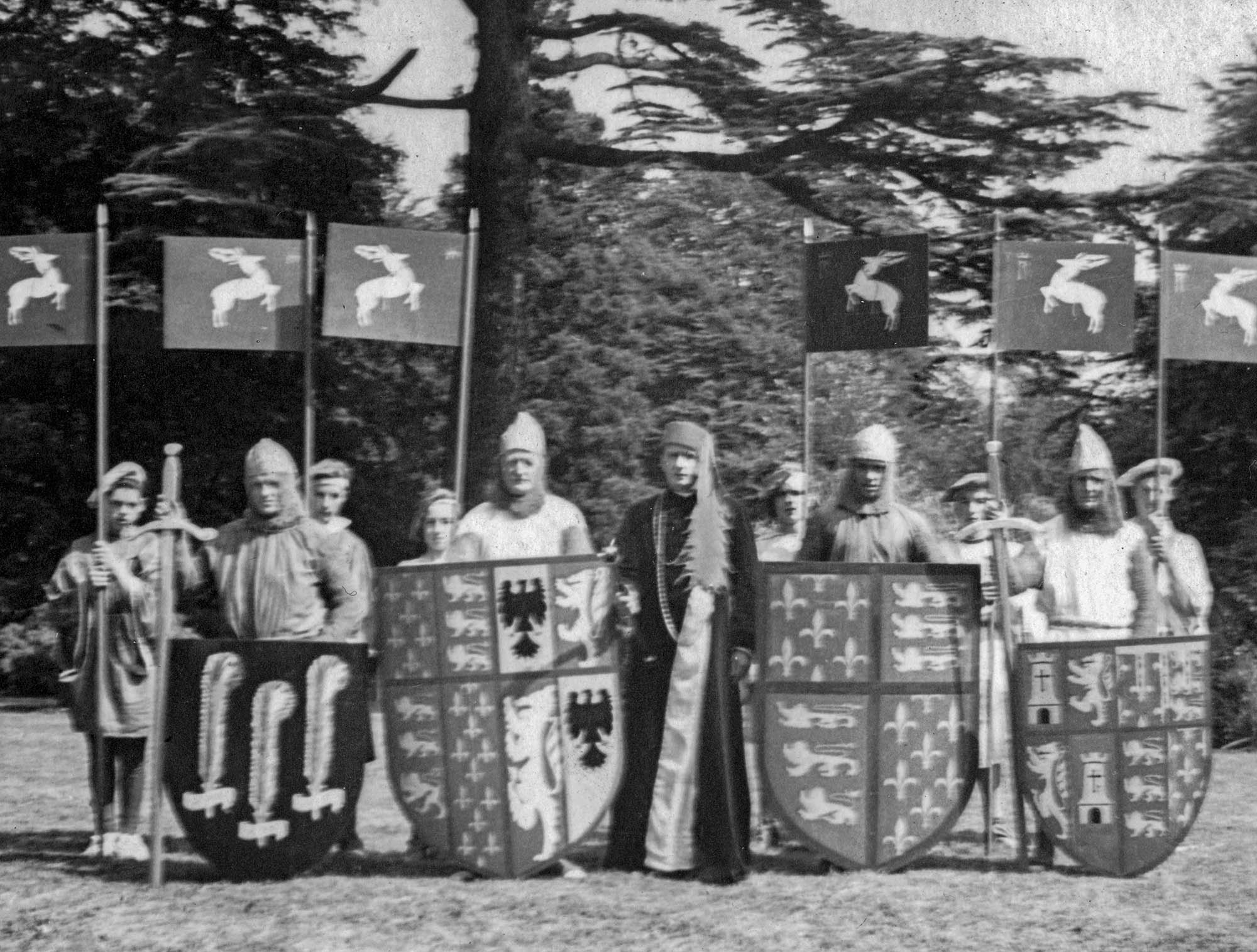
Episode 3: Bladon group: Knights and standard bearers.
(ref: POX0584197)
The nine episodes in the final programme, which were announced with by a mounted officer in Stuart period costume (Major F. G. Scott) and a fanfare, were:

Episode 6: Lady Sarah Churchill as Queen Elizabeth.
(ref: POX0584224)
The pageant was mostly in mime rather than spoken. Incidental music was provided by ‘the Oxford Players’, conducted by Mr J. J. Rolfe. The pageant ground was east of the palace in a tree-fringed area from which performers could appear. The seating for spectators was on a slope and the orchestra was located in a ditch which conveniently acted as an orchestra pit. There was one afternoon performance in bright sunshine, and two evening performances which included a torchlight procession and floodlighting.
The pageant was seen by a total audience of around 10,000 spectators, and the spectacle was widely reported as a success. The funds raised for the church and for the projected Woodstock Church of England senior school amounted to £300, worth around £20,000 today.
Performers of all ages took part in pageants and many retained memories and mementos of the events. These photograph albums provide a unique record of two remarkable pageants. There were many other historical pageants in Oxfordshire between the wars, which inspired local people to get involved in promoting their local history and in doing so, raised money for good causes.
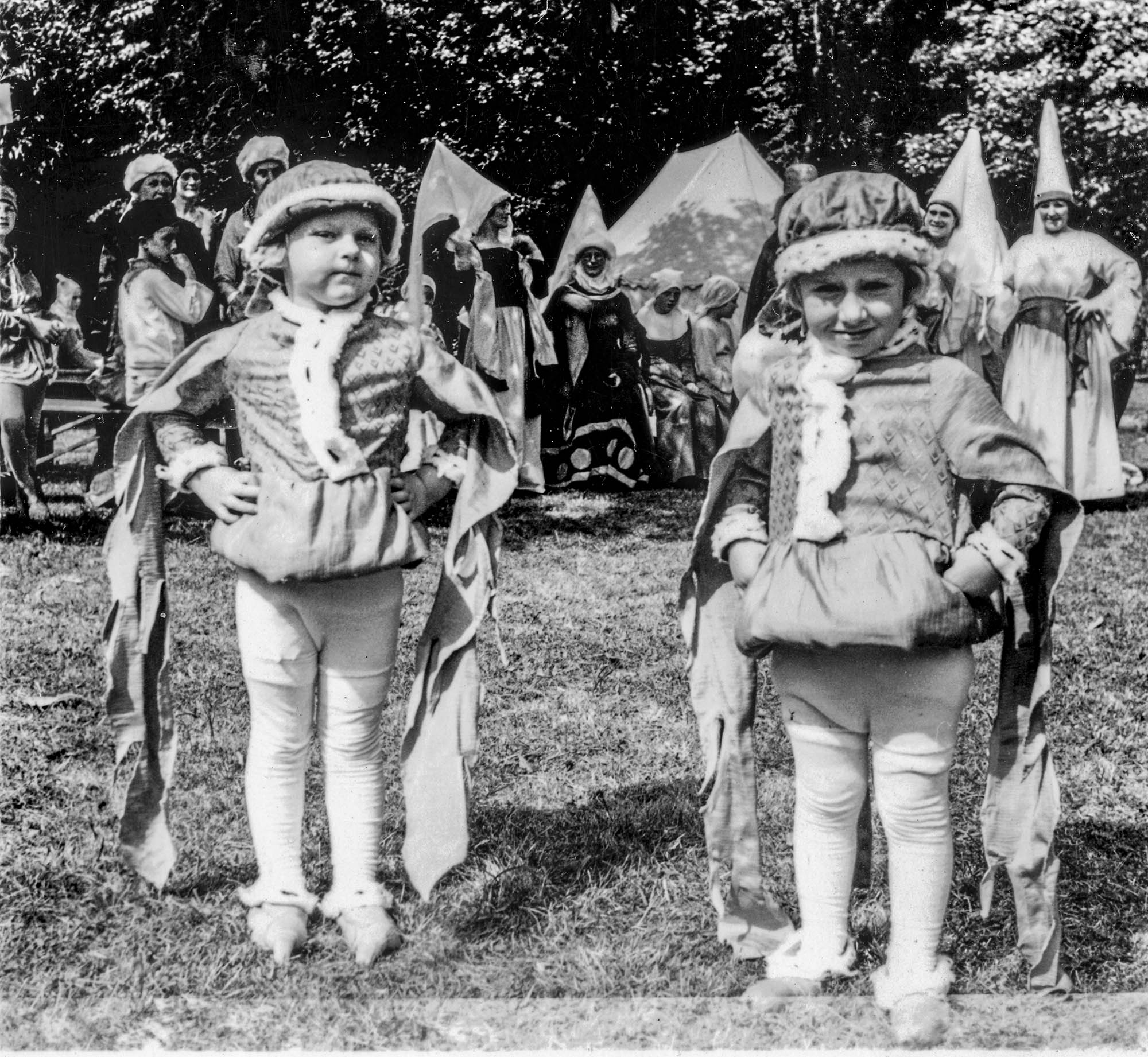
Episode 4: Hilary Bowley and friend.
(ref: POX0584219)
Posted by: Ellie Reid, Local Studies Librarian, Oxfordshire History Centre