PEOPLE buying newspapers expect to read the latest news and to hear what is expected to happen in the future.
But those writing it – the journalists – also need to know what has happened in the past.
That is where staff in the Oxford Mail and Times library came in, playing a vital role in the daily and weekly dissemination of news to readers.
Click or tap thumbnail to enlarge or view whole image
Newspaper House in New Inn Hall Street, Oxford. Former Oxford Liberal MP Frank Gray bought the premises, a former furniture warehouse, when he launched the Oxford Mail in 1928. He took over his former rival paper, The Oxford Times, in 1929. The building closed in 1972 when the newspapers moved to Osney Mead.
Housed in a small room at Newspaper House, first in New Inn Hall Street and later at Osney Mead, were thousands of cuttings which journalists could refer to, to ensure their stories were as accurate and comprehensive as possible.
There were also thousands of photographs from past events, which could be used to illustrate their stories.
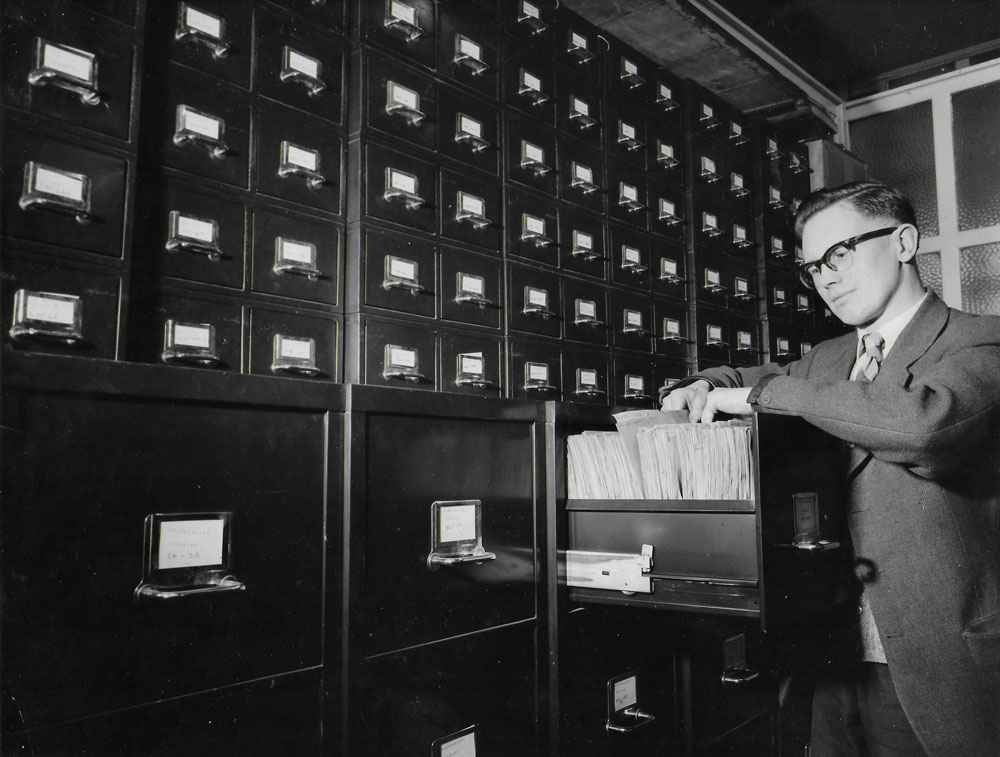
The cuttings and photographs were put into paper files, which were placed into cabinets in alphabetical order and easily traceable.
If a journalist needed previous stories of, say, Joe Bloggs, a council debate, a local company or an annual event, it would usually take just seconds to find.
The success of the operation was due to the skill and dedication of the library staff, led for more than 30 years by Yorkshireman Alec Russell.
Click or tap thumbnail to enlarge or view whole image
Oxford Mail librarian Alec Russell set up an elaborate filing system for stories and pictures to give journalists easy access to material they needed.
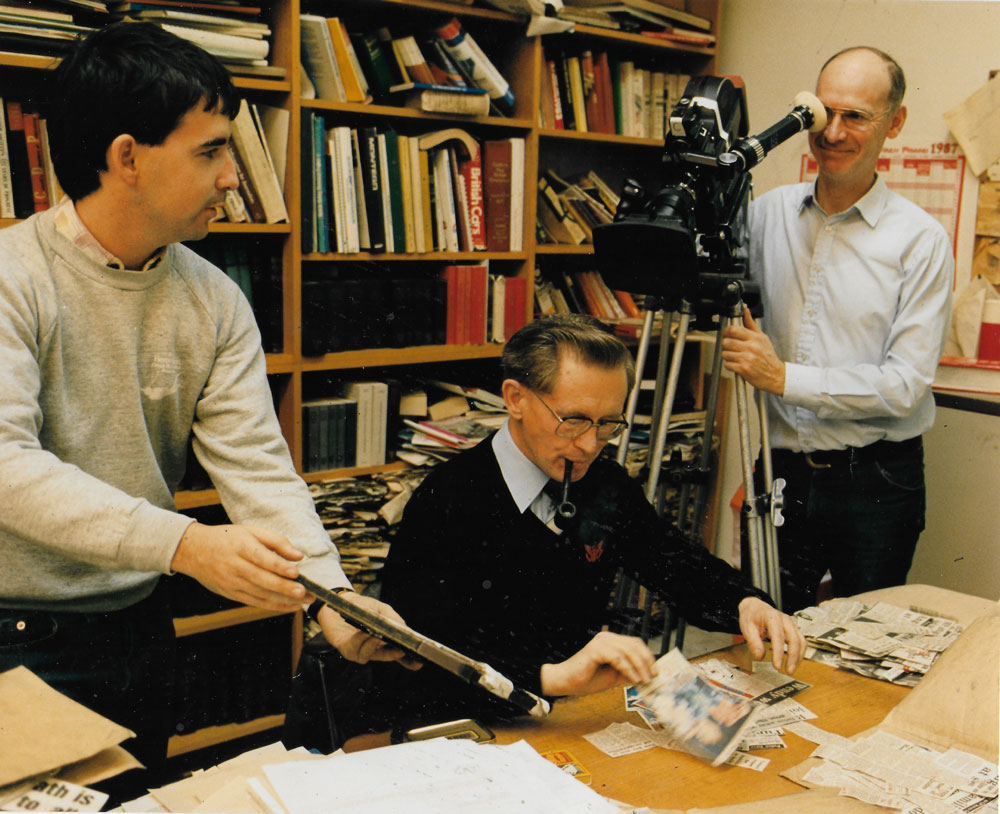
The work of Oxford Mail librarian Alec Russell featured in a TV programme in 1987. Smoking his trademark pipe, he is filmed sorting out some of the hundreds of newspaper cuttings he filed every day. Note the numerous reference books available to journalists in the background.
The library was a small part of a major company which, at one time, prepared, printed and sold 300,000 copies of newspapers every week. In addition to editorial and library personnel, there were staff handling advertising, printing and distribution at Newspaper House, as well as numerous newsagents and outlets in towns and villages selling the papers.
In such a busy office, few would have noticed the diligent work being done in a tiny office by the handful of library staff. They spent their working day cutting stories from newspaper pages, stamping them with the date and putting them and photographs in the appropriate files for future easy reference.
It wasn’t just stories from the Oxford Mail that were filed. They were also cut from its sister papers – The Oxford Times, the Oxford Star, the Abingdon, Wantage, Didcot and Wallingford Heralds, the Witney Gazette and Bicester Advertiser.
If local stories appeared in the national press, they would be cut and filed too.
Alec Russell had set up the library in 1954 at Newspaper House, on the corner of New Inn Hall Street and Shoe Lane in Oxford city centre (later the site of an Argos showroom).
He had started work in the library at the Yorkshire Evening News in Leeds and was appointed chief librarian there in 1951.
Before his arrival in Oxford, journalists had to scour previous editions of the paper to check what had been published before on a particular story – or hope that someone in the office could remember.
That could be a time-consuming exercise in an industry where deadlines are all important.
Once Alec Russell had settled in and set up his easy-to-follow filing systems, their work became quicker and simpler – and, more importantly, reduced the margin for errors.
He once said: “A newspaper library is no use unless any item in it can be found in under three minutes.”
He would spend his day, surrounded by metal filing cabinets and reference books, patiently cutting his way through the day’s newspapers, checking periodicals, handouts and pamphlets and storing away facts and figures that may one day be useful.
Woe betide any journalist who took out a file and didn’t return it!
The work he, his team and their successors have done has been much appreciated by generations of journalists, even those working for the papers today.
Setting up the library was a major task – but the job of moving everything to the newspapers’ new offices in Osney Mead in 1972 proved even greater.
The company was switching production from hot metal to more modern methods and needed larger premises. The operation was planned with military precision and went remarkably smoothly.
The library was moved over several days, but much of the other removal work had to be done in 36 hours after the Sports Mail, the Saturday evening sports paper, had been printed. Everything had to be ready for the Oxford Mail to be printed at the new premises on Monday morning.
During the weekend, a team of 10 men shifted 50 tons of material in 675 tea chests in two pantechnicons.
One of the removal men was missing on Saturday – it was his wedding day – but he left his bride on the Sunday to help with the move.
By Monday morning, the only item missing was the Uncle Charlie cartoon strip, which failed to make its usual appearance on Page 2 of the Mail.
Moving the newspaper library over several days also proved a mammoth task – estimates at the time suggested that 800 reference books, a million cuttings in 85,000 files and 200,000 photographs in 25,000 folders had been relocated.
There was an additional bonus for the library. Numerous files that had been borrowed by journalists and left buried in mountains of paper on their desks were returned to their proper place.
The move wasn’t all serious stuff, however – newspaper staff added a little fun to the operation.
Oxford Mail columnist Anthony Wood – real name, Don Chapman, the paper’s theatre critic – made the one-mile journey between the two offices by boat.
Notorious for having the untidiest desk in the office, he was pictured on a wet, blustery day sheltering under an umbrella on a punt, with his debris on board with him in a dustbin and cardboard boxes, setting off on the Thames from Folly Bridge.
Click or tap thumbnail to enlarge or view whole image
The move from Newspaper House in New Inn Hall Street to Newspaper House at Osney Mead. Oxford Mail columnist Anthony Wood (alias theatre critic Don Chapman) took his belongings by boat – an amusing aside to advertise the papers’ new home.
It was an amusing stunt, but it had a serious purpose – to tell readers that the Oxford Mail and its sister papers had moved to new premises and a new era was under way.
After the move to Osney Mead, the library continued in much the same way, but with more space to cut and file the increasing number of stories and pictures.
Pages in every edition back to the start in 1862 when The Oxford Times was launched were microfilmed and could be viewed, making it possible to check or include news items from the past.
Nostalgia became an important part of the newspapers’ armoury. Current news, of course, was always the priority, but older readers in particular welcomed the idea of including items from the past.
One of the most popular sections of the Oxford Mail, for example, is the weekly Memory Lane, which has been running since 1995.
It gave the library a new lease of life. An avalanche of stories and pictures was readily available for use, in addition to regular contributions from readers.
However, since the late 1990s, with the newspaper industry becoming more and more digital, the need for an everyday, manned library has become less important.
Journalists can now check previous stories or find photographs on their computers without the need to visit the library.
With everything online, library staff were reduced and eventually dispensed with as the need to take cuttings and file photographs became largely unnecessary.
With only a small proportion of the open-plan office at Newspaper House being used by journalists and advertising staff, the move to smaller premises in Osney Mead was inevitable.
This has led to the unmanned library being moved to a smaller office, with room for only the photographic section.
Thankfully, the Oxfordshire History Centre has taken a considerable number of the cuttings and other memorabilia, but much has sadly had to be destroyed. Alec Russell, who started it all and died at his home in Botley, aged 88, in 2015, must be turning in his grave!
But this is the modern era and we have to accept it.
Much as we ‘oldies’ might regret it, printed newspapers are no longer favoured by younger people – they want to read their news online – and the industry is not as wealthy and popular as it was in the old days.
But at least part of the Oxford Mail library is still functioning and providing pictures every week for Monday’s Memory Lane section, which I (John Chipperfield) have run for 25 years.
I owe a great debt to Alec Russell and his successors, particularly the last to hold the office, the excellent Chris McDowell, also from Botley, and their staff, who have provided me and many other journalists with such excellent support over the last 70 years.
Life as it was at Newspaper House in New Inn Hall Street
Click or tap thumbnail to enlarge or view whole image
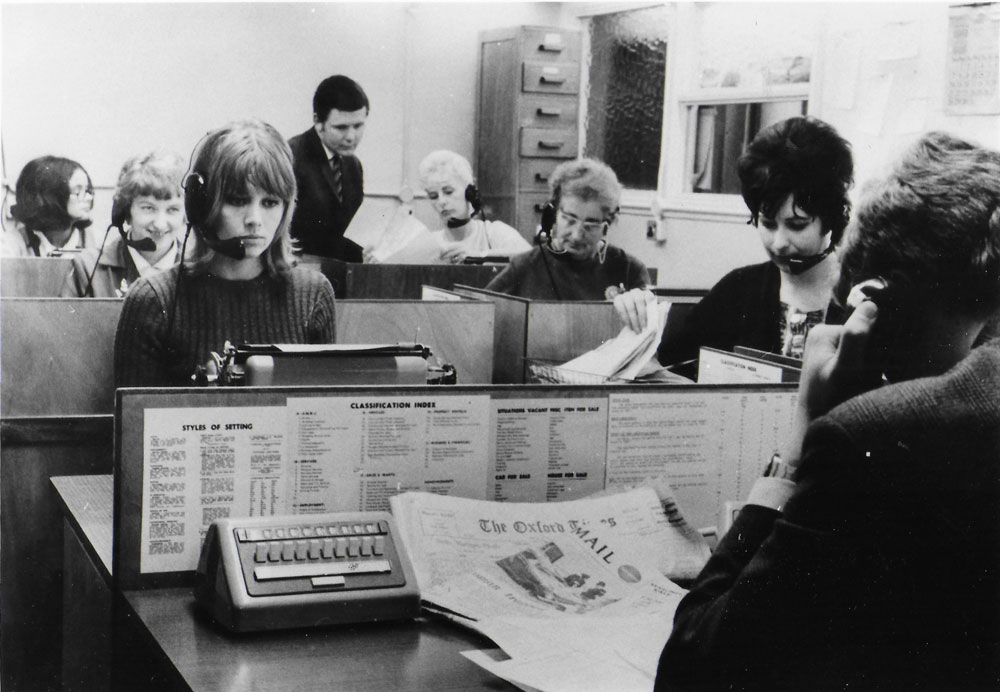
Advertising was, and is, a vital part of newspapers. Readers pay little for their newspapers, only part of the production costs. The rest is raised by attracting advertisers. Advertising staff are pictured with headsets typing the advertisements as they are dictated over the phone in the 1960s.
Newspapers rely not only on local news but national and international news. Before computers, this came via teleprinter. Reams of paper would contain stories from around Britain as well as around the world, via the Press Association and Reuters news agencies.
The reporters’ room at Newspaper House, the focal point for Oxford and district news gathering. Reporters were also based in county towns at Banbury, Witney, Bicester, Abingdon, Wantage, Didcot, Wallingford and Thame. Before the computer age, stories would be typed on paper, then dispatched to the sub-editors, who would tell the printers what type to use, write the headline and decide the story’s position in the paper and what pictures should accompany it. They would also correct any errors or bad spellings in the reporters’ work!
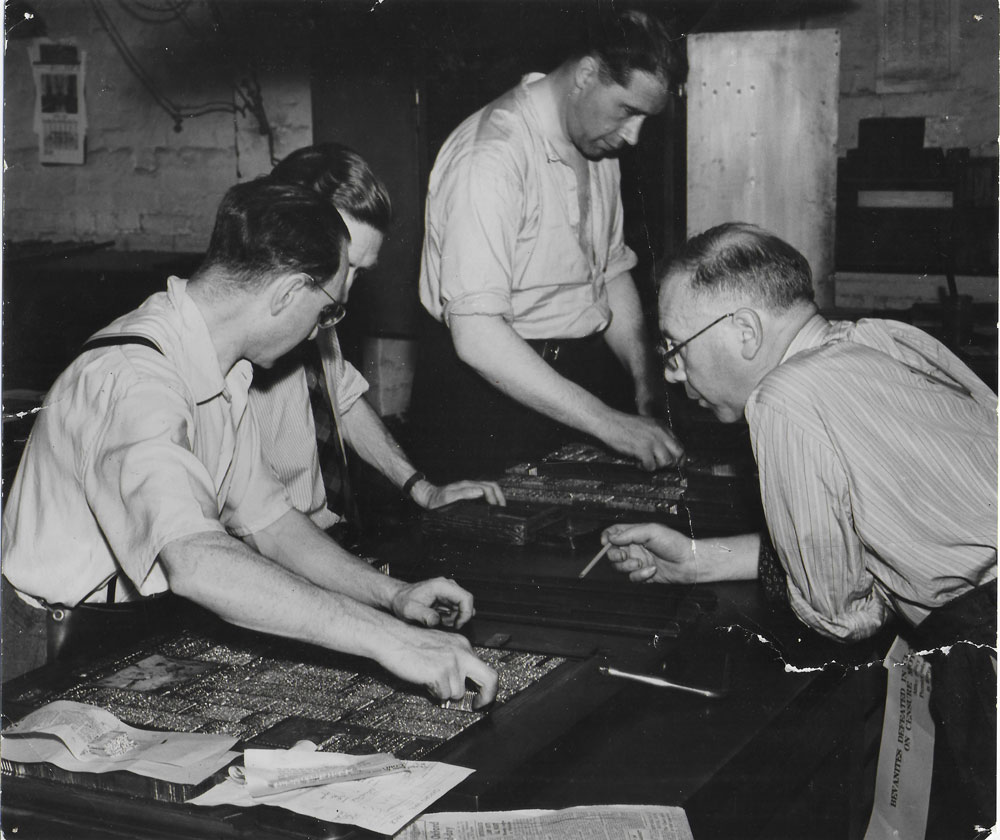
Compositors (or printers) set the journalists’ stories in metal lines of type on what was known as a linotype machine.
The lines of type would then be laid on a metal frame, following the layout provided by the sub-editors. To be printed the right way, the type had to be laid backwards. Journalists were often bemused and impressed by the layout specialists’ ability to read swiftly and correctly from right to left!
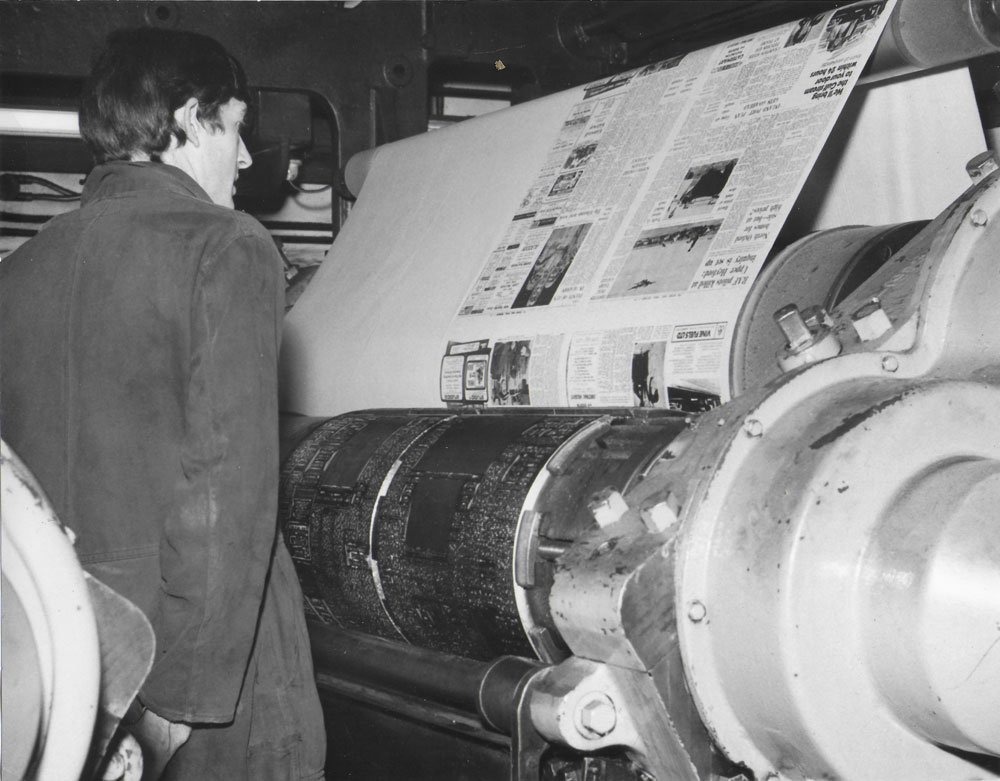
Once the page had been laid out, an image of it would be taken and transferred to a half-cylindrical metal plate, which would be attached to the printing press. A reel of paper would be attached and printing would begin in the machine room.
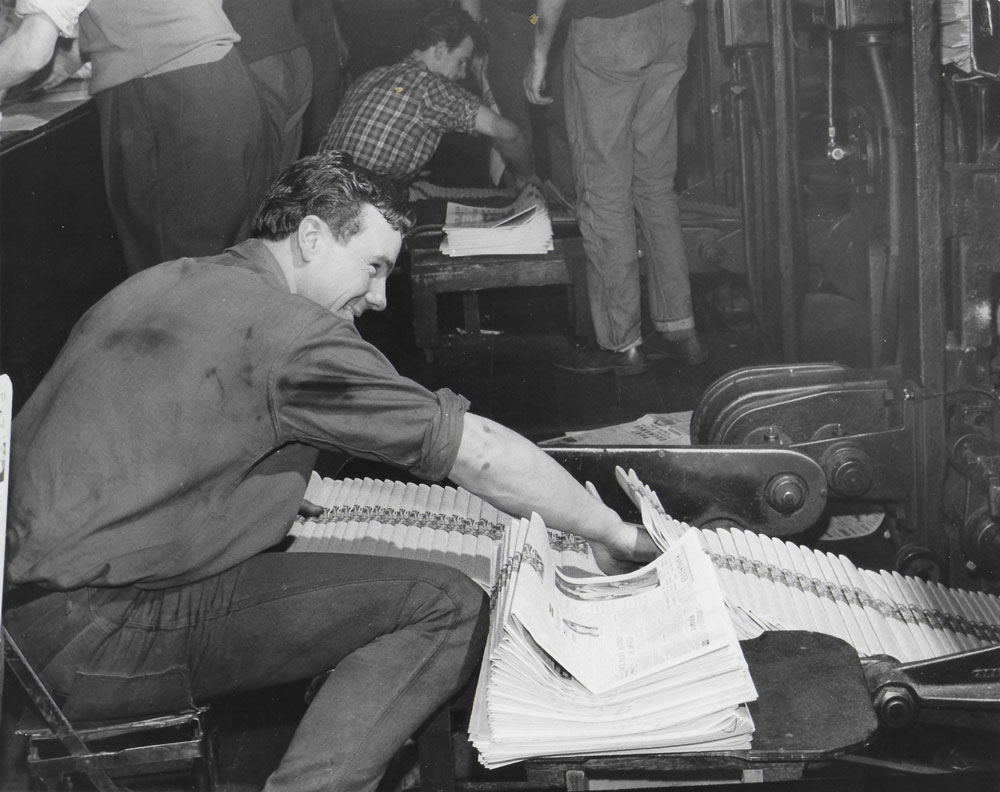
Once the printing press was under way, papers would pour off. Staff would have to be quick to stop them piling up! The Oxford Mail at one time had eight editions a day – the city received the 3rd edition at lunchtime, the 5th edition in mid-afternoon and the final and late finals in late afternoon. The other editions went to the Didcot and Banbury areas. The Oxford Times, Witney Gazette, Bicester Advertiser and the Herald series serving Abingdon, Didcot, Wallingford and Wantage areas were also printed there. Many sports fans will also remember the Saturday evening Sports Mail, known familiarly as the ‘Green Mail’ as it was printed on green paper.
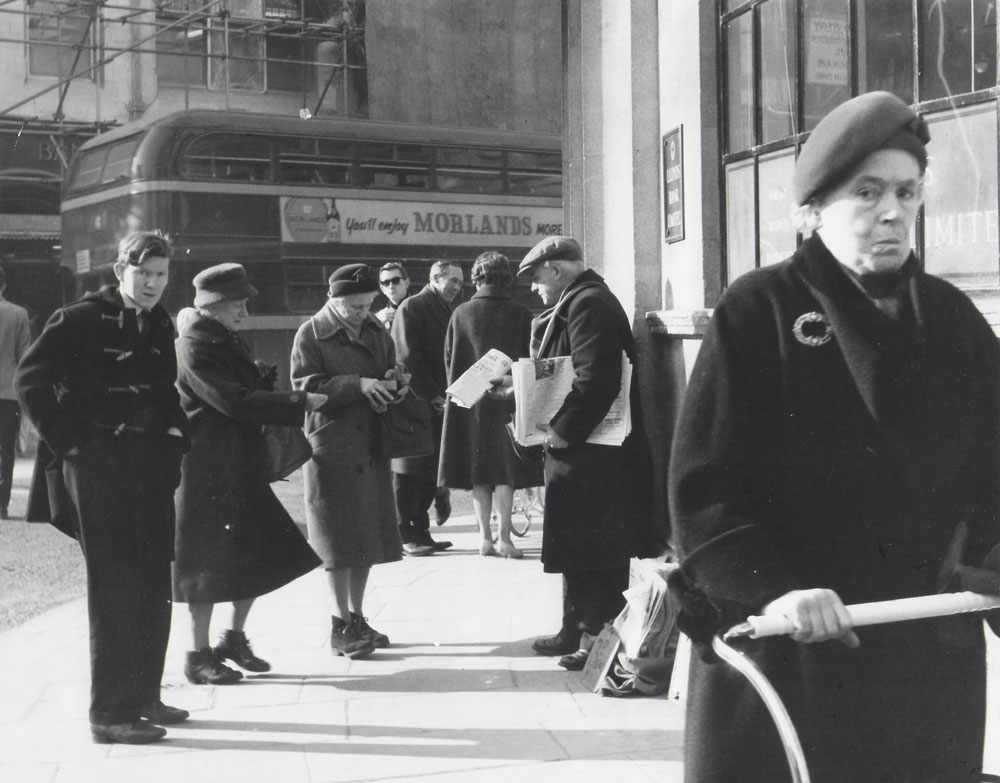
Preparing and printing the papers were important tasks, but selling them was even more vital. A team of street sellers would take their place at various points around the city, often shouting: “Don’t forget your Oxford Mail!”
The Oxford Mail produced a special Sunday edition to report on the death of Princess Diana in August 1997. More than 9,000 copies were sold. It was only the third time the paper had been printed on a Sunday – the first was on December 5, 1930 when the airship R101 crashed near Paris on its maiden flight to India and on September 3, 1939 announcing the start of the Second World War.
A loyal team of drivers in a fleet of vans made sure that the papers were delivered to newsagents and delivery agents in towns and villages as quickly as possible. Some papers were put on buses at Gloucester Green bus station and taken to some parts of the county.
Once the papers had arrived, a devoted team of delivery boys, girls and people of all ages would set off on their rounds to make sure readers got their copies on time.
Posted by: John Chipperfield, Memory Lane columnist, Oxford Mail