
Poster with returning officer's declaration of the 1874 election result for the Banbury Borough parliamentary seat
[Reference: SF Case A, barcode 308015237]
28 June 2024
Marek Lewandowski explores Oxfordshire History Centre's collections of general election ephemera
For images in this blog post, click or tap the thumbnail to enlarge or view the whole image
Poster with returning officer's declaration of the 1874 election result for the Banbury Borough parliamentary seat
[Reference: SF Case A, barcode 308015237]
Several centuries of general and local elections have produced a wealth of printed ephemera. From propagandist handbills to satirical verse, and from poll books to official notices, both Archive and Local Studies collections at Oxfordshire History Centre are rich in examples of surviving material. This blog post explores just one small part of our collections, focusing largely on material from the 1750s to 1880s.
Oxfordshire History Centre also holds a substantial collection of more modern election ephemera, up to and including the recent council elections of 2nd May 2024, and the forthcoming General Election on 4th July will undoubtedly generate more printed material, even in an age of digital social media:

General election ephemera for the Oxford West and Abingdon seat, June 1983
[Reference: SZ 324.2, barcode 306003740]
Using our online catalogue, Heritage Search, you can find relevant material listed under topical keywords like election or poll.
The first general election that we might recognise as such took place in 1661 with the Court Party under Edward Hyde emerging with a comfortable majority, 379 to 139 seats, over the opposition lead by Denzil Holles.

King Charles II, as he would have been dressed (in robes of state) for the opening of the Cavalier Parliament
The county was represented by the following men, in what would become to be known as the Cavalier Parliament source :
| Seat | Member source |
|---|---|
| Oxfordshire | Henry Cary, 4th Viscount Falkland and Sir Anthony Cope, 4th Baronet |
| Banbury | Sir John Holman, 1st Baronet |
| Oxford | Richard Croke and Brome Whorwood |
| Oxford University | Heneage Finch, 1st Earl of Nottingham and Laurence Hyde, 1st Earl of Rochester |
| Woodstock | Sir Thomas Spencer, 3rd Baronet and William Fleetwood |
England was still recovering from the Civil War that had pitted neighbour against neighbour, when, for the most part, Englishman slew fellow Englishman in bloody conflict, when a king had been beheaded outside the Banqueting House in Whitehall and the country had been through an interregnum led by Lord Protector Oliver Cromwell and subsequently, following his death in 1658 by his son Richard, the "Tumbledown Dick" and "Queen Dick" of history source. This was the age when Parliaments, when they did sit, had been given nicknames such as “Rump”, “Barebone’s” so called after the wonderfully named member, Praise-God Barebone, “Short”, “Long”, and sitting from June to August 1625 the “Useless” Parliament.
Now England was a monarchy again with Charles II occupying the throne of his executed father, and facing a Parliament with two distinct political groupings. The majority Court Party would become the Tory Party and eventually the Conservative Party, whereas the opposition, consisting mainly of Civil War Roundheads, eventually formed the Country Party, which became the Whig Party, and later the Liberal Party (now the Liberal-Democrats).
The origins of the names Tory and Whig are worth a brief diversion. Tory was an insult (derived from the Middle Irish word tóraidhe, modern Irish tóraí, meaning "outlaw", "robber", from the Irish word tóir, meaning "pursuit" since outlaws were "pursued men") that entered English politics during the Exclusion Bill crisis of 1678–1681. The party was founded in 1678 and dissolved in 1834 source.
Whig, on the other hand, began as a short form of whiggamore, a term originally used by people in the north of England to refer to (cattle) drovers from western Scotland who came to Leith to buy corn. The Scottish cattle drivers would call out "Chuig" or "Chuig an bothar" meaning "away" or "to the road" - this sounded to the English like "Whig", and they came to use the word "Whig" or "Whiggamore" derisively to refer to these people. The Whig party was likewise founded in 1678 and dissolved in 1859 source. Although “Tory” remains in common political usage today, “Whig” has disappeared into the dusty pages of history. Political power in England, and after the Act of Union with Scotland in 1707, in Britain, would oscillate between these two until the rise of the Labour Party from 1900 onwards to become the ‘other’ party in British politics and British politics itself akin to the three-body problem in classical mechanics.
Oxfordshire History Centre's political ephemera collections date from the 18th century, the earliest being a an Oxford University poll book of 1721 and a Berkshire county poll book of 1727.
A later Oxford University poll book for 1750 - “A True Copy of the Poll taken at Oxford January 31, 1750, with several Papers sent to the Common Rooms of the respective Colleges, relating to the Election of a Member of Parliament for the University” [reference: SV OXFU/13, barcode 606224118] - reflects a by-election caused by the elevation to the peerage of Henry Hyde, Viscount Cornbury.
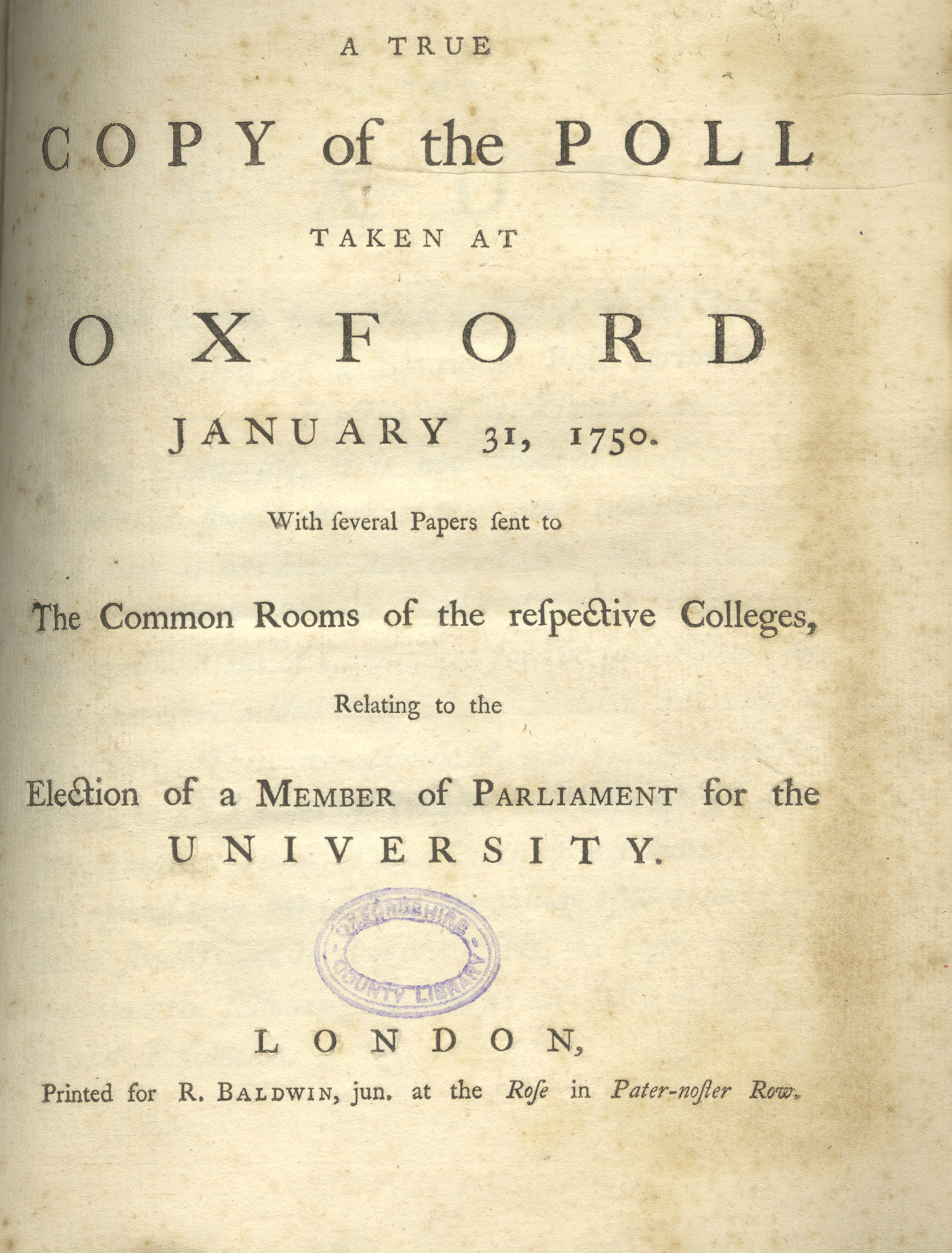
Title page from Oxford University poll book, 1750
Hyde had been elected unopposed in the election of 1734, and was re-elected, again unopposed, in 1747, but became disillusioned with the House of Commons having taken a one year leave of absence for the sake of his health. In 1750 he applied to George II for a peerage, and he was elevated to the House of Lords by a writ in acceleration in his father's title of Baron Hyde source. The result of the by-election was as follows source – all three candidates were Tories:
| Sir Roger Newdigate | 184 votes |
| Robert Harley | 126 votes |
| Sir Edward Turner | 67 votes |
Returning two Members to Parliament, the constituency of Oxford University was created by royal charter of James I, along with that of Cambridge University, in 1603 source. Its electorate was not restricted to any geographic area but consisted of graduates of the University, before 1918 restricted to male graduates with a Doctorate or MA degree. Its first members were Sir Thomas Crompton and Sir Daniel Donne (or Dun); its last James Arthur Salter, 1st Baron Salter, who had served as Mayor of Oxford in 1908, and humourist, novelist, playwright, and social reformer Sir Alan Patrick Herbert. University constituencies were abolished in 1950 by the passing of the Representation of the People Act, 1948, or to give it its long title “An Act to amend the law relating to parliamentary and local government elections and to corrupt and illegal practices, and for purposes connected therewith source.”
The title of this item “A True Copy of the Poll…” introduces us to a whole class of election ephemera held by the Oxfordshire History Centre – poll books. Going back to the 1700s, and therefore predating Census returns, poll books were like present day electoral lists, but with some important differences. In addition to the name and address of the voter they may also include details as to their occupation their qualification to be on the electoral roll, if they voted, and if they did, who they voted for, which was all put out in the public domain.
The page reproduced below is taken from “The Poll of the Freeholders of Oxfordshire taken at Oxford on the 17th, 18th, 19th, 20th, 22nd and 23rd of April 1754”. The four columns on the right of the page indicate who that elector voted for.
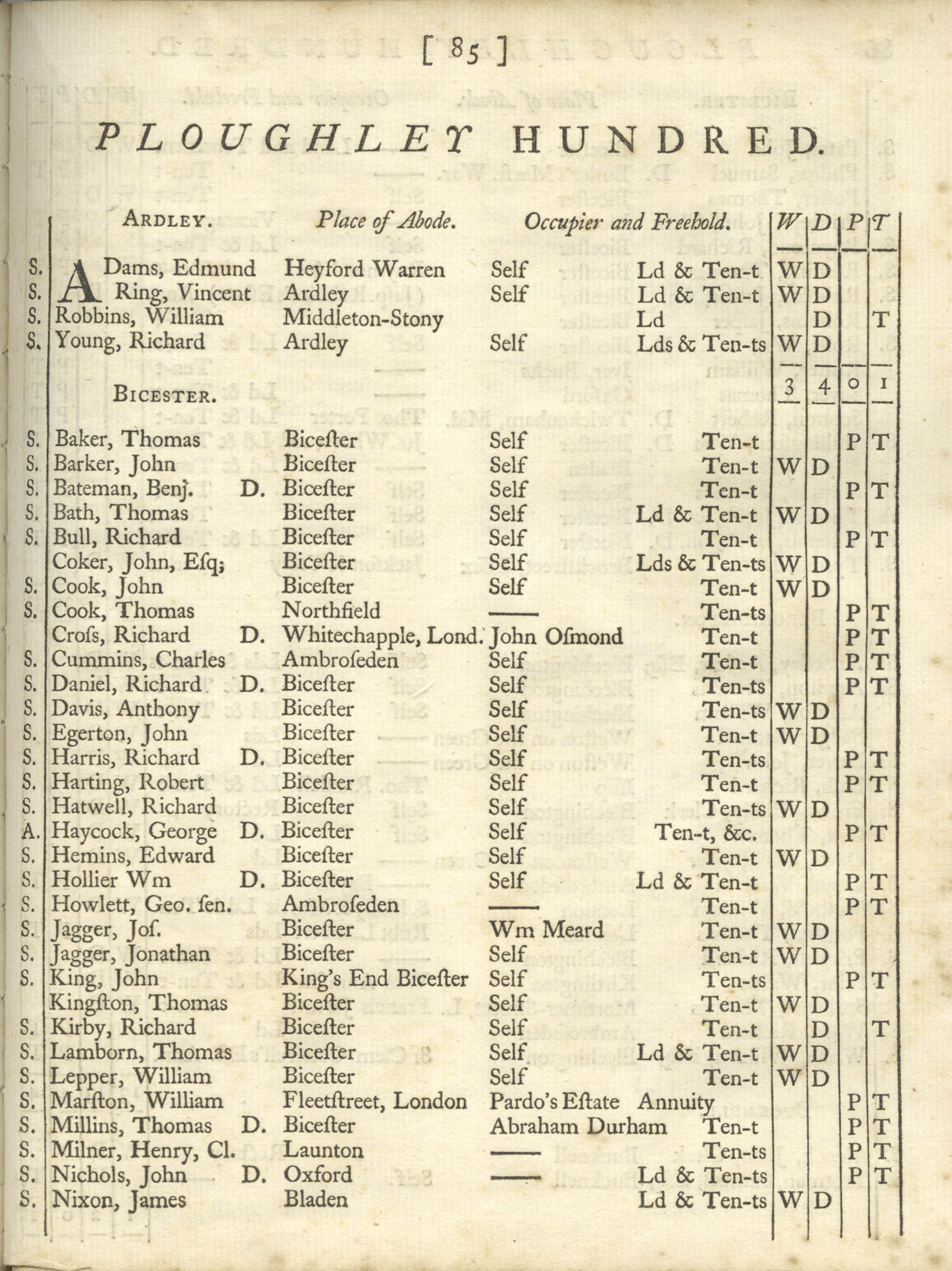
Extract from the Oxfordshire county poll book, 1754
The four candidates along with the votes each received were:
| Philip Wenman, 6th Viscount Wenman | 2,033 votes |
| Sir James Dashwood, 2nd Baronet | 2,014 votes |
| Thomas Parker, 3rd Earl of Macclesfield | 1,919 votes |
| Sir Edward Turner, 2nd Baronet | 1,890 votes |
The first two were Tories, the second two were Whigs source. The electoral roll – only four names in Ardley – was limited to forty Shilling freeholders; those who had the parliamentary franchise to vote by virtue of possessing freehold property, or lands held directly of the king, of an annual rent of at least forty shillings (i.e. £2 or 3 marks), clear of all charges. Forty Shilling freeholders dated back to statutes passed in 1430 and 1432 during the reign of Henry VI source. Under these Acts, all owners of freehold property or land with an annual value of least forty shillings in a particular county were entitled to vote in that county. In other words, Parliament was elected by a minority of a minority.
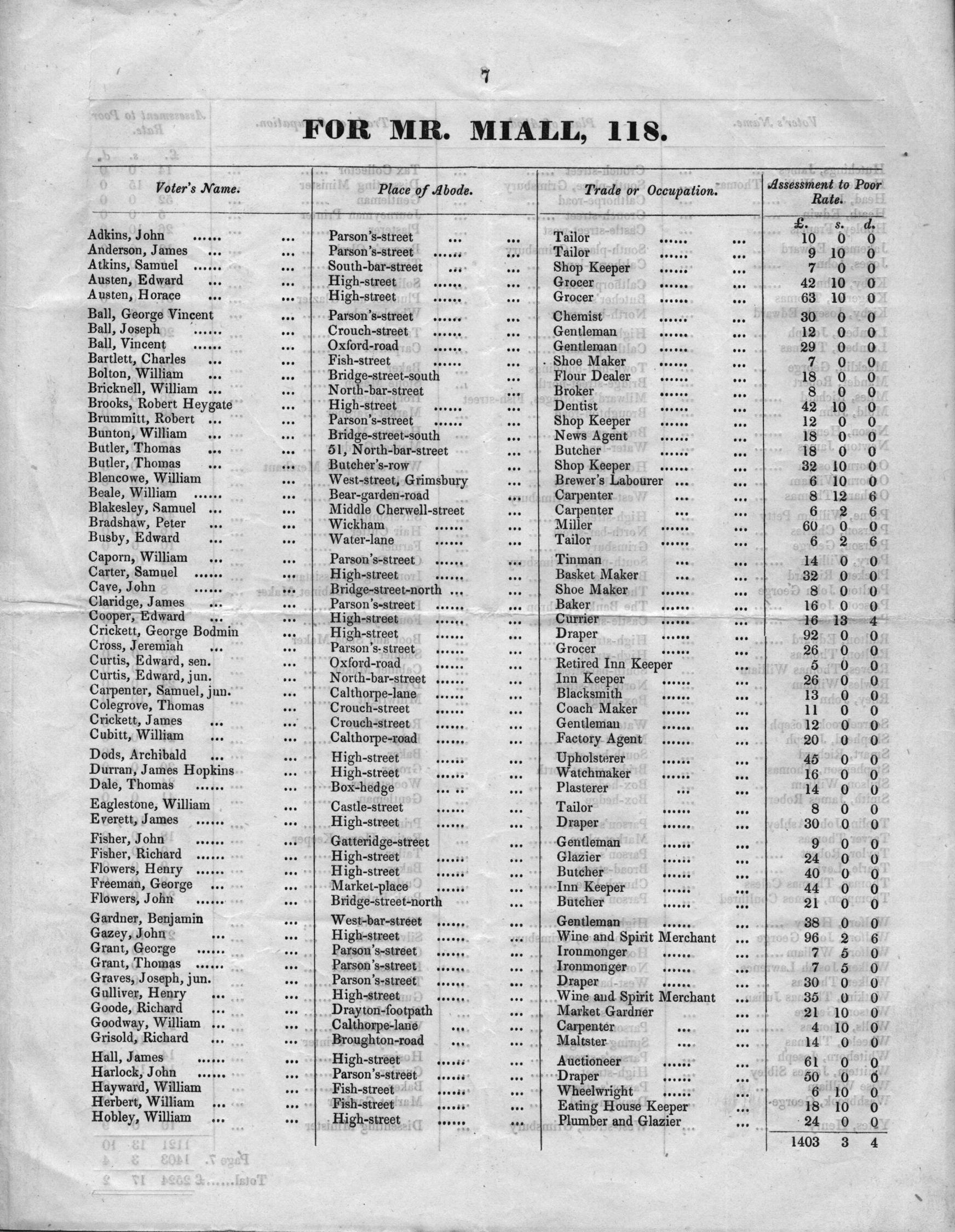
Banbury poll book - voters for Mr Miall, who split the Liberal vote in the 1859 election, almost allowing the Tory candidate Mr Hardy to win, but Liberal candidate Bernhard Samuelson was finally victorious by a single vote.
The British electorate would have to wait for more than 170 years before anything approaching universal suffrage was achieved and women were given the same voting rights as men. Oxfordshire History Centre's collection of Banbury Borough poll books are listed at BOR2/6/A4 and at P136/X/1. The Eureka Partnership's The People of … series can also carry useful details about these early electors.
At this time election was via the ‘hustings system’. The candidates would deliver speeches, sometimes at several places in the constituency, and then there would be a show of hands. Not very precise, as no official record was kept of the number of votes for each candidate. The Reform Act, 1832 required that a separate husting be held for every 600 electors. It also extended the franchise from 5% to 7% of the population source. It was estimated that there were between 200,000 and 400,000 electors in the country as a whole in 1831 source.
The poll books were an improvement in the transparency and accountability of electoral proceedings. They listed who the electors were, how many electors had voted, or not voted, and who they had voted for, but having this information did leave the electors open to bribery and intimidation by the more powerful people in the constituency. This can be seen in the results of the 5th of January 1835 election for the Borough of Banbury, the contest being between Henry William Tancred Esq. (Whig) and Edward Lloyd Williams Esq. (Tory). In a sixteen-page booklet issued after the election, cover right, are given not only the result, but who voted for each candidate, who did not vote, and the street in Banbury or Neithrop where they lived. Henry Tancred polled 157 votes in Banbury, 39 in Neithrop and 7 in the hamlets, total 203. Edward Williams polled 30 votes in Banbury and 13 in Neithrop and the hamlets, total 43, giving the former a majority of 160. 120 electors did not vote: giving a total of 366 electors and a turnout of just 67.21%.

Title page of Banbury poll book, 1835
Low turnouts at elections are not a modern phenomenon, although there was the mitigating factor that the election was at the start of January. In 1831 the population of Banbury was 5,906 source. This also led to ‘pocket’ or ‘rotten’ boroughs with small electorates where the landowner effectively controlled the vote. An example of this can be seen in the “Dish and Dishonesty” episode of the satirical TV comedy, Blackadder the Third, when Sodoff Baldrick is elected to the rotten borough of Dunny-on-the-Wold by 16,472 votes to nil, despite there only being one elector in the constituency – Edmund Blackadder himself source!
The secret ballot as we have it today had to wait until the passing of “An Act to amend the Law relating to Procedure at Parliamentary and Municipal Elections”, or, as it was more commonly known, the Ballot Act, in 1872.
Section 2 of the Ballot Act reads as follows: “In the case of a poll at an election the votes shall be given by ballot. The ballot of each voter shall consist of a paper (in this Act called a ballot paper) showing the names and description of the candidates. Each Ballot paper shall have a number printed on the back, and shall have attached a counterfoil with the same number printed on its face. At the time of voting the ballot paper shall be marked on both sides with an official mark, and delivered to the voter within the polling station, and the number of such voter shall be marked on the counterfoil, and the voter having secretly marked his vote on the paper, and folded it up so as to conceal his vote, shall place it in a closed box in the presence of the officer presiding at the polling station (in this Act called “the presiding officer”) after having shown to him the official mark at the back.”
Any ballot paper which has not on its back the official mark, or on which votes are given to more candidates than the voter is entitled to vote for, or on which anything, except the said number on the back, is written or marked by which the voter can be identified, shall be void and not counted source.
With the exception of the recently introduced photographic ID requirement to be allowed to vote, the procedure of 1872 remains unchanged today.
Just in case the new voting procedure was still alien to the voters in the Mid-Oxfordshire (Woodstock) constituency on voting day on 2nd of December 1885, both of the candidates standing, in their campaigns reminded the electorate not only how to vote, but who to vote for - Francis William Maclean (Liberal) or Arthur Annesley, Viscount Valentia (Conservative):

1885 election: instruction for voters' in the Mid-Oxfordshire seat, encouraging a vote for Viscount Valentia (Conservative)

1885 election: instruction for voters in the Mid-Oxfordshire seat, encouraging a vote for William Maclean (Liberal)
Both are postcard sized serving as an aide-mémoire as to who to vote for. In addition to these, and no doubt amidst other election communications, the candidates, or their agents, sent out personally addressed printed copies of speeches that they had made. With a small electorate of just over 10,000 this was still logistically and financially possible.
Oxfordshire History Centre, in transparent political neutrality, holds one from either side of the political balance – from Francis William Maclean to the Rev A. Clarke at Lincoln College in Oxford, and from Arthur Annesley to Mr G.J. Dew, of Freehold Street, Lower Heyford – below:

Election correspondence from William Maclean (Liberal), 1885

Election correspondence from Viscount Valentia (Conservative), 1885
The result was as follows, part of an overall win for the Liberals under William Gladstone who returned to Parliament with 319 seats, 22 fewer than in the previous Parliament, the result of a negative 7.0% swing and with fifteen seats short of an overall majority in the House of Commons source.
| Candidate | Votes | Percentage | Percentage change |
|---|---|---|---|
| Francis William Maclean | 4,327 | 51.1 | +4.2 |
| Arthur Annesley, Viscount Valentia | 4,138 | 48.9 | -4.2 |
| Majority | 189 | 2.2 | |
| Turnout | 8,465 | 84.5 | -6.4 |
| Registered electors | 10,012 | ||
| Swing | +4.2 | source |
William Gladstone’s minority government lasted until July 1886 when another General Election returned Robert Arthur Talbot Gascoyne-Cecil, 3rd Marquess of Salisbury’s Conservatives to power source. Francis William Maclean stood again in the same constituency and was re-elected unopposed. He resigned his seat in 1891 and until 1896 was a Master in Lunacy source. This, apparently, was a genuine position, ranked after a Master in Chancery in the order of precedence, and was part of the Lunacy Commission which had been set up in response to the Lunacy Act 1845 to oversee asylums and the care of the mentally ill in England and Wales source. Having only one candidate to vote for was not uncommon in this part of Oxfordshire.
Between 1840 and 1859, at ten separate elections, there was only one candidate’s name on the ballot paper, and on each occasion, he was a Conservative source. Nor were the electors of Woodstock the only ones being told how to vote and who to vote for. In the same election the supporters of Sir Bernhard Samuelson, 1st Baronet (Liberal) issued a similar piece of election ephemera for his bid for the Banbury constituency; again, addressed to the elector in person [reference: SF Case Y, barcode 308015245]. Sir Bernhard Samuelson was successful:

1885 election: instruction for voters in the North Oxfordshire seat, encouraging a vote for Sir Bernhard Samuelson (Liberal)
Having not seen a contested election for 44 years, the Oxfordshire election of 1754 has been described as "probably the most notorious county election of the [18th] century, and no expense or chicanery was spared by either side "
A bitterly fought and corrupt contest, the 1754 election was the inspiration for William Hogarth’s quartet of satirical paintings, “Humours of an Election.” One of these four views, The Polling (1755), shows voters declaring their support for the Whigs (orange flags) or Tories (blue flags), with agents from both parties employing unscrupulous tactics to increase their votes or challenge the other side – for example, a Whig voter with a hook to replace his amputated hand is being challenged because he is placing his hook, rather than his hand (as legally prescribed) on the book as he swears to his voter identity:

William Hogarth, The Polling, 1755
from The Humours of an election series
[Reference: Wikipedia]

William Hogarth, The Polling, 1755
(a reversed engraved print, derived from Hogarth's original painting) - this extract shows the Whig voter, with a hook for his right hand, being challenged.
The 1754 election’s notoriety has echoed across the centuries and was the subject of a 1970 publication for schools, The Oxfordshire Election of 1754, that was An Archive Teaching-Unit Prepared by a Joint Party set up by the Oxfordshire County Record Office and the Oxfordshire Education Committee. Compiled by Miss Gwendoline H. Dannatt, a history teacher at Bicester Grammar School, it is a mine of information on the whole sordid affair. Dannatt's collection of related research material is catalogued at SZ 324.2 - barcode 306003600.

Oxfordshire Election of 1754 - Archive Teaching Unit (1970) - title page and contents
[Reference: SZ 324.2 - barcode 306003586]
Oxfordshire’s earliest county newspaper, Jackson’s Oxford Journal, has its origins in 1753 when its editor, William Jackson, saw the opportunity to advance his publishing career during the long prelude to the Oxfordshire county election of 1754.
Jackson, although overtly Tory in his outlook, aimed to produce a newssheet which would present both points of view, tagging his publication with the strapline, “By an Impartial Hand.”
The first issue, a satirical paper entitled, News, Boys, News! or the Electioneering Journal, promoting the Whig interest (and mocking the Tory or “Old” interest), appeared on Wednesday 11th of April 1753:
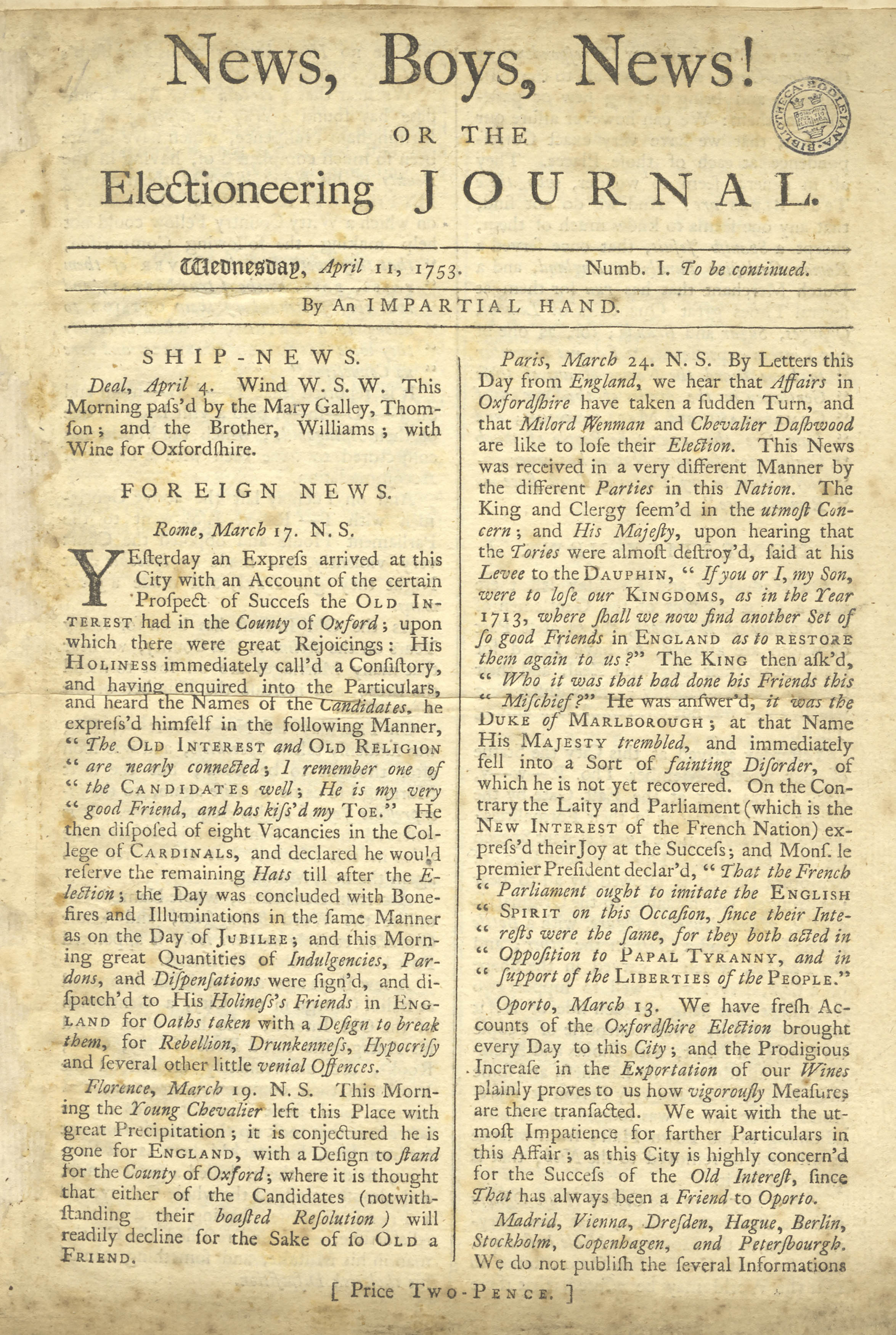
William Jackson's satirical newssheet, 11 Apr 1753,
News, boys, news! - front page - Whig version
[Reference: SZ 324.2 - barcode 306003591]
It was succeeded a fortnight later by: News, boys, news! Or, the electioneering journal with improvements, promoting the Tory interest. The genuine newspaper, Jackson’s Oxford Journal, continued to be published from 5 May 1753. The newssheet is one of the earliest items of election ephemera in Oxfordshire History Centre collections.
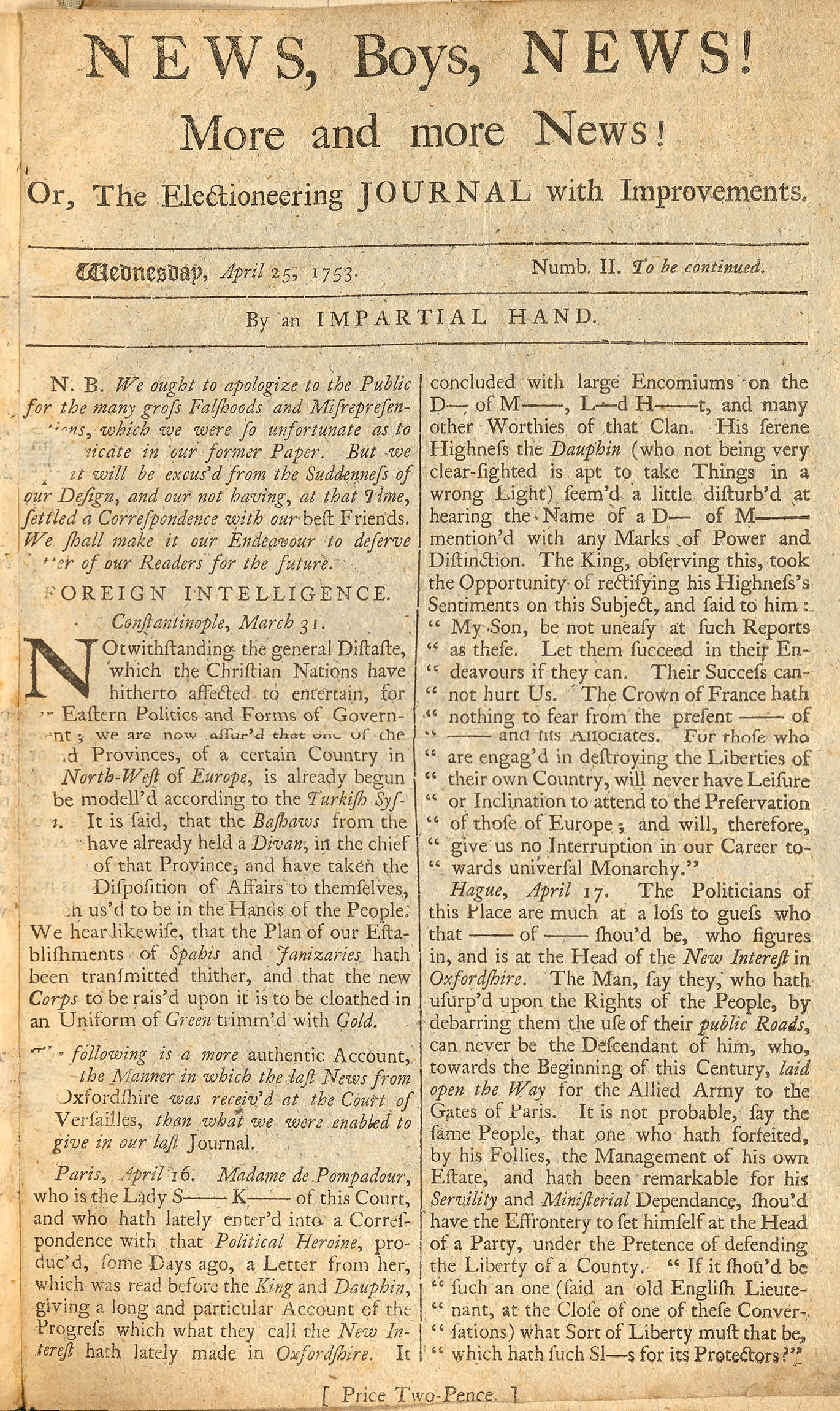
William Jackson's satirical newssheet, 25 Apr 1753,
News, boys, news! - front page - Tory version
[Reference: SZ 324.2 - barcode 306003591]
The complete text of News, boys news: the electioneering journal, issues I-II, 11-25 April 1753 is available to download here (pdf file, 2.65Mb
Other items covering nineteenth century elections reflect, as mentioned above, the long and sometimes arduous road towards the modern model of democracy great strides towards reaching were made by the passing of the various reforming Acts of Parliament in that century and the overdue enfranchisement of women in the first half of the twentieth. In the days when the only way of getting your message across was ink on paper you had to be quite creative and inventive as to how you used that ink, as the following examples will perhaps illustrate.
The 1826 election in Oxfordshire was unusual in one respect. With the exception of 1754, when there was a sudden outbreak of ‘democracy’, all of the members of parliament had been elected unopposed since at least 1715 with the balance of power swinging between the Tories, the Whigs and Nonpartisan members. At the time the county, then a single constituency, returned two members to the House of Commons. Now, for the first time in over one hundred years, there would be a real contest; a three-way fight between: William Henry Ashurst and John Fane, both Tories, and George Frederick Stratton, the lone Whig.
George Stratton’s team put out Oxfordshire Yeoman’s Catechism in two parts, reproduced below, extoling the qualities of their candidate whilst criticising William Ashurst. John Fane appears not to have been in their sights for some reason. Perhaps William Ashurst was seen as the greater threat or the easier target.
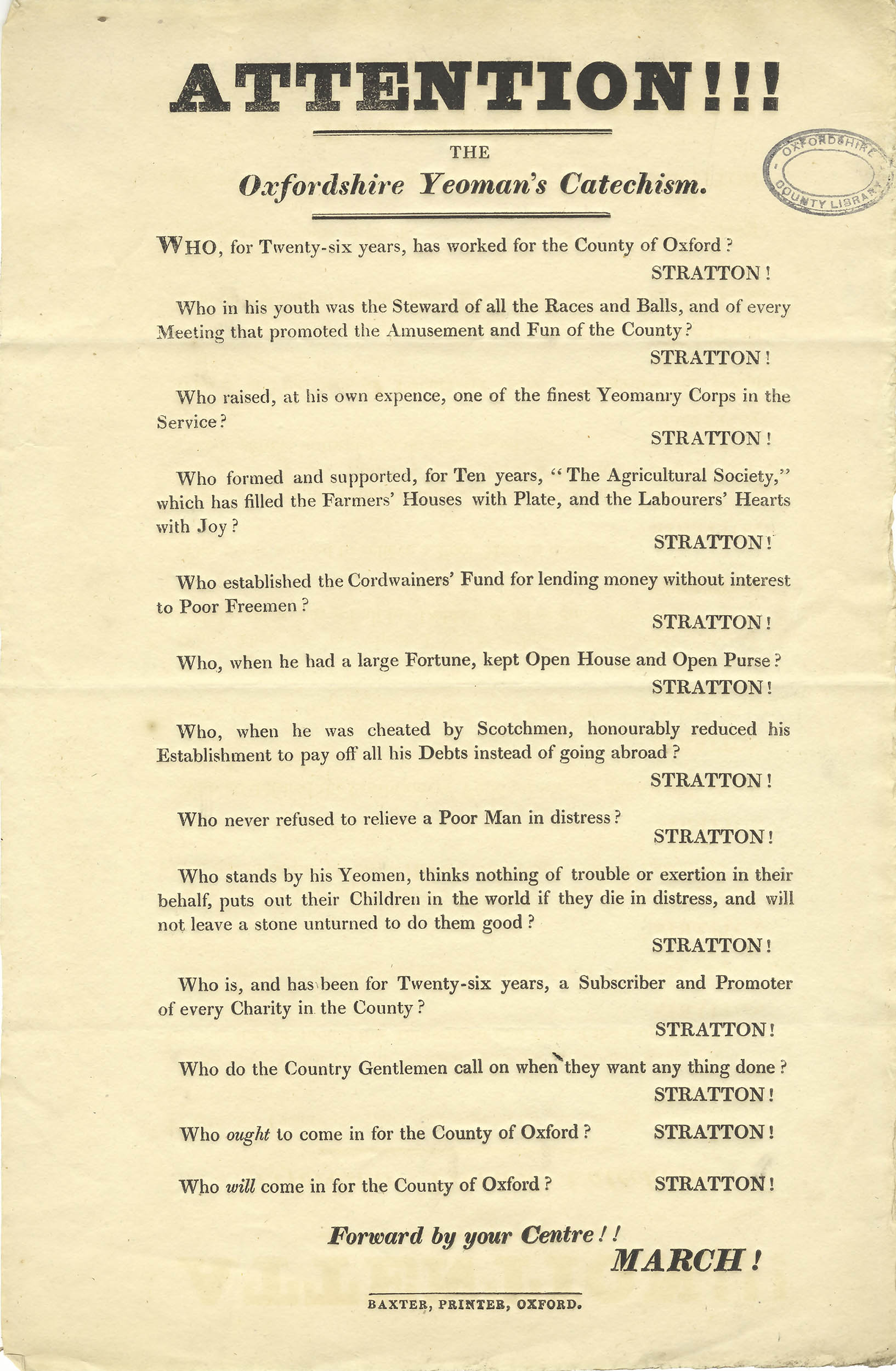
1826 Oxfordshire county election propaganda (Whig): Oxfordshire Yeoman’s Catechism, part 1

1826 Oxfordshire county election propaganda (Whig): Oxfordshire Yeoman’s Catechism, part 2
The ‘Catechism’ did not do enough to overturn the result. William Ashurst received 1,329 votes, John Fane 1,268, and George Stratton 1,058. It is also interesting to note that there were just 3,655 electors in Oxfordshire at the time of the 1826 election; just 2,295 voted source. This win helped Robert Banks Jenkinson, 2nd Earl of Liverpool to a comfortable majority over Henry Petty-Fitzmaurice, 3rd Marquess of Lansdowne, by 426 seats to 198 in the House of Commons source.
By the time of the 1831 election the pendulum had swung back the other way in Oxfordshire politics. Once again there were three candidates: George Granville Harcourt, Richard Weyland, both Whigs, and Montagu Bertie, 6th Earl of Abingdon, Lord Norreys, the lone Tory. If the collection of ephemera is used as a yardstick, then reform of the rotten boroughs, mentioned above, was on the minds of the Whig candidates:

1831 Oxfordshire county election propaganda handbill (Whig): How to treat the boroughmongers and their candidates
There are indications that the campaign got quite nasty and personal in some quarters prompting an ‘policies not personalities’ response dated 6th May 1831:
Mr Harcourt’s committee disclaim all knowledge of the writers or authors of scurrilous publications in the present contest, and give no countenance to personal attacks.
This may have been prompted by a printed notice that appeared in Banbury on the 27th of April. Addressed directly to Lord Norreys, and anonymously signed “A. Freeholder” its text read, italics as in the original:
We remember your speeches and promises at our last Election. You have deceived us. Whether your conduct is to be attributed to your head or your heart, we know not. We will not attribute it to your heart. You boast of your independence – all well and good. – But an independent blockhead will not do for the Country.
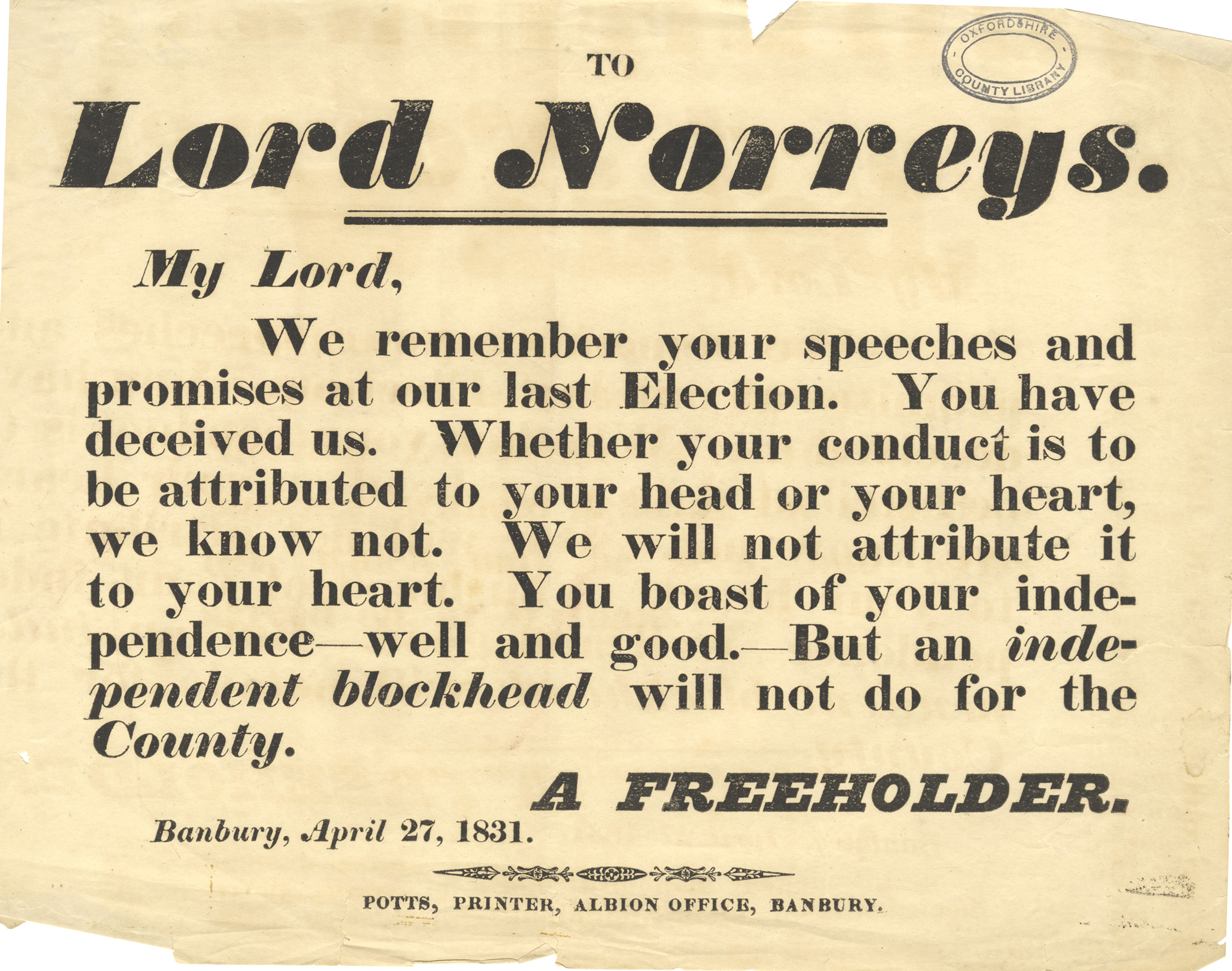
1831 Oxfordshire county election propaganda handbill (unattributed, but attacking Tory candidate, Lord Norreys): A. Freeholder
Then, as now, local issues sometimes occupied the minds of the electorate. On this occasion it was the Eynsham or Swinford Toll Bridge - photographed by Henry Taunt in the 1880s (below) – and one of the candidates had a direct family connection to the bridge.

Henry Taunt, Eynsham Bridge (Swinford Toll Bridge), 1880s
[Reference: POX0115458]
Before the bridge there was a ford across the Thames at this point – is “Swine (from the Old English “swin”) Ford” too simple an explanation? So, the Story goes, George III got wet crossing the Thames at this point, and in 1766 Parliament passed “An Act for building a Bridge cross the River Thames, from Swinford, in the County of Berks, to Eynsham, in the County of Oxford”. A part of the Act gave the owner the power to charge tolls for the use of the bridge, but not to pay tax on the income earned. Three years later the bridge, built of local limestone in the Georgian style, was opened, its construction having been funded by Willoughby Bertie, 4th Earl of Abingdon source; Montague Bertie, fighting the election, was the 6th Earl.
Penned by someone who signs themselves “One who has paid the Ensham Bridge Turnpike for more than 50 years”, the following piece of doggerel verse entered the election campaign:
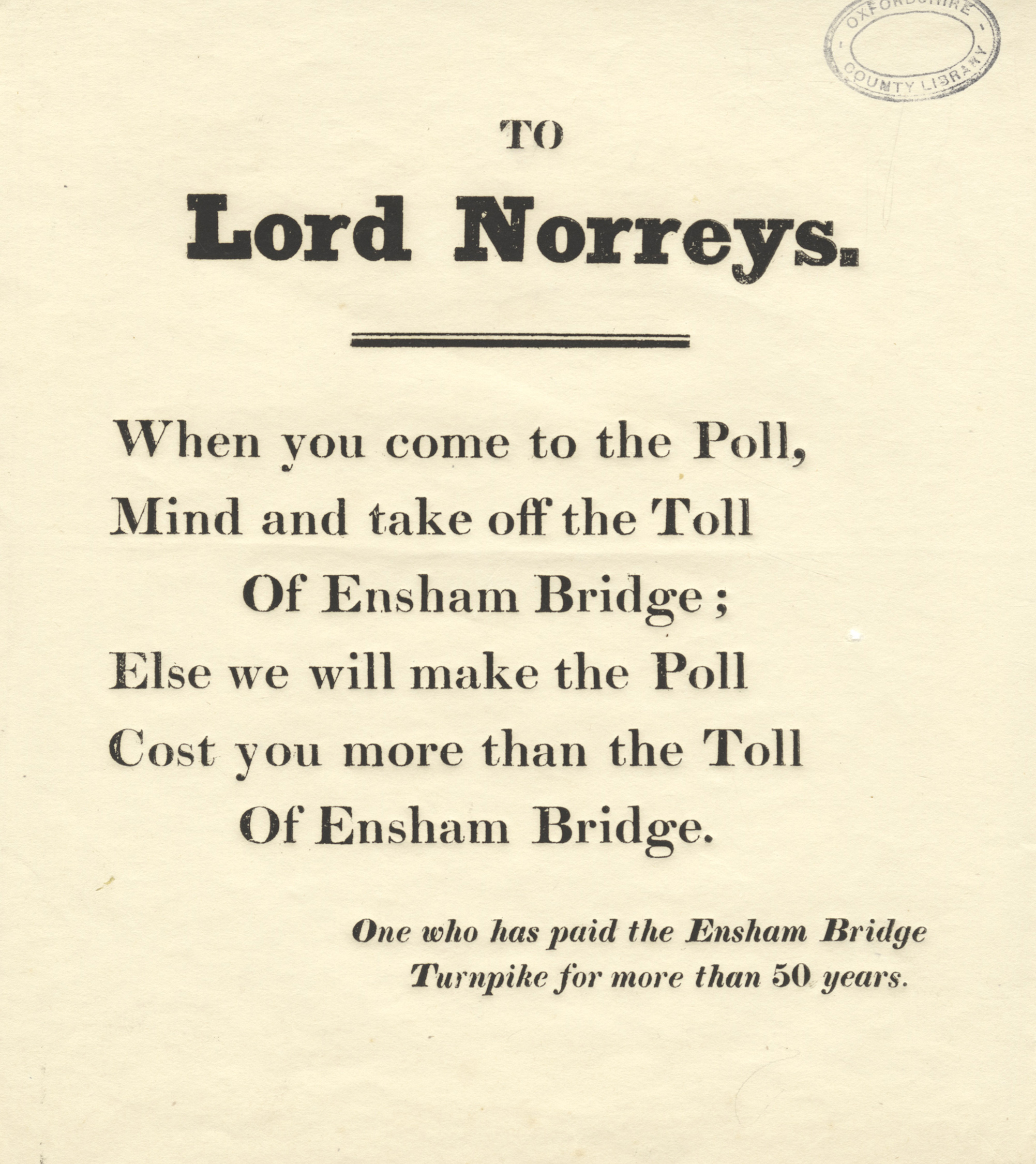
1831 Oxfordshire election: handbill campaigning against the Swinford Bridge toll
We do not know how much this issue swayed the electorate and if the matter was a bridge too far for them – in the final reckoning the result was as follows.
| Candidate | Votes | Percentage | Percentage change |
|---|---|---|---|
| George Harcourt (Whig) | 1,782 | 37.2 | +24.1 |
| Richard Weyland (Whig) | 1,688 | 35.3 | +22.2 |
| Montague Bertie (Tory) | 1,316 | 27.5 | -46.3 |
| Majority | 372 | 7.8 | |
| Turnout | 2,934 | c. 83.8 | c. +4.9 |
| Registered electors | c. 3,500 | source |
The Reform Act 1832 increased Oxfordshire representation to three seats, and at the election that year Messrs Harcourt, Weyland, and Bertie were all returned unopposed source. George Harcourt was grateful to his supporters for his victory (below) stressing his commitment to the reform of the political system then in place:

1831 Oxfordshire election: handbill - successful Whig candidate, George Harcourt, thanking his supporters
His opponent Montague Bertie was magnanimous, as a communiqué issued on Wednesday night on the 11th of May announced:
The committee for conducting the Election of Mr Harcourt have received a Communication, that it is not the intention of Lord Norreys to give his Opponents further trouble. They congratulate their Friends on this termination of the Contest and rejoice that Victory releases them from further exertion.
In 1837 it would be Montague Bertie’s turn to thank his supporters as he unseated one of the Whig members in a general election brought about by the death of William IV and the accession of Queen Victoria:

1837 Oxfordshire election: card issued by successful Conservative candidate, Lord Norreys, thanking his supporters
However, this was not sufficient for Sir Robert Peel’s Conservatives to unseat the existing Whig administration of William Lamb, 2nd Viscount Melbourne, although it did reduce his majority by 41 seats to a smaller but still workable 30 source. In the previous election of 1835 George Harcourt had switched sides to the Tories, and the Oxfordshire county seats continued to be held by Tories until 1857.
From among Oxfordshire History Centre's uncatalogued collections comes a huge bound volume of posters, handbills and smaller items of ephemera, collected together by local printer John Golby Rusher, and printed both by him and rivals, Potts, Cheney and Sons. With an informal spine title of Rusher Collection, volume I, 1830-1880, the content chiefly covers the period 1836-1860.
Covering social, local government and political subjects from nineteenth century Banbury, there is nevertheless a primary focus on elections in the Banbury area, including the less honourable aspects of electioneering – for example, ad hominem attacks on religious beliefs of one of the candidates, Thomas Stonor.
Religious issues were dominant in Banbury politics during the period of Sir Robert Peel's Conservative government of 1841–6 source. Henry William Tancred, sitting Whig M.P. for Banbury, was opposed in the 1847 general election by James MacGregor (Conservative), who was critical of the Whig government's financial support for the Roman Catholic seminary at Maynooth, County Kildare. Tancred retained his seat until 1858 when he retired due to ill-health.
Here is a typical page from Rusher's tightly packed volume of printed Banbury political ephemera, which captures just part of Tancred's and MacGregor's clash over the Maynooth College issue.

[Reference (original): Rusher collection, volume I, 1830-1880, page 243 - uncatalogued]
[Reference (microfilm copy): MR2]
The following mock report of a Coroner's Inquest was printed by Rusher, presumably for MacGregor's 1847 election campaign, attacking Whig candidate, Tancred.

[Reference (original): Rusher collection, volume I, 1830-1880, page 239 - uncatalogued]
[Reference (microfilm copy): MR2]
Rusher's volume of printed ephemera is a goldmine of information about the local political life of Banbury and really deserves its own article, if we were to do it full justice.
Also held by Oxfordshire History Centre are examples of the bureaucratic apparatus required in running an election. This includes copies of the official proclamation that an election has been called - for instance by Edward Cobb, Mayor and Returning Officer for Banbury Borough in 1847 - also an oath taken by the presiding officer at the polling station, and an oath taken by the returning officer for the constituency whose role it would be to announce the result.

1847: Banbury Borough election proclamation
[Reference (original): Rusher collection, volume I, 1830-1880, page 236 - uncatalogued]
The Banbury Borough collection of Mayor's Oaths contains, for example, the following oath, taken by Mayor Thomas Brayne during the 1831 election preparations (Reference: BOR2/6/A3/27):
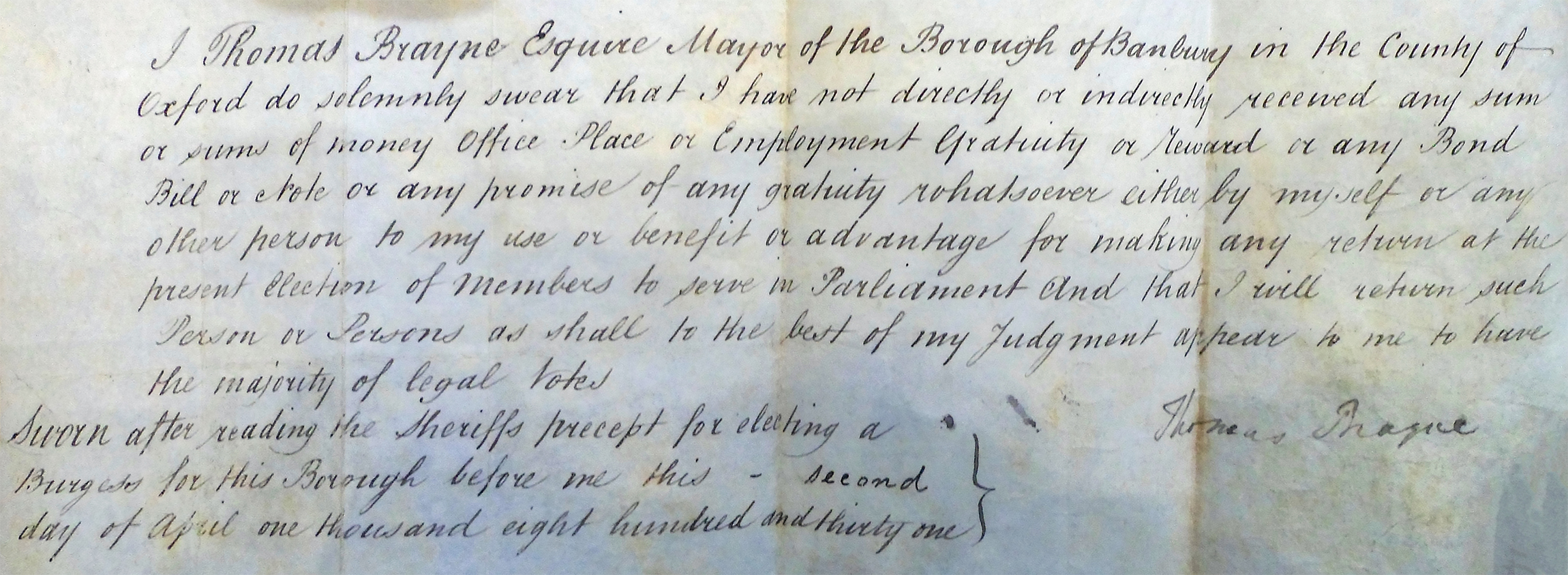
1831: Election oath by Thomas Brayne, Mayor of Banbury [Reference: BOR2/6/A3/27]
I Thomas Brayne Esquire Mayor of the Borough of Banbury in the County of Oxford do solemnly swear that I have not directly or indirectly received any sum or sums of money, office, place or employment gratuity or received any bond bill or note or any promise of any gratuity whatsoever either by myself or any other person to my use or benefit or advantage for making any return at the present return of members to serve in Parliament and that I will return such person or persons as shall to the best of my judgement appear to have the majority of legal votes.
Banbury Borough archive is also the source of an indentured 'return', dated 2nd May 1831, between the Burgesses of Banbury and the County Sheriff, Henry Lambert, noting the election of John Easthope (Whig party) as member for Banbury, and committing to his appearance in Parliament on 14th June. The broader collection at BOR2/6 contains a century's worth of parliamentary election records and ephemera, as they relate to Banbury.

1831: Indentured return of John Easthope, Esq., as (Whig) Member of Parliament for Banbury
[Reference: BOR2/6/A5/24]
The Reform Act of 1832 required registration of voters in England for the first time, and assigned the overseers of the poor in each parish the additional task of compiling the electoral register. Oxfordshire History Centre holds the full set of surviving registers in collection EL1 Oxfordshire Registers of Electors, 1832-2022.
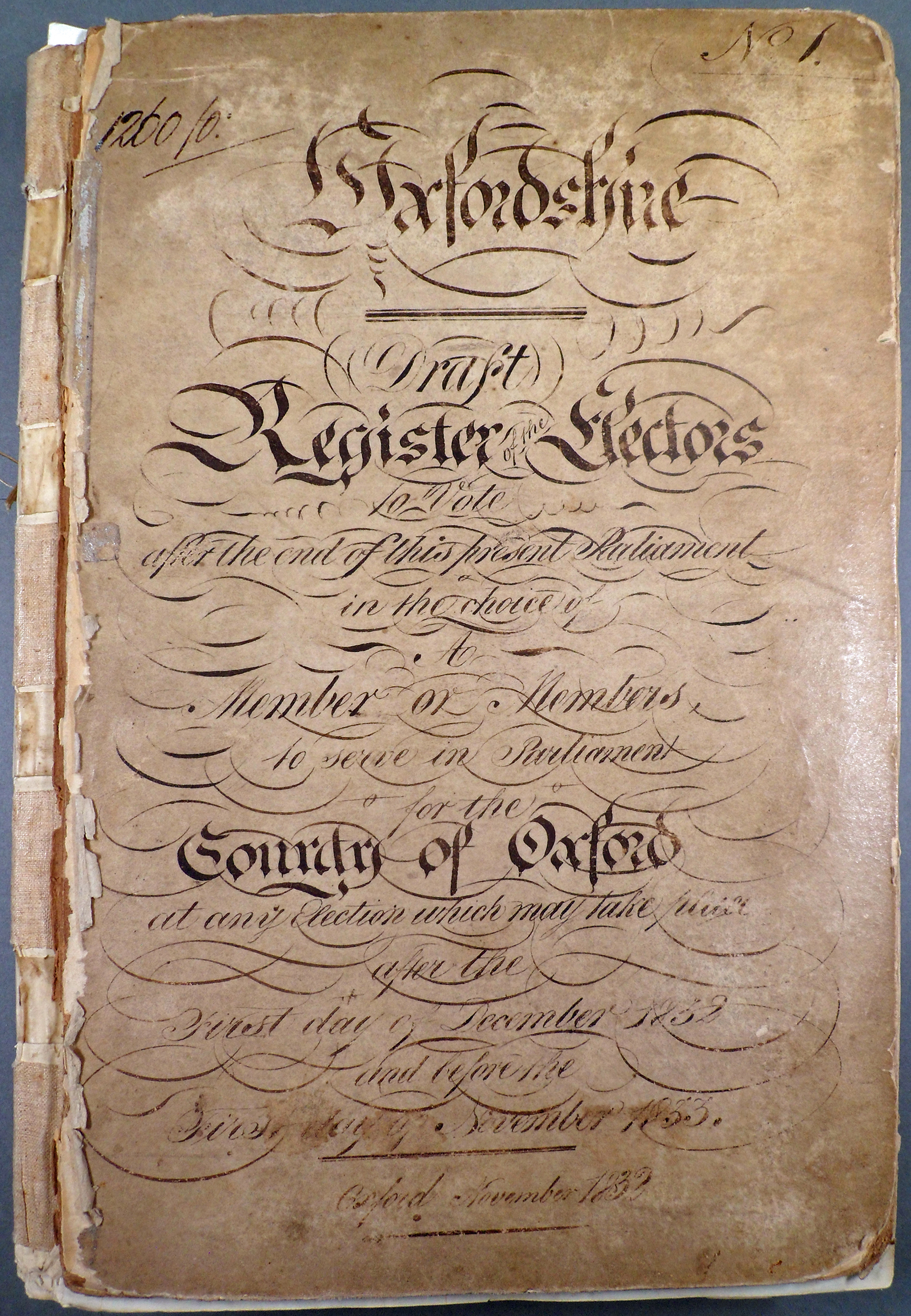
1832: Title page and cover of Oxfordshire's first (draft) electoral register [Reference: EL1/1832/1]
The Third Reform Act extended the same voting qualifications as existed in the towns to the countryside, more than doubling the electorate in the counties, with the result that the majority of male householders over 21 were now entitled to vote. The following 1888 list of electoral divisions also notes the resident poulation in each division:
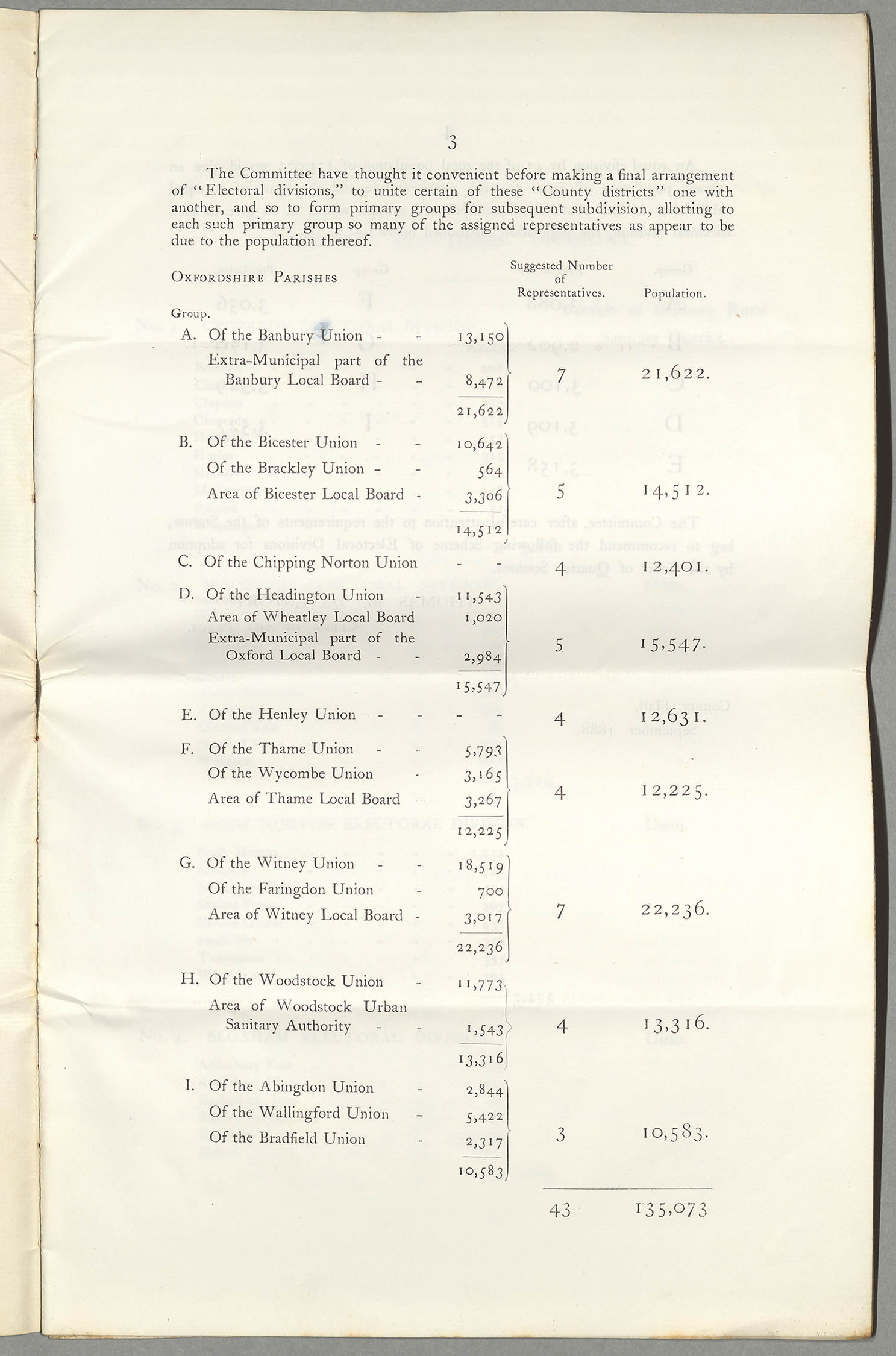
October 1888: County list of electoral divisions
[Reference: CC3/2/A7/16]
Jumping forward a little from our primary focus on the nineteenth century, within the records of Oxfordshire County Council’s Clerk of the Peace there is a plain-looking exercise-book [Reference: CC101/A2/1], an Election Diary, containing a chronological record of the Returning Officer's work in connection with Parliamentary elections and by-elections, noting such matters as: issuing notices and letters, ordering ballot papers, and the administration of the polls and counts.

1909: extract from Oxfordshire County Council, Clerk of the Peace, Election diary, 1906-1945
[Reference: CC101/A2/1]
Covering the years 1906 to 1945, the diary records the step by step administration that was necessary and would have taken place for each election in Oxfordshire – a process repeated across the country – everything from the election being called and Parliament dissolved, through ordering the various items of stationery, the ballot papers themselves, to the result being declared and the papers being sent to the Crown Office, each step along the way being meticulously recorded.
Finally, we take a look at events in Oxford City, surrounding the 1880 by-election source for the single parliamentary seat of the City of Oxford. This was a straightforward fight between the Conservative Alexander William Hall and the Liberal William Vernon Harcourt, which the former gentleman won by 2,735 votes to 2,681, a narrow majority of 54 on a turnout of 87.9% of the 6,163 registered electors. It had come about because of William Vernon Harcourt becoming Home Secretary which necessitated a by-election. However, there were concerns about the conduct of the by-election, sufficiently substantial for an inquiry by the Royal Commissioners to be set up “… appointed to enquire into the existence of corrupt practices in the City of Oxford …”
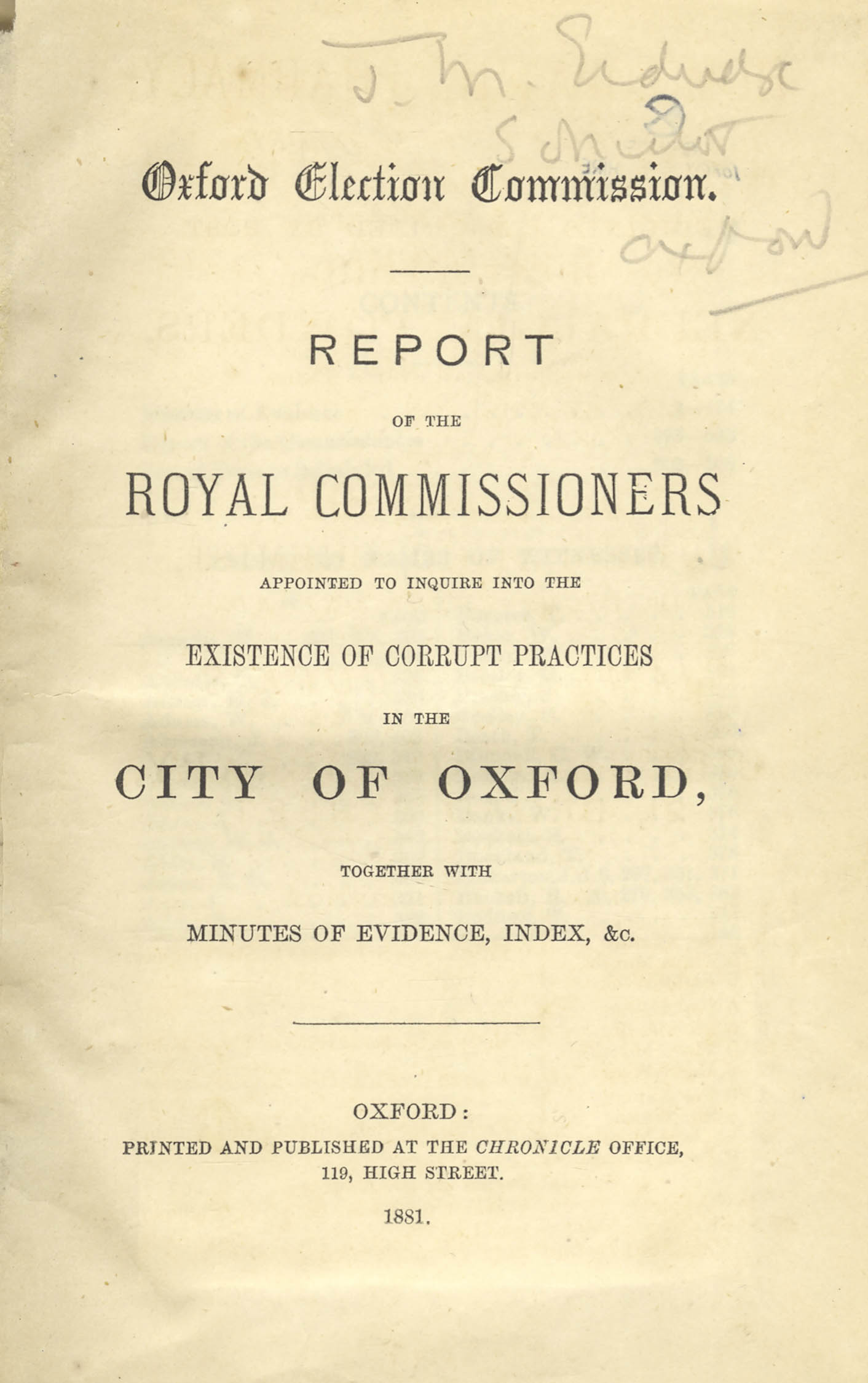
Title page from the Oxford Election Commission report, 1881 [Reference: SV OXFO/324.2, barcode 306552538].
Google also offers a digital copy.
The Commissioners were: Lewis William Cave, Esq. Q.C. (President), Hugh Cowie, Esq, and Edward Ridley, Esq., and began hearing evidence on Friday, 1st of October 1880 at the Crown Court in County Hall. It not only investigated the 1880 by-election, but also at the results of the elections that had taken place in 1866 and 1874.

The nomination at Oxford, for the City, Illustrated London News, 28 November 1868
[Reference: POX0078866]
The report of the first day of the Inquiry noted:
The liberals presented a petition against the return of Mr Hall on the ground of bribery, treating, and undue influence, and the hearing took place before Mr Justice Lush and Mr Justice Manisty, on August 2, 3, and, 4. Mr Hall was declared unduly elected, and the Judges having reported to the House of Commons that “they had reason to believe that corrupt practices extensively prevailed at the last election,” a Royal Commission was appointed.
The Commission heard evidence for forty-seven days, finishing on Monday, 14th of March 1881 (they were allowed to have Christmas off) and the Report of the Royal Commissioners …, title page above, dated 5th of April 1881, runs to 508 pages with a full account on the evidence presented on each day with a verbatim record of the testimony given. In summary, its findings were as follows:
We think, however, that Mr Hall ought, in common prudence, to have informed himself in 1874 of the manner in which the money expended on his behalf in the contests of that year had been disposed of. If he had examined the published returns, he would have become aware how large a sum Mr Walsh had failed to account for, and it would have been his duty to decline to entrust the conduct of any future elections to that gentleman.
It continues:
The constituency of the City of Oxford is not in our opinion generally corrupt. There is very little direct buying and selling of votes; the corruption in Oxford mostly takes the form of colourable employment. Some money, but not much, has been expended in paying voters for their loss of time, and in treating. The number of electors open to those corrupt influences has been estimated by those who know the constituency best at about 1,600. It must be remembered, however, that owing to the fact that very few members of the University reside at Oxford during more than half the year, there is a very large class of persons whose ordinary employment is not continuous.
Considering the evidence the Commissioners's primary conclusions were as follows:

1881: Oxford Election Commission report, page 503 - conclusions regarding corrupt practices
[Reference: SV OXFO/324.2, barcode 306552538]
The report draws attention to five members of Oxford Town Council: Robert Buckell, John Calcutt, George William Cooper, William Evetts and Thomas Wells, and two magistrates from the City of Oxford: John Calcutt and John Juggins mentioned in the list of names of those involved. The report then goes on to list the names and occupations, ranging from shoemakers to solicitors, from ash collectors to the Assistant Librarian at Magdalen College, of those “Guilty of Corrupt Practices …”

1881: Oxford Election Commission report, page 507 - extract from Schedule III, Persons guilty of corrupt practices in respect of the votes of others, April 1880
[Reference: SV OXFO/324.2, barcode 306552538]

Alderman Robert Buckell, who was found guilty of corrupt practices in the parliamentary elections of April and May 1880, and lost his Oxford Council seat. He was eventually elected Mayor for the first time in 1885.
[Reference: POX0655066].
For further information on Robert Buckell, see: Oxford Mayors and Lord Mayors website.
The result of the 1880 by-election was deemed invalid, and Alexander William Hall lost his seat in the House of Commons. There was no immediate by-election and the seat remained vacant until the election of 1885 when Alexander William Hall was again elected to serve the Oxford constituency beating the Liberal Charles Alan Fyffe by 3,212 votes to 2,894, a majority of 318 on a high turnout of 90.3% of the 6,764 registered electors source.
Posted by: Marek Lewandowski, Oxfordshire History Centre volunteer