
Calendar of prisoners in custody at Witney House of Correction, 1732
[Reference: QS P 1733 Ep 2]
21 May 2025
Over the centuries, Oxfordshire has been home to many prisons and places of incarceration. These institutions have held numerous felons convicted of serious crimes, along with countless others detained for petty offences, debt and religious or political beliefs.
Oxfordshire History Centre holds a variety of records touching on these institutions, along with papers relating to trials and sentencing, and reflecting conditions endured by inmates. Sources are especially rich for the 18th and 19th centuries, particularly records of the County Quarter Sessions which for many years both acted as a criminal court and oversaw the running of the County Gaol and House of Correction at Oxford Castle.
In the first part of this blog, we’ll look briefly at a few of Oxfordshire’s past prisons and the records we hold relating to them. Parts two and three will examine the plights of those committed to the County Gaol at Oxford Castle, and the cases of those sentenced to transportation or execution.
For images in this blog post, click or tap the thumbnail to enlarge or view the whole image
Prison history is complex, with various institutions serving different and sometimes overlapping purposes which evolved over time. One of the main types of prison in England was the Bridewell, or House of Correction. The former term derives from Henry VIII’s Bridewell Palace, which became a prison for petty offenders in the 16th century and after which similar institutions were often named.
These institutions were originally used to incarcerate those tried locally for petty crimes and misdemeanours including poor law offences and vagrancy. As implied by their name, Houses of Correction in part aimed to reform an individual’s behaviour. They typically held inmates for relatively short periods and by the 18th and 19th centuries could sometimes form part of a larger gaol. A number of local Bridewells were set up in towns around Oxfordshire, including Oxford, Thame and Witney.
Few official records exist for these institutions, but some prisoner lists and Keepers’ expense accounts crop up in our Quarter Sessions collections. Surviving accounts and committal orders show that local Bridewells would often be employed to hold prisoners prior to sentencing at the next County Quarter Sessions, and in practice could be used for imprisoning individuals for several months or years. A 1709 petition from Francis Collier, Keeper of Witney House of Correction, shows that this institution was at times also being used to hold some of the felons guilty of more serious crimes transferred from the Oxford Castle Gaol - much to his chagrin:
‘there have lately beene committed into your petitioners custody several convicted felons and very dangerous persons from the Castle in Oxford to continue for eighteen months….your petitioner Humbly sheweth that the s[ai]d House of Correction is not of strength to secure such & so many prisoners as are now committed without escapeing out of custody…therefore Humbly prayeth that the s[ai]d House may be Repaired and made stronger otherwise your petitioner may be censured if any escape should be made and is not able to prevent it…’
[Reference: QS P 1709 E3]
Calendar of prisoners in custody at Witney House of Correction, 1732
[Reference: QS P 1733 Ep 2]
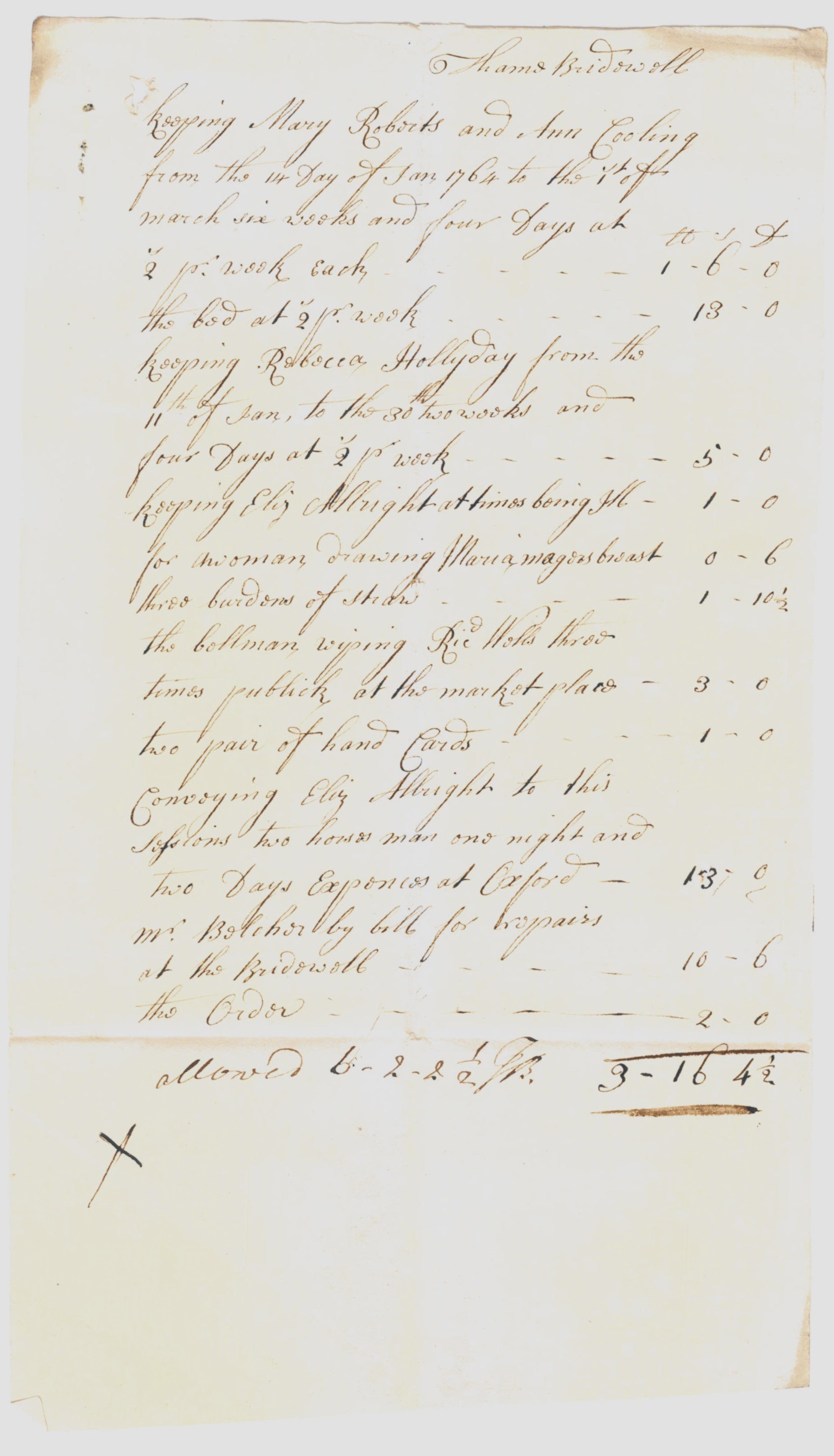
Account for expenses at Thame Bridewell, 1764
[Reference: QS A 1764 Ea 2]
An Inventory of the value of material in Witney Bridewell in 1766 gives some small insight into conditions there. It lists, alongside numerous locks, fetters and chains, a spinning wheel and hand cards – presumably to engage the prisoners in useful labour. It also reflects the punishments that could be meted out, listing a whipping post and ‘cat of nine tails’ amongst the Bridewell’s possessions.

Inventory of materials belonging to the Bridewell, Witney, 1766
[Reference: QS A 1766 T 12]
Oxfordshire’s old boroughs – Chipping Norton, Henley, Banbury and Woodstock - were administratively largely separate from the County of Oxfordshire. For periods in their history, boroughs held their own Sessions courts and some maintained a local gaol.
The most notable among these was Banbury, which was granted the right to Sessions and to a town gaol by a charter of 1608. A gaol on Market Place operated from around the 1640s. It was a small institution – even by 1833, the maximum number of prisoners held at any one time was only 15, with the gaol effectively operating as a combined gaol, House of Correction, debtors’ prison and lock-up house. In the 1830s, it became necessary for Banbury to contract with the County Justices so that those convicted at Borough Sessions could be confined at the County Gaol at Oxford, an arrangement which continued after the eventual closure of Banbury Gaol in 1852.
Surviving records of Banbury Gaol include gaol journals from the 1830s, recording those committed and discharged, and the outcome of trials at the local Sessions. An account book lists the money spent supporting individual prisoners during their confinement, including a number of deserters from the army.
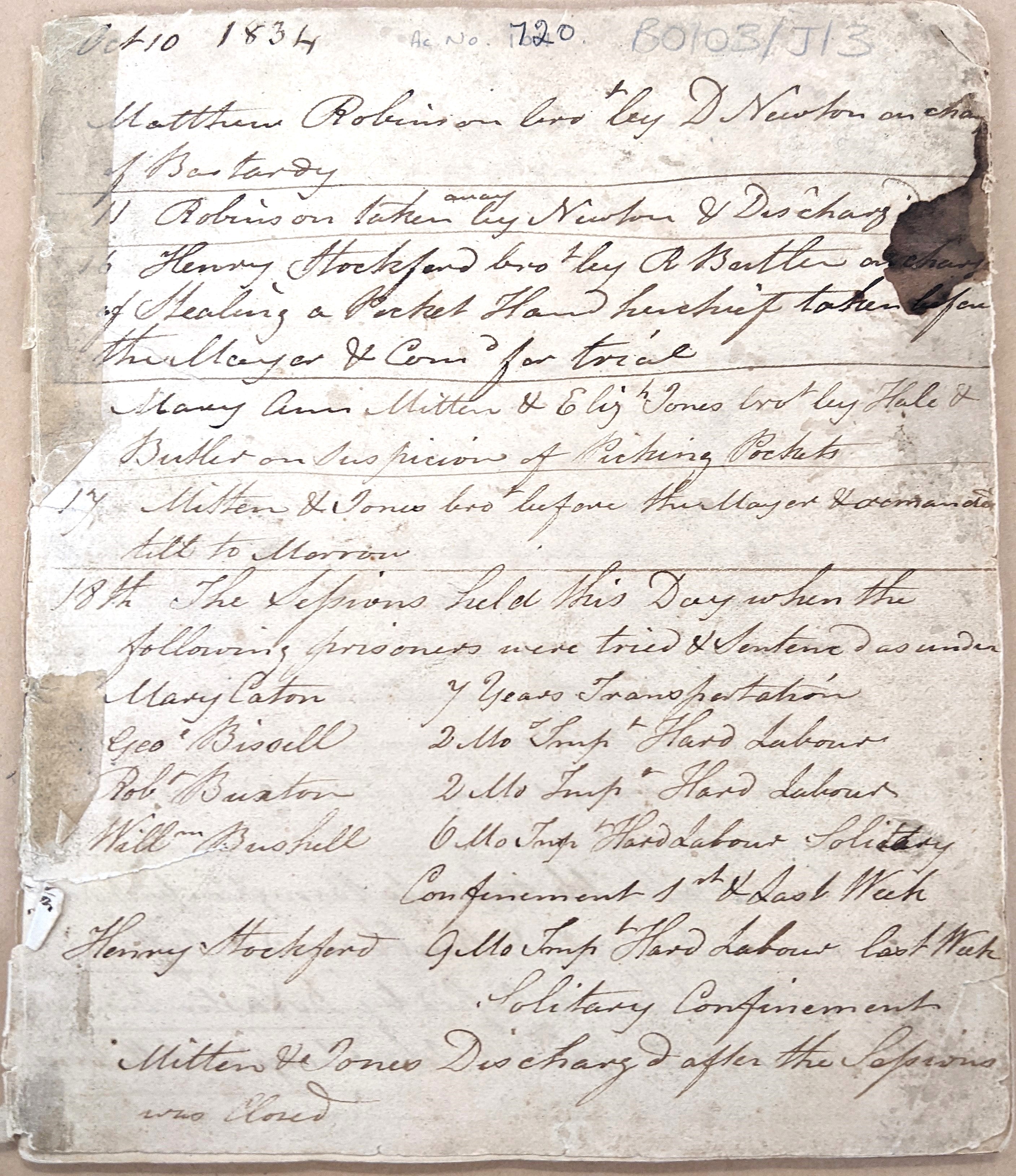
Page from a Banbury Gaol journal, October 1834, recording committals for bastardy, picking pockets and stealing a pocket handkerchief
[Reference: BOR103/J/3]

Elevation and plans of Banbury Gaol in c.1830s from Alfred Beesley’s ‘History of Banbury’
[Reference: POX0067207]
Lock-up houses have been used for centuries and have generally served to enforce punishment within a community, or to temporarily detain people prior to a hearing before a magistrate. They vary in their size and nature – some were within existing buildings, such as the lock-up in The Tolsey, Burford, while others could be tiny, purpose-built spaces such as that in the village of Wheatley, constructed in 1834. In the later 19th century, ‘lock-ups’ could form part of a local police station.

The lock-up in Wheatley
[Reference: Photo by Malcolm Graham, POX0030510]
A number of new ‘Lock-up Houses’ were to be established in Oxfordshire in the 1850s as places to temporarily hold County Prisoners prior to trial or transfer to Oxford Gaol. A Lock-Up Houses Committee reported in 1852 that there was a long-felt need for such institutions around the county, and recommended that one be provided within every Petty Sessional Division except Oxford. Spaces in existing local gaols and requisitioned buildings were to be used for these purposes.
The Minutes of the Committee, which lay out their recommendations for Lock Up Houses around the county and briefly detail existing prison arrangements in each area, exist for 1852-1856 [reference: QS/C/IV/1].
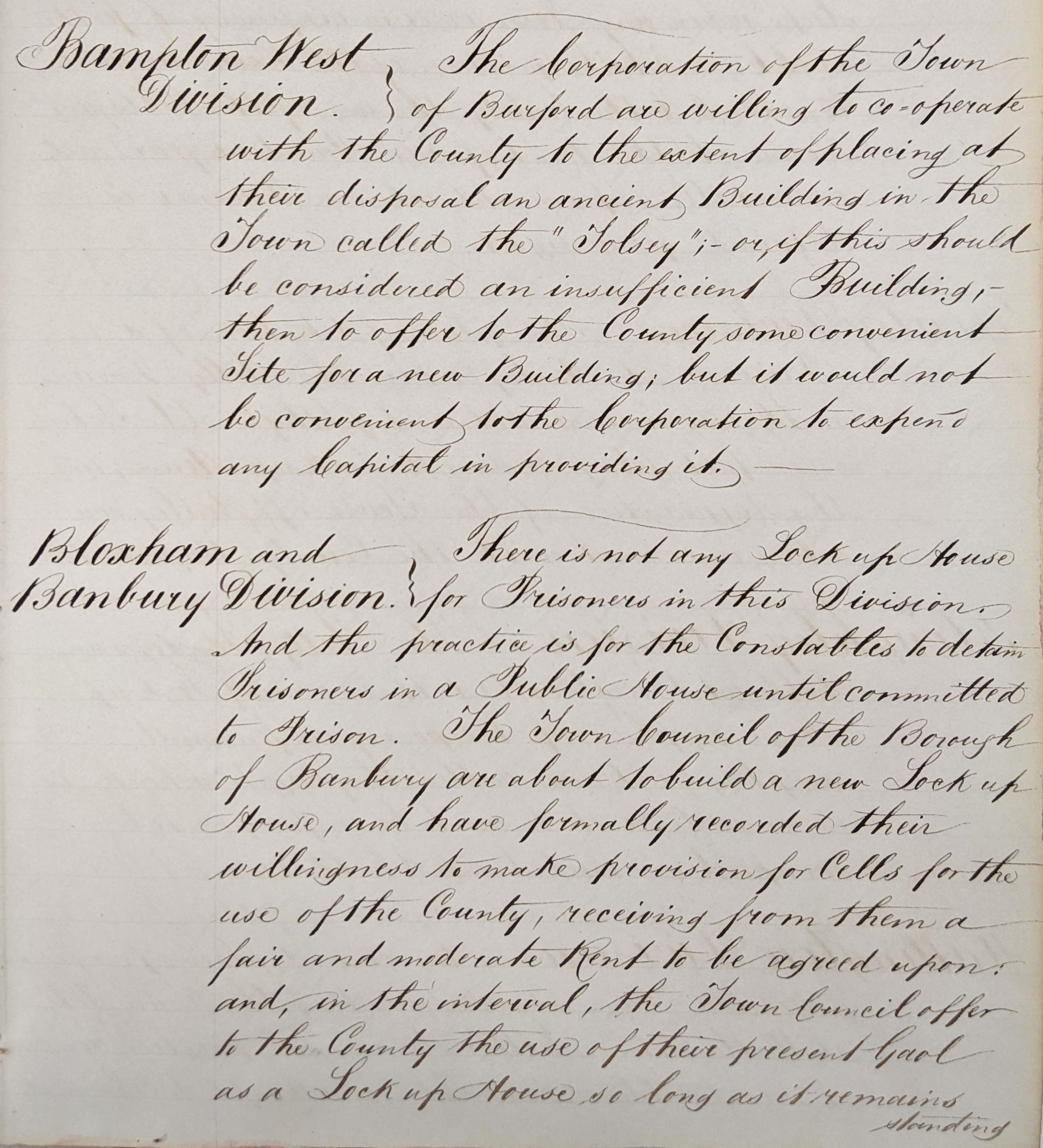
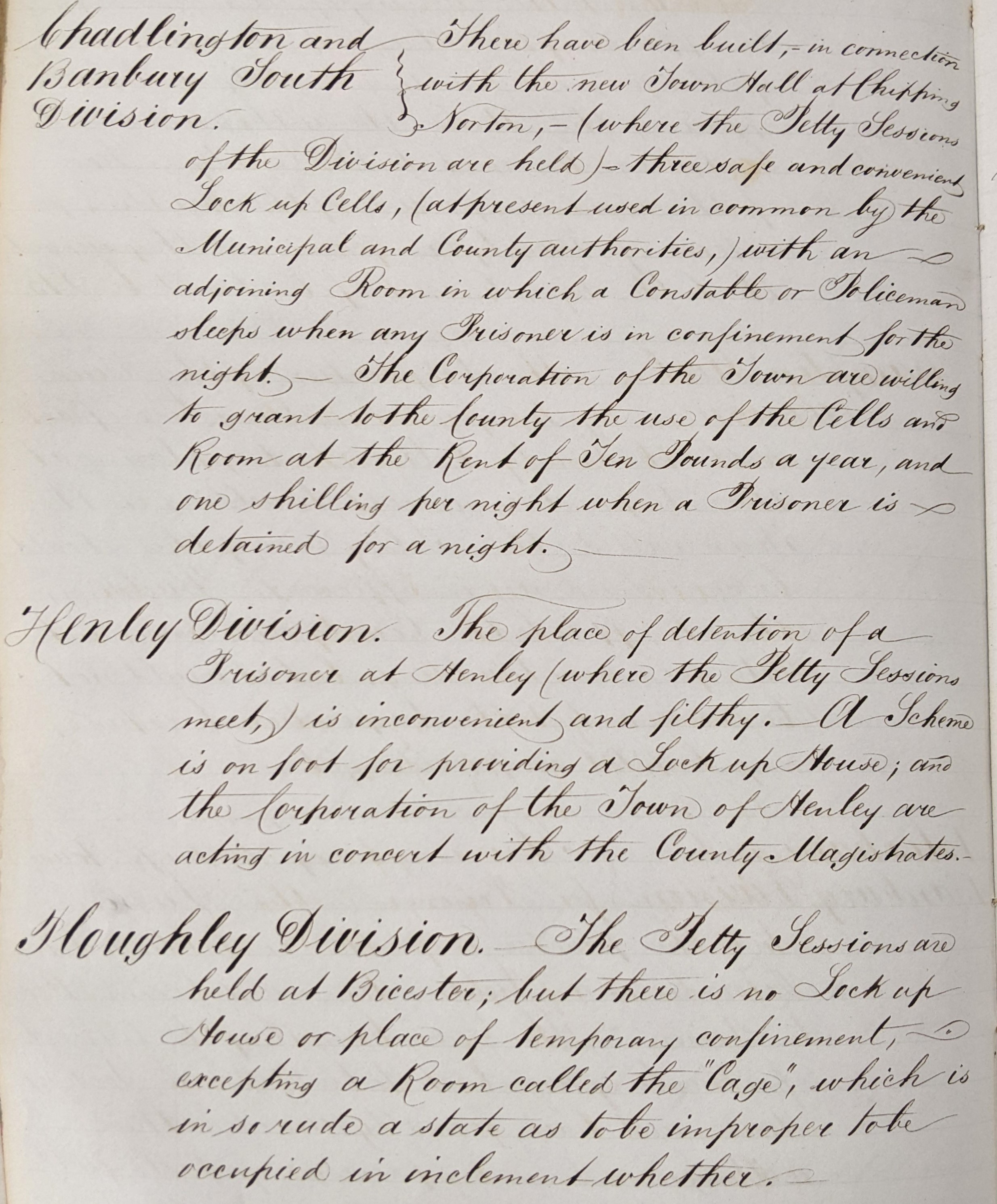
Pages from the Minutes of the Lock-up Committee, describing existing prison or lock-up arrangements
[Reference: QS/C/IV/1]
A number of plans, contracts and other papers relating to lockups and early police stations, largely constructed in the 1850s and 1860s, also survive amongst our Quarter Sessions collections.
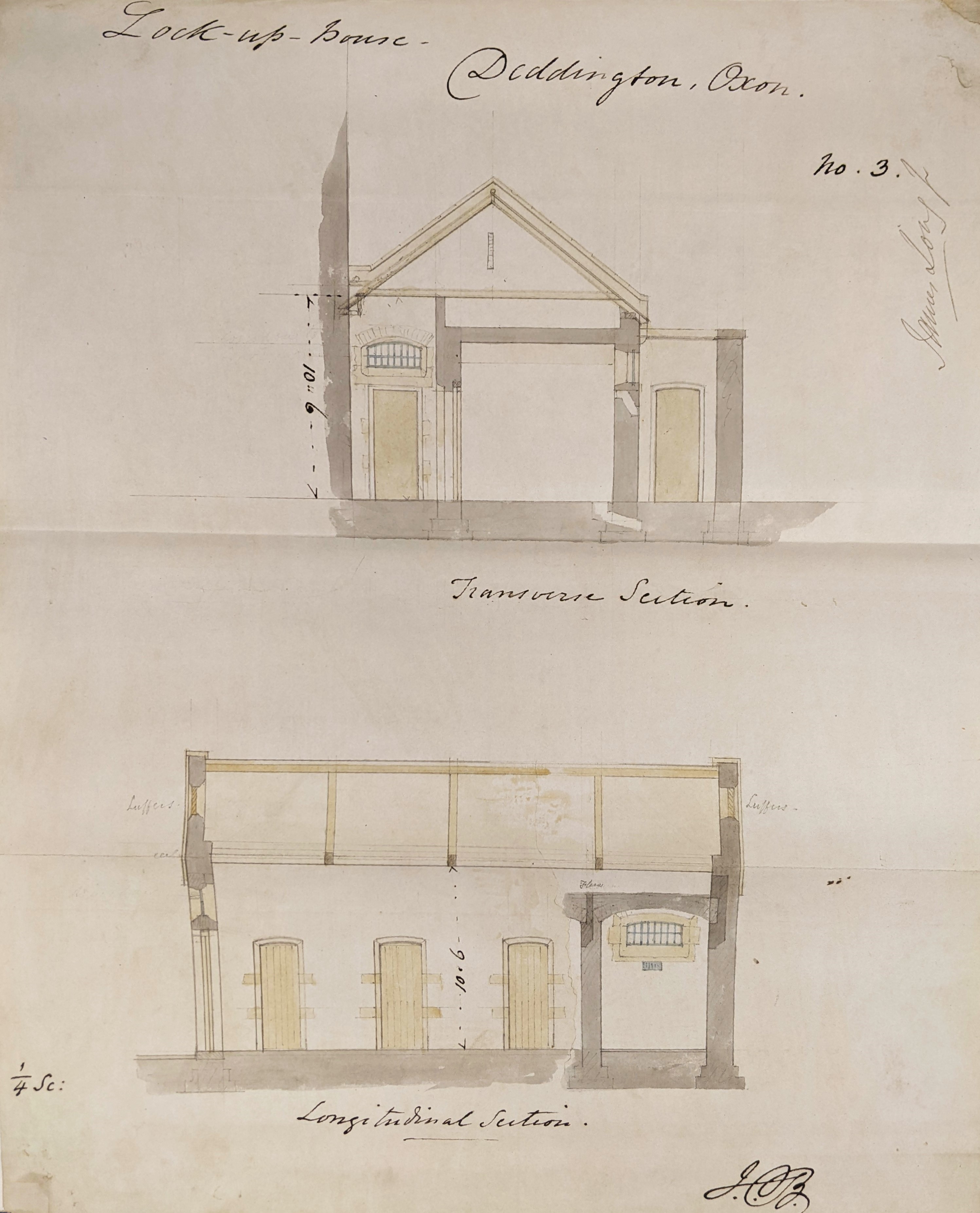
Plan of a proposed lock up at Deddington, 1854
[Reference: QS/E/13]
An early gaol for Oxford City was Bocardo. This was situated on modern-day Cornmarket, adjoining the North Gate next to St Michael at the North Gate Church. It operated from around the 13th century until 1771. This prison held a range of inmates from within the City of Oxford, including many debtors. The most famous individuals imprisoned here were the Oxford Martyrs; Archbishop Thomas Cranmer, Bishop Hugh Latimer and Bishop Nicholas Ridley. The bishops were burnt to death for heresy on a site now lying at the end of Broad Street, on 16 October 1555. Cranmer was to meet the same fate the following March. A City Bridewell was established next to Bocardo in the 1630s. Bocardo was demolished in 1771, to allow for the widening of Cornmarket.
A new gaol was opened at Gloucester Green in 1789 to replace Bocardo. It underwent major alterations in 1871, with an additional wing and cells added, improved ventilation and the provision of heating. It was closed in 1878, after which the prison at Oxford Castle was used as a prison for both County and City offenders.
Few records survive in our collections relating to Bocardo, with the exception of references in the Record Books and Quarter Sessions papers of the City of Oxford. However, it is captured in a number of illustrations and shown on early maps of Oxford.
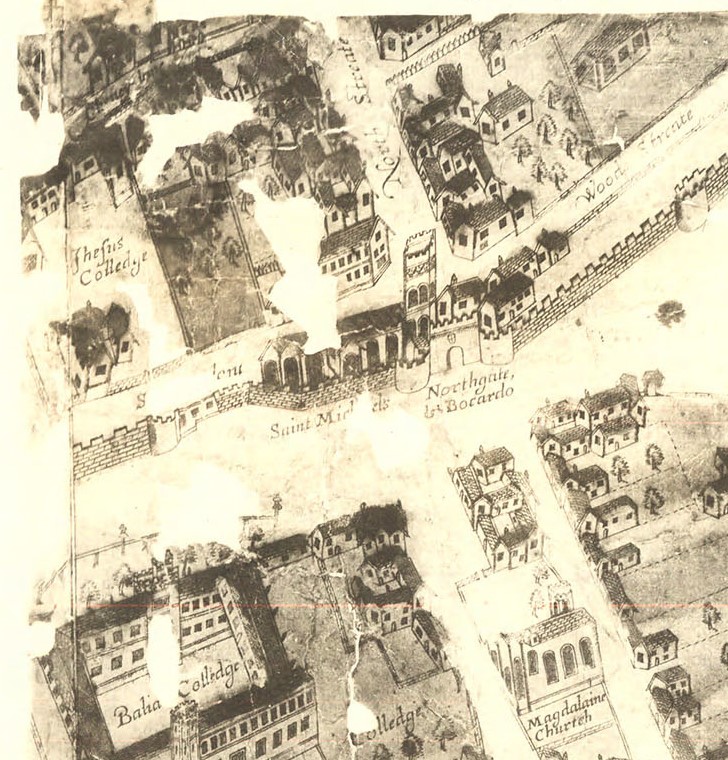
Bocardo, as shown on Ralph Agas’ map of 1578-88
[Reference: POX0582188]

A 19th century illustration, showing how Bocardo had looked prior to demolition in 1771
[Reference: POX0076441]
The Oxford City Quarter Sessions, separate to those of the county, contain some records of those committed to the City Gaol, along with papers relating to its upkeep. A set of gaol indentures (ref. OCA11/2/L2/1-30) record the surrenders of the gaol and its contents from one set of bailiffs to their successors. The indentures, the first three of which relate to Bocardo and the remainder to the gaol at Gloucester Green, detail the possessions of the gaol – chains, fetters, collars and bedsteads among them – along with the names and offences of the prisoners confined there at the time.
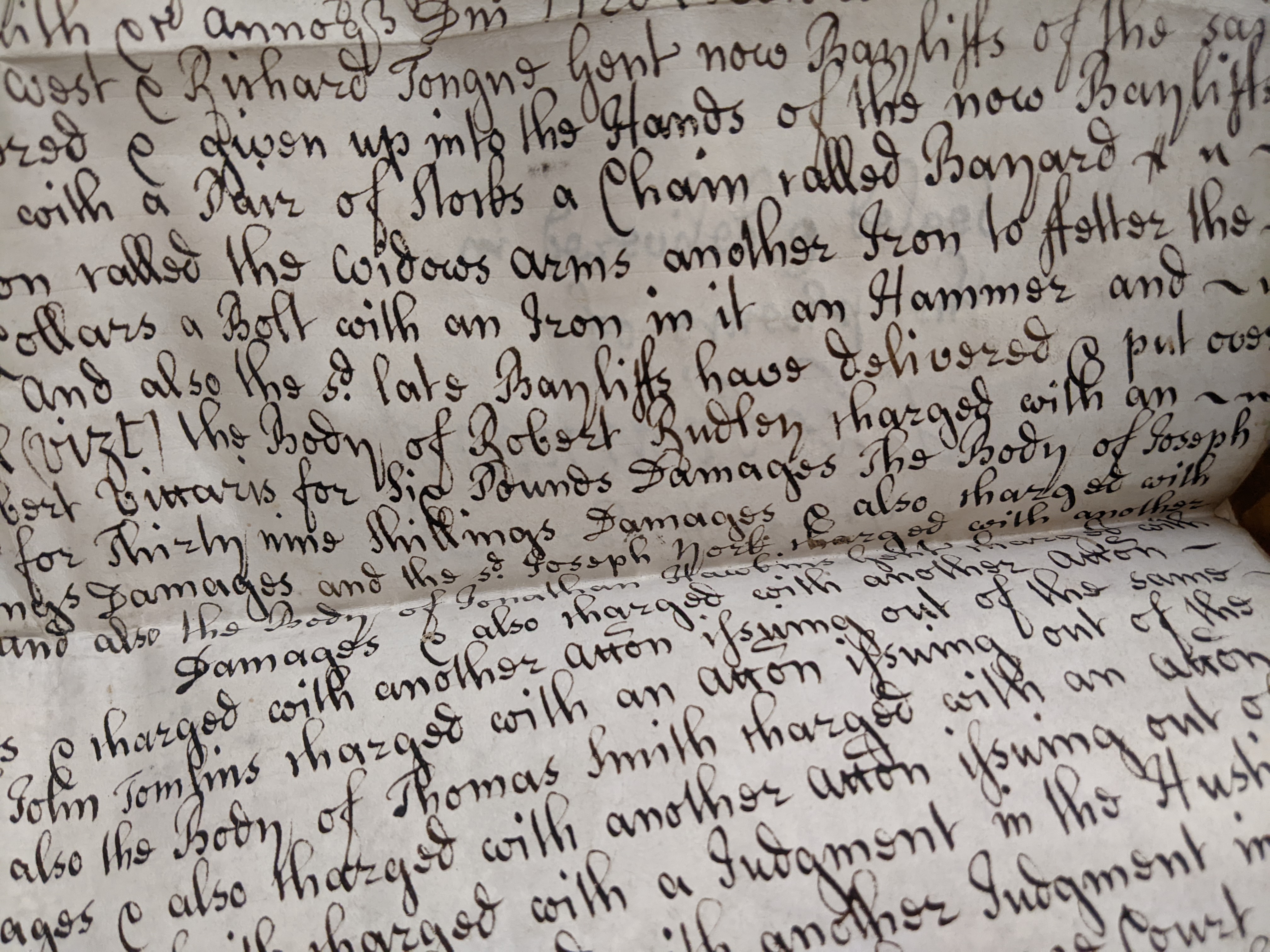
Extract of the Gaol indenture for Bocardo, 1720, recording prisoners and gaol contents
[Reference: OCA11/2/L2/1]

The City Gaol, shown on the OS Town Map of Oxford, 1876
[Reference: POX0582100]
The main gaol for the County was located at Oxford Castle. The Castle had served as a prison for many centuries and over the years had been a place of incarceration for Civil War prisoners, University students and for those imprisoned for their religious beliefs, amongst many others. Throughout much of the 18th century, it was leased and run by its then-owners Christ Church College to various private Gaolers, notably the Etty and Wisdom families.
The old castle gaol was acquired by the County Justices in 1785 and the prison was largely rebuilt in the following decades, allowing for greater capacity and the addition of a new House of Correction. The prison was enlarged and remodelled again throughout the 19th century, with the addition of yards and new women and men’s wings. By the 1850s, the Castle Prison could hold 218 male and 24 female felons and 133 male and 25 female debtors. From 1877-8, control of the prison passed from the County Magistrates to Central Government, the prison becoming ‘Her Majesty’s Prison at Oxford’ and housing both county and city offenders. From 1924, only men were imprisoned there. After decades of overcrowding, Oxford Prison eventually closed in 1996.

A section of Ralph Agas’ map of 1578-88, showing the Castle
[Reference: POX0582184]

1876 Ordnance Survey Town Plan of Oxford, showing the much-extended gaol complex at Oxford Castle
[Reference: POX0582104]
Records relating to the gaol at Oxford Castle can be found across the Quarter Sessions collections held at Oxfordshire History Centre. Alongside prisoner lists, these include bills for craftsmen for the maintenance of and additions to the prison buildings, Rules and Regulations, reports of visiting magistrates inspecting the condition of the gaol and its inmates, and bills for medical treatment, food and other sundries supplied to inmates. A number of plans for improvements made or proposed for the castle and gaol complex in the 19th century also survive.
Later administrative records of the prison, mainly dating from the 1840s onwards, can be found within the Oxford Prison collection, [ref. O29]. The collection includes nominal roll books of prisoners, a register of baptisms and burials in the gaol – both staff and inmates, Calendars of Prisoners, Minutes of the Visiting Committee, Governors Journals and even a small selection of early 20th century prisoner portraits. Some records dating to within the last 100 years may be closed to the public. Earlier photographs of prisoners, dating from between 1870 and 1881, are available on FindMyPast.co.uk, and have been published in the volumes Oxford Gaol Prisoner Portraits.
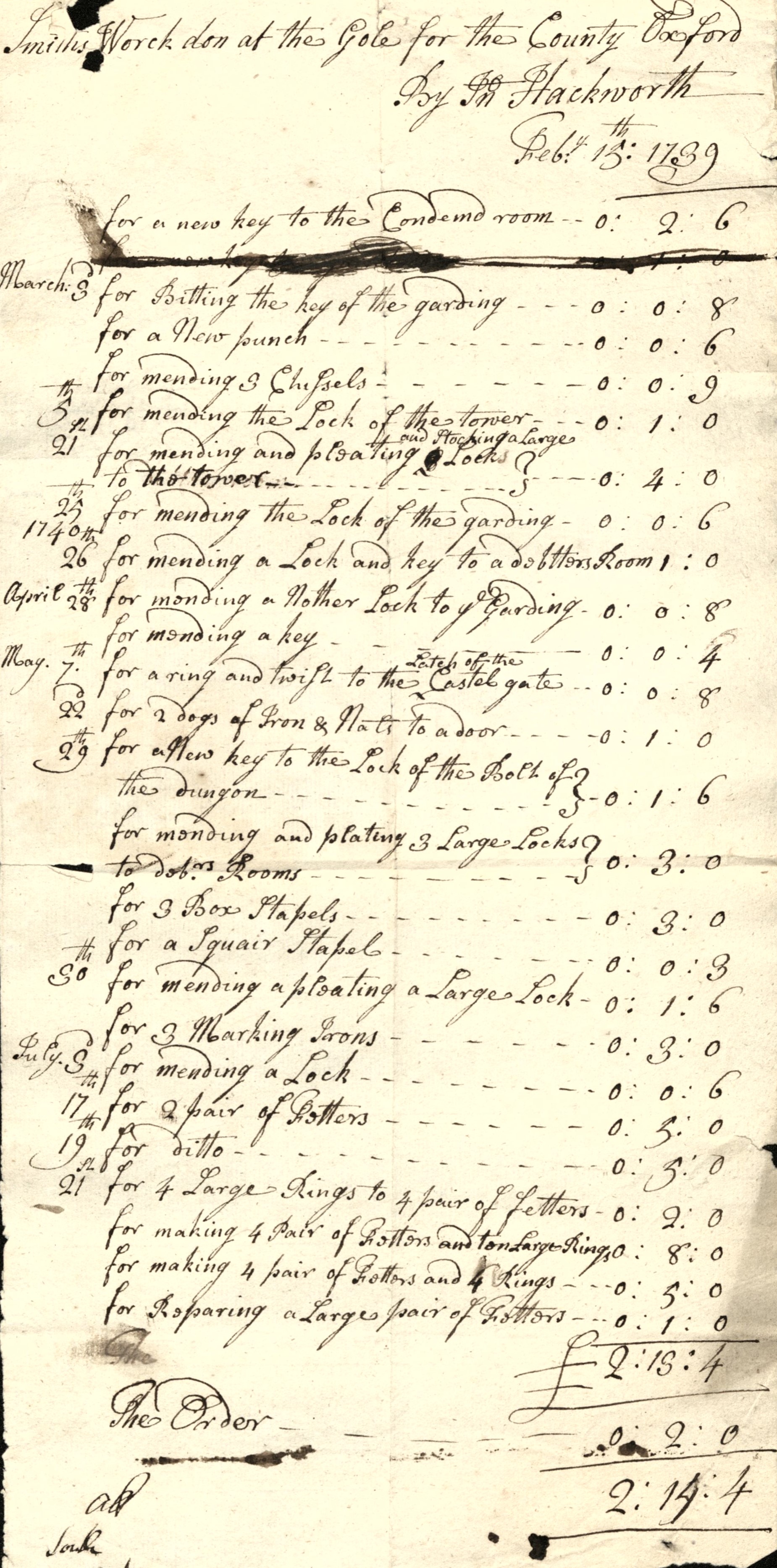
Bill for smith’s work done at the gaol, Feb 1739
[Reference: QS A 1740 T5]

One of several plans drawn up relating to proposed improvements to the prison, c.1842
[Reference: QS E 20]
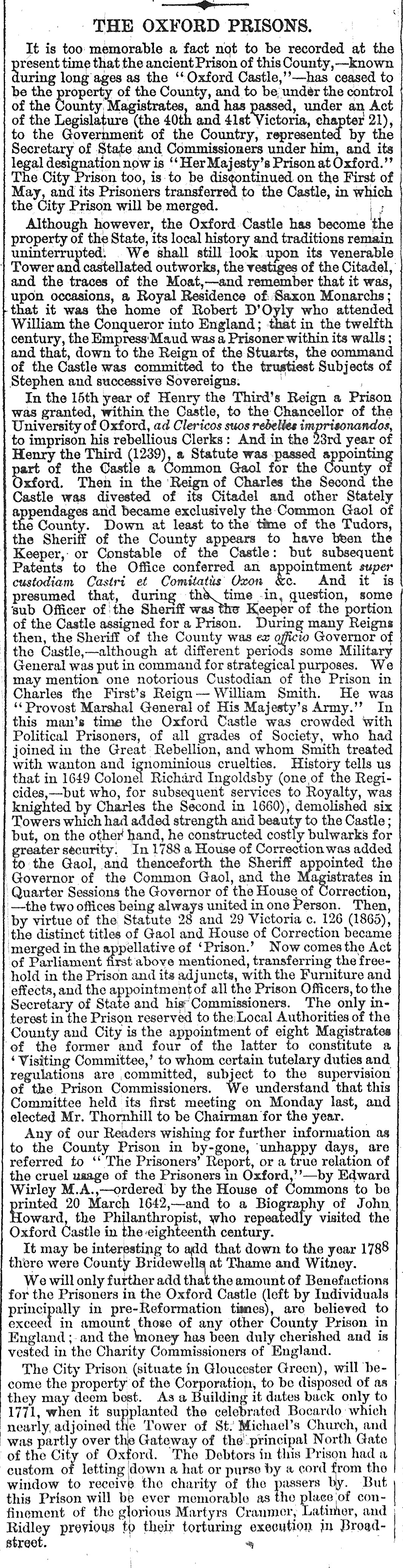
Article in Jackson’s Oxford Journal on the transfer of the prison from the County Magistrates, 20 April 1878
Posted by: Katherine Kinrade, Archivist