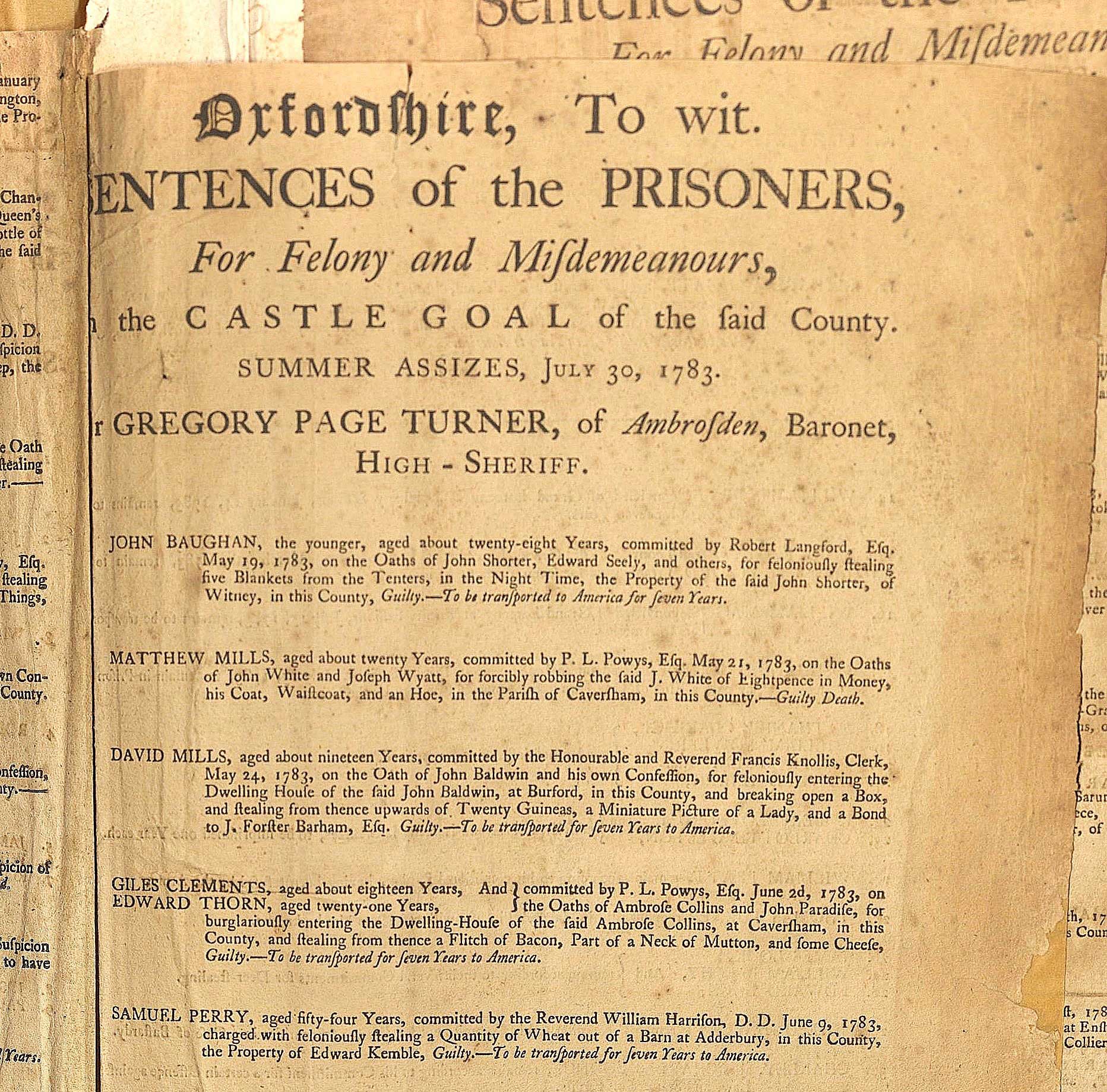
Sentences of the Prisoners, Summer Assizes 1783
[Reference: QSP/I/1]
11 July 2025
The first parts of this blog gave an overview of a number of Oxfordshire’s historic prisons and explored the living conditions and punishments suffered by some of those sentenced to confinement at the County Gaol at Oxford Castle.
Part Three will focus on the fates of those sentenced to the harshest punishments: transportation or execution.
Sentences of transportation could be handed down to those found guilty of serious crimes. This involved the removal of prisoners overseas for a fixed period. Most convicts from the UK were transported to the American colonies until the War of Independence in the 1770s - some were sent elsewhere, including to Africa. Transportation to Australia started in 1787 with the ‘First Fleet’ and continued until 1868. Sentences usually lasted for 7 or 14 years, but many individuals would not have had the resources to pay their way back to their native country.
Crimes which warranted a punishment of this severity were often heard by the Assize courts - surviving records of these courts are held by The National Archives. However, some Calendars of Prisoners held in the Castle Gaol for trial at Assizes can be found in our Oxfordshire Quarter Sessions collections. These Calendars can include pre-trial summaries relating to the prisoners and the crimes they were accused of, with post-trial equivalents noting the sentences handed down. The documents can also include lists of people serving custodial sentences in the Oxford Castle Gaol and House of Correction.
For images in this blog post, click or tap the thumbnail to enlarge or view the whole image
Sentences of the Prisoners, Summer Assizes 1783
[Reference: QSP/I/1]
Examples of transportation sentences recorded in the Calendars of Prisoners include:
David Mills, 19 years old, was convicted at Summer Assizes, 1783. He was found guilty of breaking into the house of John Baldwin at Burford and stealing 20 guineas, a miniature picture of a lady and a bond. He was sentenced to be transported to America for seven years.
Joseph Simmonds, 29 years old, originally from Wallingford and William Best, 33 years old, of Oxford. They were sentenced to be transported to Africa for 7 years, on charges of theft. However, the Calendar of Prisoners of Summer 1783 notes that they escaped from the gaol over the wall in the debtors’ yard on the night of 17 July 1783. Newspapers of the time provide descriptions of the men and offer a bounty to aid in their capture. William Best was later apprehended and sentenced to death at Lent Assizes 1784 – this itself was commuted to transportation for life, and he was conveyed from the Castle under guard that March to start his sentence.
Anthony Casey, a 39-year-old mason from Clifton, was convicted at Lent Assizes 1787. He was found guilty of theft from the parish church of Toot Baldon, from which he stole a large old bible, a quarto common prayer book and two ropes. He was also accused of stealing a pair of iron plough chains belonging to William Almond from a house in Sandford. He was sentenced to be transported for 7 years. However, he actually remained at Oxford Castle at hard labour in the Castle Works, awaiting a conditional pardon – he still appears on a Calendar in 1792.
George Priest, 21 years, was convicted at Lent Assizes 1822 of the theft of five pounds in silver from a waggon at Wheatley, the property of Hannah Ferris of Pershore. He was sentenced to 7 years transportation and was sent to Australia in May 1823, arriving in Hobart that October.
Other records in the Quarter Sessions collections can shed light on the transportation system. Post-trial, the courts usually contracted out the conveying of prisoners, either to ships, prison hulks or to their eventual destination. Bills for expenses associated with this process presented to the local justices for payment can sometimes be found, accounting for the issuing of transportation orders, drafting contracts and bonds, and paying merchants. Several interesting examples can be found listing expenses for conveying prisoners to ships to be transported, itemising detailed costs for horses, servants, coaches, boats, meals and the like along the journey from Oxford.
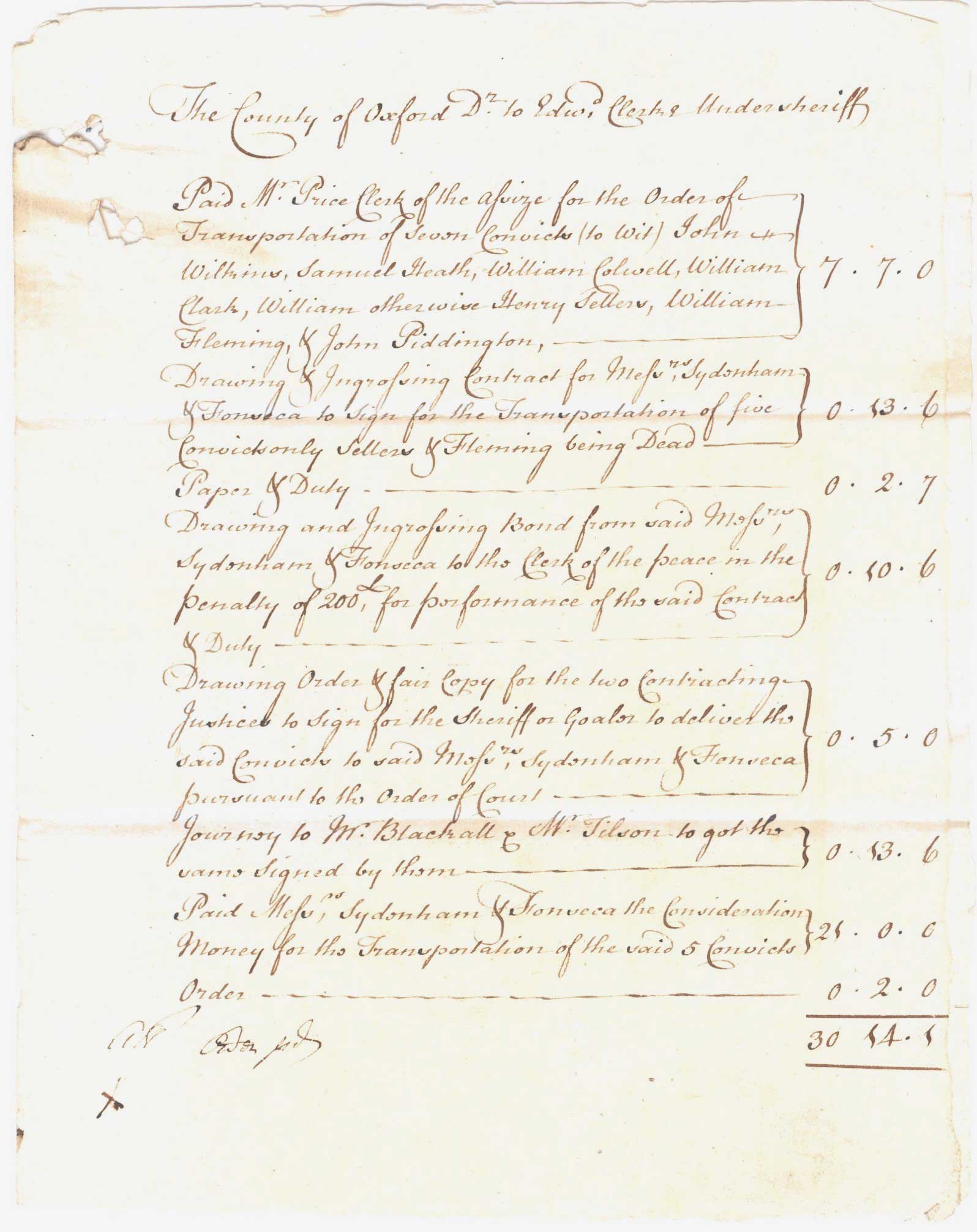
Bill of the Under Sheriff, for arranging the transportation of five convicts, 1764
[Reference: QS 1764 Ea 10]
A 1723 contract for transportation contains a list of convicted individuals, including Sarah Cooke of Burford, Richard Waine of Milton, Thomas Pickmore of Oxford and John Trentham of Deddington. They, along with several others, were sentenced to 7 or 14 year terms in the American colonies. John Becher, a merchant of Bristol, was contracted to ensure that they got there, and was required to present certificates to the Assize court within a year as proof.
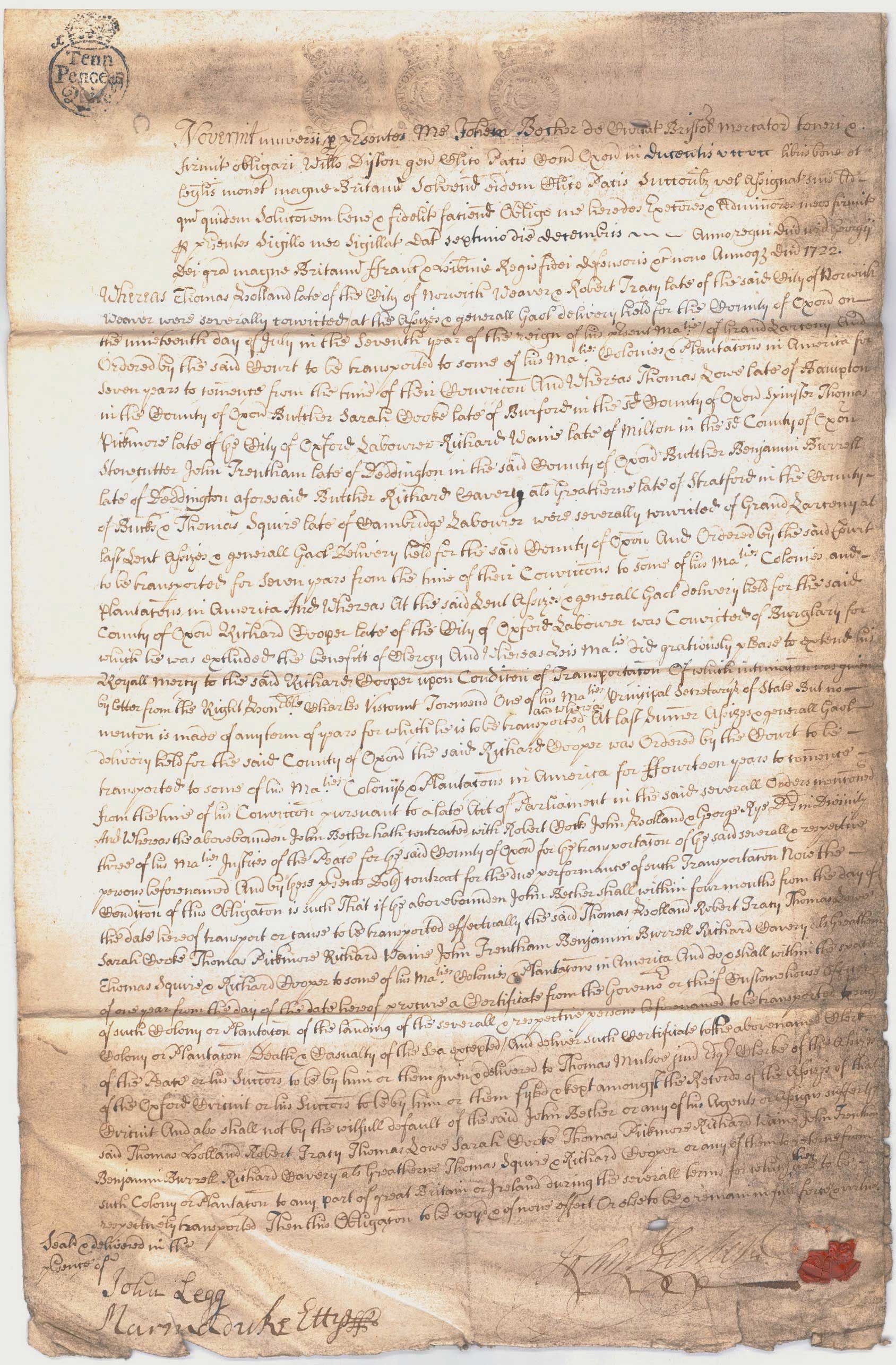
Contract for Transportation, 1723
[Reference: QS A 1723 Ep 3]
Lists of those condemned to be transported from 1787 to 1867 have been compiled in the books Banished: Sentences of Transportation from Oxfordshire Courts, which offer details of each individual, their sentence, and sometimes their eventual destinations and available biographical details.
The English legal system from the 1720s to the early 19th century would come to be termed the ‘Bloody Code’. This was principally due to increasingly harsh punishment for crime, especially the marked increase in the number of offences which could be punishable by death. From 1723, the poaching of fish, rabbit and deer, along with many other crimes, became capital offences under the Black Act. Damage to property, including cutting down trees and damaging turnpike roads, the theft of horses and sheep, forgery, arson and of course murder, also carried death sentences. By 1815, more than 200 individual offences were capital crimes. Such harsh laws were deemed to act as a deterrent.
Despite the high number of crimes which carried a death sentence in this period, executions were perhaps not as frequent as might be expected. Juries are thought to have sometimes acquitted individuals, either due to lack of evidence or by purposefully underestimating the value of stolen goods or the severity of a crime because it was felt that death was too harsh for the offence that had been committed. This became known as ‘pious perjury’.
For those sentenced to death, a sympathetic judge might subsequently offer a reprieve, perhaps a pardon or a sentence commuted to hard labour. One example from Oxfordshire is the case of George Austin, 16, and James Truby, 13, who stood trial for the theft of just four bottles of ‘spiritous liquors’ from the house of John Bice in Charlton upon Otmoor. They were found guilty at Lent Assizes 1822 and sentenced to death. Fortunately, the Calendar for Easter Sessions 1822 lists both boys as remaining ‘under reprieve’ and it’s likely that they were soon released.
In the 19th century, the punishment handed down by the court was not always as serious as it might seem to us at first glance. A number of cases listed in the Calendars of Prisoners carry the sentence ‘Death recorded’. This type of sentence, formally introduced from 1823, was applied where the law technically required a sentence of death, but the judge intended that the defendant be recommended for a pardon and would not be executed. One example of a ‘death recorded’ sentence was handed down to 15-year-old William Waite at Summer Assizes 1826. He was found guilty of breaking into the house of James Bedwell of Coate (Cote) and stealing a silver watch and other items, worth 25 shillings.

Sentences of the Prisoners at Summer Assizes, 1826, including a number of ‘death recorded’ sentences
[Reference: QSP/I/1]
Not everyone received leniency. The overall number is unknown, but around 44 people were executed in Oxford in the 110 years between 1778 and 1887, according to a list published in Jacksons Oxford Journal. Of these, sixteen were for murder, seven for robbery or burglary, seven for highway robbery, six for horse stealing, five for sheep stealing, one for forgery and two for arson. In the 19th century, execution was increasingly only carried out as a punishment for very serious crimes like murder and highway robbery – at Oxford all seven executions listed from 1836 to 1887 are for murder.
In the 18th and 19th centuries, a death sentence for a County prisoner was typically carried out at Oxford Castle, generally in full public view in the presence of large, often rowdy, crowds. The bodies of murderers were then delivered to the University anatomy schools for medical dissection. The unpleasant spectacle of public executions ceased under the Capital Punishment Amendment Act 1868, the undertaking being moved indoors.
One unusual ‘execution’ from an earlier century was that of Anne Greene, a servant from Steeple Barton. She was prosecuted by her own Master, Sir Thomas Reade J.P., for the infanticide of her illegitimate child and sentenced to death in 1650. It was suggested that this may well have been a miscarriage, though at the time the concealment of the body of an illegitimate child carried a presumption of murder. She was hanged at Oxford that December, put in a coffin and sent for dissection. At that point, she was found still to be alive! She was resuscitated by a number of University of Oxford physicians. Upon her eventual recovery, she was pardoned, released, and went on to have a family.
Printed Calendars of Prisoners are a useful source for identifying those condemned to death, particularly in the late 18th and 19th centuries. Two cases included in the records are:
George Strap, a bootmaker of about 25, born in Camsey, Worcestershire. He was found guilty of the murder of his master, Edward Bowden, at Bicester Market End late in 1774. He was convicted and executed on 13 March 1775 at Oxford.
Giles Covington, aged 22, who was convicted in January 1791 of having, along with three others, robbed and murdered David Charteris near Nuneham Wood in 1787, over three years earlier. He was sentenced to death and his body was subsequently taken to the Anatomical School to be dissected and studied. His skeleton was on display for many years at the Museum of Oxford.

[Reference:QSP/I/1]
The death sentences that were carried out could garner a lot of attention, both amongst local inhabitants and the wider population. Public hangings could attract crowds of many thousands and coverage of these events was spread more widely amongst the population through newspaper coverage and specially published broadsides. These might recount the trials, offer a potted history of the defendant and sometimes purport to record the dying words of the condemned.
A volume within the Oxfordshire Quarter Sessions collections compiled by long-term Clerk of the Peace John Davenport (1809-1882) contains a variety of these items, alongside Calendars of Prisoners for Trail at the Assizes (ref: QSP/I/1). Some provide a fairly sober report of events, while others offer more sensationalised accounts containing laments and overwrought warnings to others against the evils of a criminal life.
A few of those hanged (or ‘launched into eternity’ in the words of many of the accounts) for whom we hold these more detailed histories, include the following men:
John Price was 18 years old, originally of ‘Issington’ (likely Hyssington), Mongomeryshire. He apparently had a history of desertion from various army regiments. He befriended Thomas Knight, a boy of around 16 years old, on the Turnpike Road between Tetsworth and Wheatley on New Years Eve 1784. On learning that Knight had four shillings and sixpence on him, Price attacked him with a knife and took the money, leaving him seriously injured. He was convicted of robbery and attempted murder at the Lent Assizes in 1785. Price was executed five days later, 7 March 1785, on Milton Common and his body was hung in chains on a gibbet erected there.
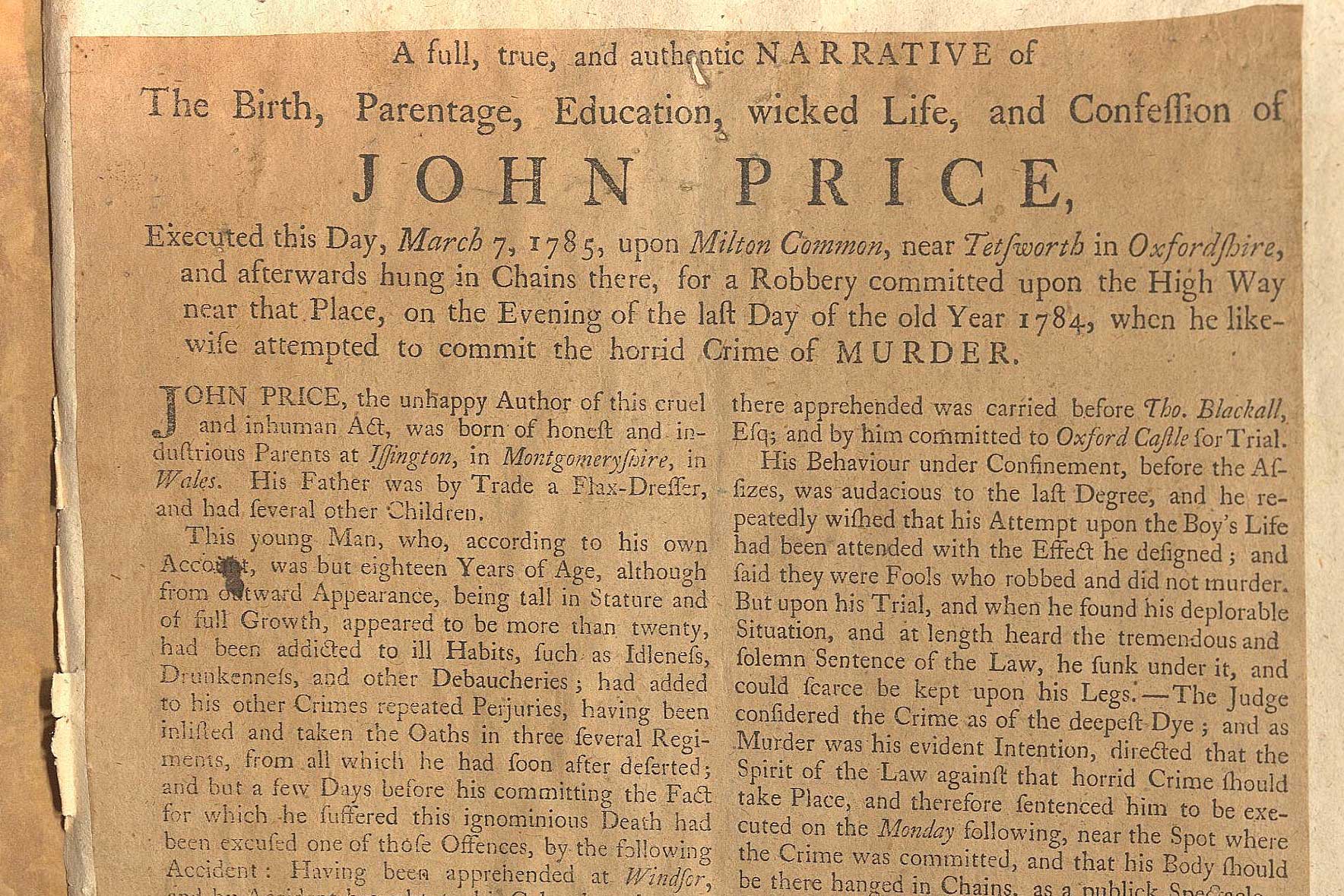
A full, true and authentic narrative of the birth, parentage, education, wicked life and confession of John Price, 1785
[Reference: QSP/I/1]
Thomas White, late footman to the Duchess of Marlborough, was convicted of stealing 21 silver plates, a silver salver, a number of silver forks and a napkin from his employers at Blenheim House (Blenheim Palace). He was executed at Oxford on 6 August 1787, the same day as 19-year-old Charles Walter Wyatt, an apprentice barber of Witney, convicted of the theft of bank bills. The Oxford Journal reports that the two were executed following a new ‘method’, which was deemed solemn and affecting, not inducing the usual disorder and riotousness amongst the assembled spectators. The other felons held in the Castle ‘were compelled to be spectators of this last and horrible scene’. White was then taken to be buried in the churchyard of St Thomas’ Parish.
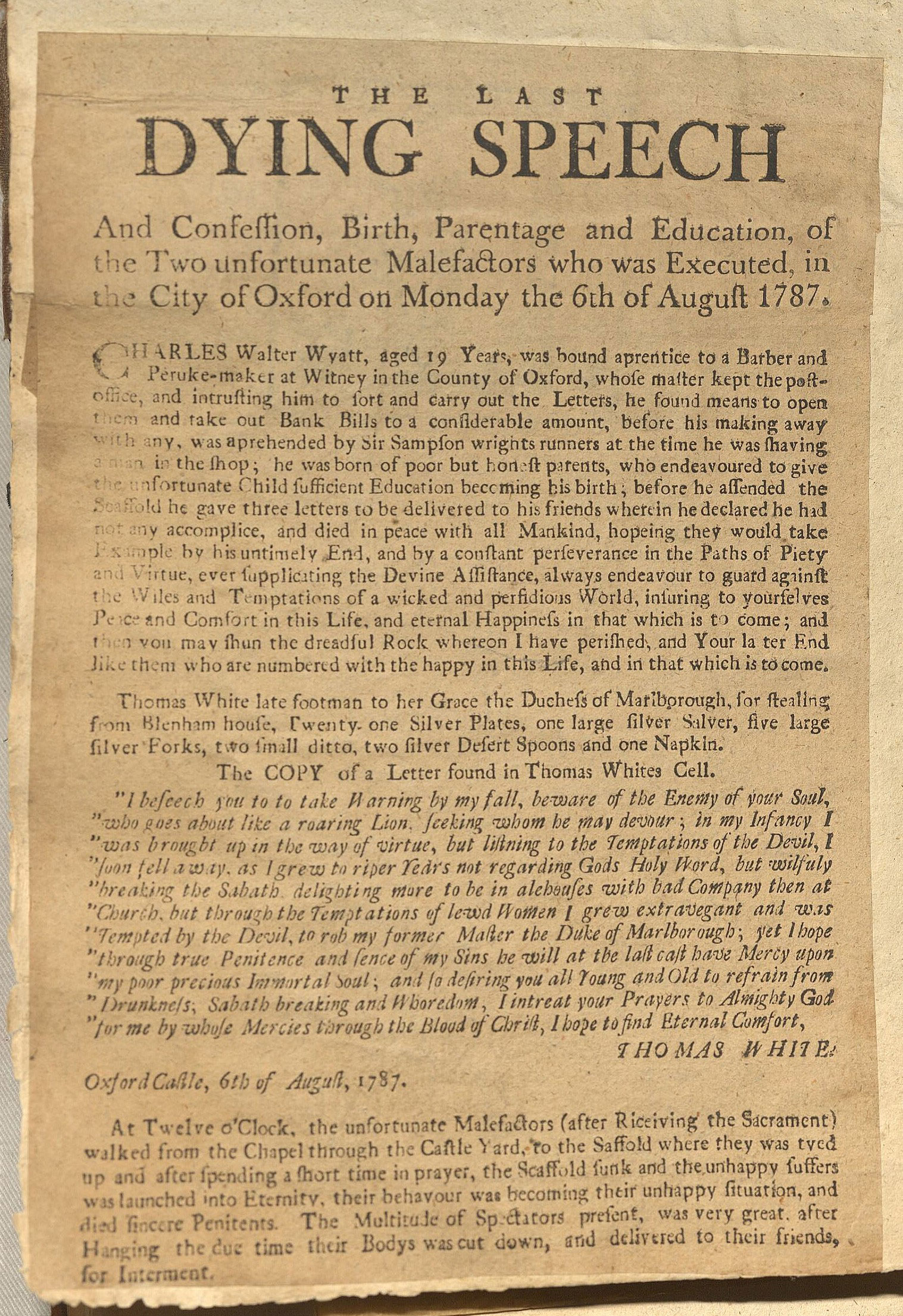
‘The last dying speech…of the two unfortunate malefactors who was executed in the City of Oxford’, 1787
[Reference: QSP/I/1]
Edward Thorn, 62 or 63 years old, was a long-term resident of Henley upon Thames, having been born in Steventon. He worked as a labourer and was keeper of the White Hart pub at Northfield End, Henley. He was found guilty of the murder of Amy Jacob at Summer Assizes 1800. It appears that Amy, around 24 years old, had worked at the pub as his servant and had become pregnant by him. He was found to have wilfully poisoned her with ratsbane, a type of arsenic. He was executed at Oxford on 28 July 1800 and then taken to the Anatomy School to be dissected.

‘An authentic narrative of the birth, parentage and dying behaviour of Edward Thorn’, 1800
[Reference: QSP/I/1]
Giovanni Kalabergo (known as John Kalabergo) was an Italian native settled in Banbury, where he lived for over four decades. He worked as a jeweller and maker of barometers and clocks. On 9 January 1852, he was out with his 22-year-old nephew Giovanni (known as William Kalabergo) and his cart containing some of his wares. He was shot dead on the road at Williamscot Hill. William Kalabergo, who had fled the scene, later claimed that they had been attacked by three men who had demanded money and then murdered his uncle. However, the authorities doubted his story and William was temporarily detained on suspicion of murder at the North Arms pub in Wroxton, from which he made a failed escape bid. He was put on trial at Lent Assizes 1852 and was found guilty of wilful murder, on the evidence that William had purchased a gun a few weeks earlier and there was no clear evidence of a robbery. He confessed to the crime prior to his execution on 22 March 1852. It was reported in the Oxford Journal that a crowd of 8-10,000 people attended to watch the sentence be carried out.
The case seems to have drawn a lot of attention - a number of items can be found in our collections which were published at the time. These include a supplement to the Oxford Chronicle giving an extensive account of the trial and of the life of the victim John Kalabergo, complete with sketches of the murdered man and the accused, and an eight-verse supposed lamentation of the young man.
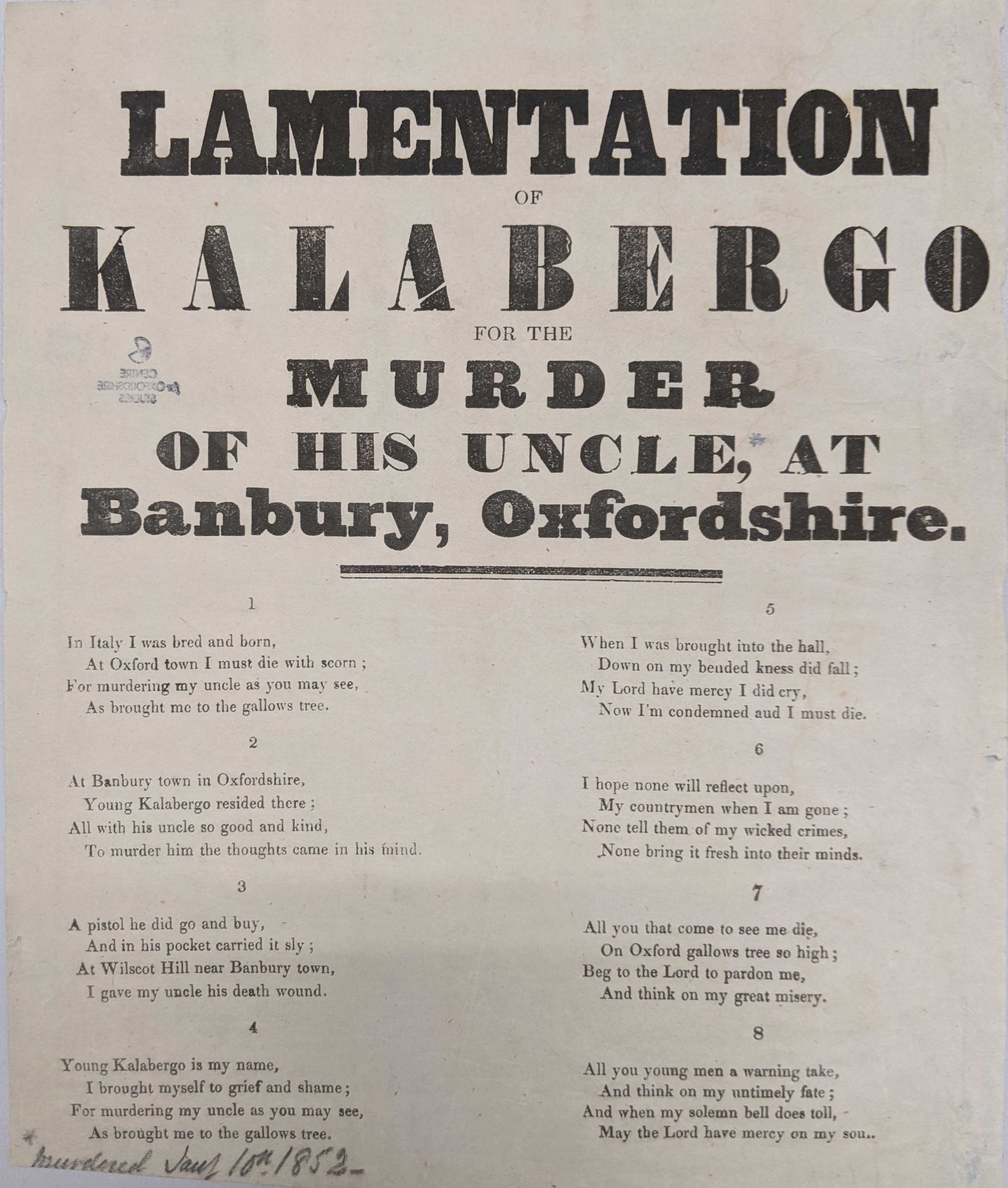
‘Lamentation of Kalabergo’, 1852
[Reference: PA/BANB/364]
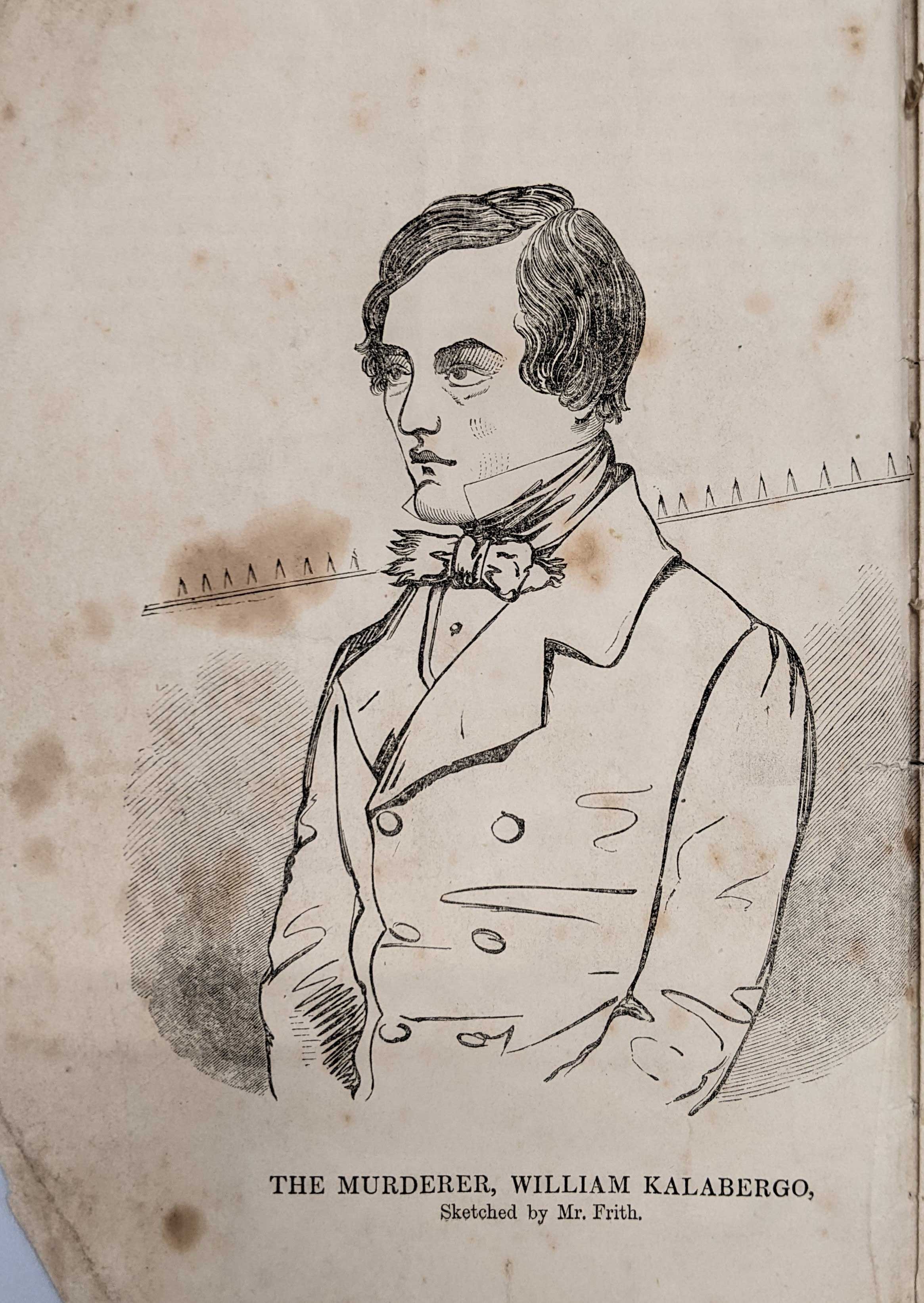
Illustration from ‘Trial of John Kalabergo for the murder of his uncle William Kalabergo’
[Reference: PA/920/KALA]
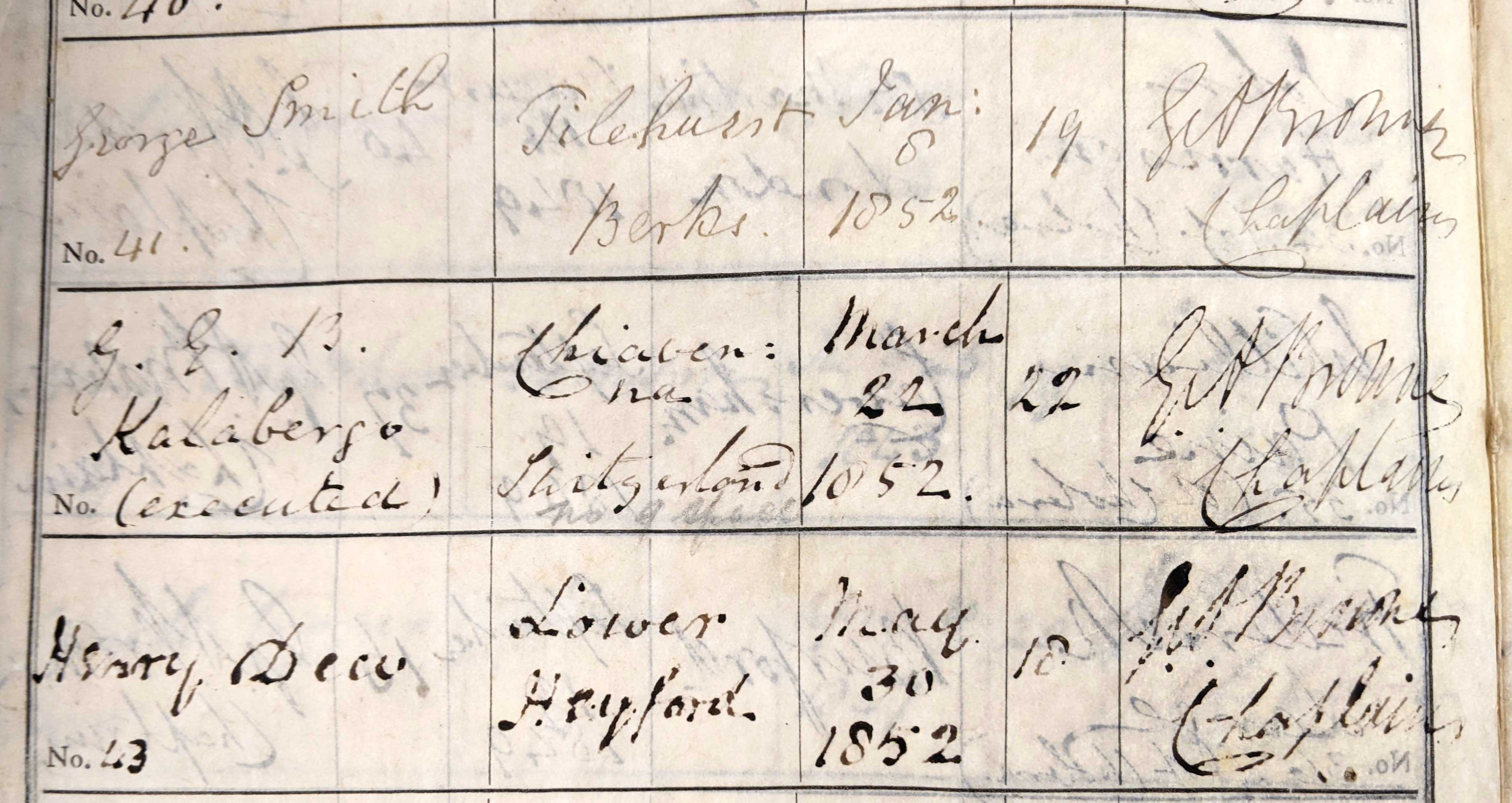
Burial entry for Giovanni (William) Kalabergo from the Oxford Prison Register of Baptisms and Burials
[Reference: O29/R/1]
The last public execution at Oxford Castle was carried out in 1863. The final execution wouldn’t be for another 89 years, in 1952. Capital punishment for murder was effectively abolished in Britain in 1965.
Posted by: Katherine Kinrade, Archivist